|
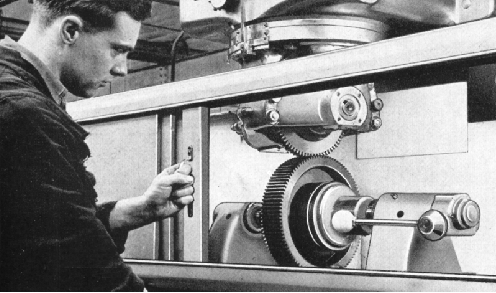
Continued: Splined-centred, 1.5 MOD 20PA "metric" changewheels took the drive from spindle to an oil-bath dual Metric/English screwcutting gearbox. The box was totally enclosed, fitted with hardened and ground gears throughout and operated by three conventional levers plus one that moved through an unusual, 8-position vertical gate. A wide range of pitches and feeds was possible without dismounting or changing any of the changewheels; the range comprised: 39 Metric from 0.2 mm to 14.0 mm; 18 Module from 0.3 to 3.5m; 45 English from 2 to 72 t.p.i. and 21 Diametral from 8 to 44 D.P. The range of sliding feeds varied from 0.001" to 0.040" (0.03 mm to 1.0 mm) and surfacing feeds (at half the sliding rate) from 0.0005" to 0.020" (0.015 mm to 0.5 mm) - all per revolution of the spindle. Both the leadscrew and the powershaft were protected by special shear pins, the specification of which was outlined in the manual with strict instructions not to vary the material used. Doubled-walled, the apron had all its shafts supported on bearings at both ends and the base closed off to form an oil bath. Although not fitted as standard, or even on the Options List, some Student 1800s have been found fitted with the apron-mounted, hand-plunger-operated pump that fed lubricant to the bed, cross slide and cross slide feed screw. The power feeds were selected by a push/pull button and positively engaged by a lever that allowed the feed to be instantly stopped regardless of how heavy the cut was. A thread-dial indicator was fitted as standard to the right-hand apron wall. The carriage traverse handwheel could be pulled out to disengage it when power feeds were being used - though it is unclear if this was a standard fitting during all the years of production. Machined all over, the compound slide rest assembly was fitted with taper gib strips that allowed a very precise fit to be obtained while giving far superior support in comparison with the cheaper "loose-strip" type. The cross slide was especially wide and fitted with a cross-feed screw that could be adjusted to reduce backlash. The 8.25-inch travel cross slide was especially wide and fitted with a cross-feed screw that could be adjusted to reduce backlash; although the slide was devoid of T slots and tapped holes - and so appeared, at a glance, to be incapable of mounting any accessories - the edges of the slide were machines to accept "slide-on" T-slotted and plain blocks that could hold a variety of items including hydraulic profiling units, and parting-off and other special tools. While the top slide could be rotated through 360 degrees the standard toolpost was, unfortunately, a barely-adequate and very simple slotted block able to hold just one tool. The set-over tailstock had a No. 3 Morse taper barrel engraved with metric and inch graduations and, happily, a large-diameter zeroing micrometer dial on the handwheel. Constructed around two cast-iron plinths, the stand was supposed to be fitted with a slide-out chip tray; however, not all are so fitted, perhaps a move to cut costs late in production. Even more, and most surprisingly, the stand offered no storage at all, in either the plinths or under the centre section, even though this would not have been difficult to engineer and would have made life a lot easier for the operator.. The 25-inch Capacity Student 1800 weighed approximately 790 kg and the long-bed 40-inch version around 840 kg..
|
|