|
 |
 |
 |
 |
 |
 |
 |
 |
 |
 |
 |
 |
 |
 |
 |
 |
 |
 |
 |
 |
 |
 |
 |
|
|
|
|
|
|
|
Tony@lathes.co.uk Home Machine Tool Archive Machine Tools For Sale & Wanted Machine Tool Manuals Machine Tool Catalogues Belts Colchester - 1930s, 1940s & Early 1950s Geared-head Master & Triumph Lathes A data pack is available for the models. Please email for details Bantams Original Bantams 800, 1600 & 2000 Modern Chipmaster Student 1800 Mascot 1600Student/Master Mk. 1 & Mk. 2 Student 3100 Master Original 1930s/40s Master 2500 Triumph Mk. 1 & Mk. 2 Triumph 2000 Mascot - 1950s Mastiff 1400 COLCHESTER HOME Magnum Serial Numbers Early Drive System Outline of Colchester Range as Text Only Factory Testing Catalogue Covers Colchester 1909/14 Master - 1940s to early 1950s Photo Essay
By the early 1930s the Colchester Master (6" x 38") and Triumph (7-inch centre height) lathes were being produced in both flat-belt and geared head forms, as shown below; the Mascot, a name later associated with a heavy 81/2" centre height, was also being made, but as a 6-inch lathe. Although most manufactures, especially those in the USA, had been offering lathes in the 6 to 8-inch centre height class with the option of self-contained motor drives many years, Colchester listed only the Bantam (a flat-belt drive machine) with such a unit. However, by the end of the 1930s things had improved and the Company were offering all their lathes in a variety of improved specifications. New geared headstock models were taking the majority of sales and a simple motor-mounting platform fastened to the back of the headstock-end leg was offered as an extra - although in reality, with the geared headstock, this was really an essential fitting. Development was steady, with many detail changes, though one essential extra, the full screwcutting and feeds gearbox was slow to arrive, with only post WW2 lathes so equipped - and then rarely. A naturally conservative company, it took Colchester until the early 1950s to further develop the lathe (but still with the same basic bed dimensions and by-then-ancient slide-and-lift selection of power feeds) into the very successful and popular Student, Master, Triumph and (by the early 1950s) Mascot 81/2" centre-height models. It was not unusual at this time for large machine-tool merchants to re-badge machines and the cast changewheel covers, being easily modified and non-structural, were often used for this purpose..
|
|
|
|
|
|
|
|
|
|
|
|
|
|
|
|
|
|
|
|
|
|
|
|
|
|
 |
|
|
|
|
 |
|
|
|
|
|
Colchester Master as made circa 1930 to 1939 with spindle clutch, pressed-steel changewheel guards, external tumble-reverse drive to the leadscrew, a simple two-speed gearbox connecting the powershaft and leadscrew (under covers at the headstock end of the leadscrew) and steel-tipped handles to the cast-iron spindle-speed selection levers. The motor was bolted to the back of the headstock-end leg and drove to the spindle by either a flat or twin V-belts. The 7.5-inch centre height Triumph looked virtually identical, but was of a slightly heavier build. Note the electric isolator box bolted to the front of the headstock-end plinth, a fitting later developed to include full push-button and reverse-switch control.
|
|
|
|
|
|
|
 |
|
|
|
|
|
|
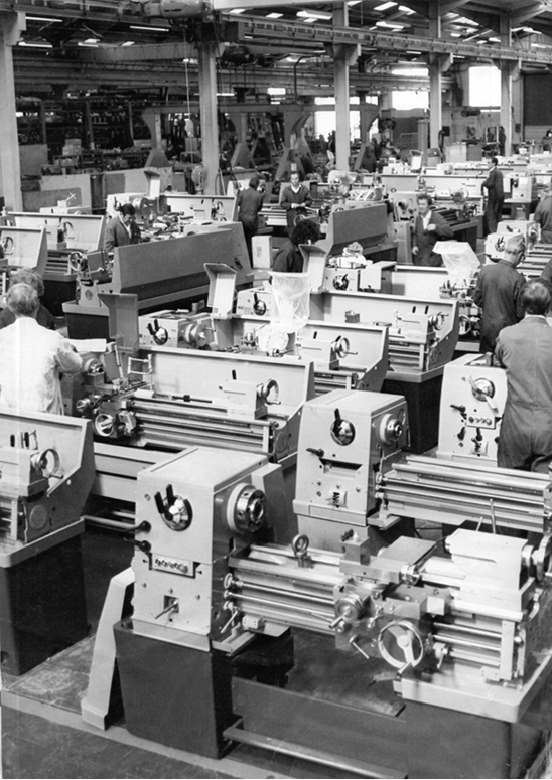
Mid 1940s to early 1950s geared-head Master on cast iron standards. Early versions of this lathe pre-dated the availability of a full screwcutting gearbox and employed a 2-speed (disengageable) drive to the leadscrew and power shaft. The changewheel guards were made in both in cast iron and cast aluminium (instead of pressed steel), and the reverse drive to the leadscrew and power shaft by an enclosed gear mechanism within the headstock with control by a lever in the bottom left-hand corner of the headstock's front face. The spindle-speed selection levers were tipped with inverted-cone plastic knobs, the spindle clutch was dropped and replaced by a spindle brake - the operating lever for which is the tall lever pivoting bottom right on the face of the headstock. Electrical controls were neatly integrated into a single plate let into the front face of the headstock-end cabinet leg - foreshadowing the even neater demountable system introduced with the full cabinet introduced in the mid 1950s.
|
|
|
|
|
|
|
 |
|
|
|
|
A long rod, pivoting from the lower right-hand corner of the headstock's front face, operated a spindle brake.
|
|
|
|
|
|
|
|
|
|
|
|
 |
|
|
|
|
Maker's taper-turning unit. Note the full-width T slots across the front edge of the saddle and the long T slots in the front right-hand wing.
|
|
|
|
|
|
|
|
|
|
|
|
 |
|
|
|
|
The spindle-speed selector levers (on top of the headstock) had their spring-loaded indents at the end of the long cast-iron levers; later machines (with rod levers) had them built into the pivot hub and, with less leverage available to keep them in place, were more prone to accidental disengagement.
|
|
|
|
|
|
|
|
|
|
|
|
 |
|
|
|
|
|
|
The dial-thread indicator was built into a cast-iron leadscrew swarf guard bolted to the left-hand face of the apron.
|
|
|
|
|
|
|
 |
|
|
|
|
|
|
|