|
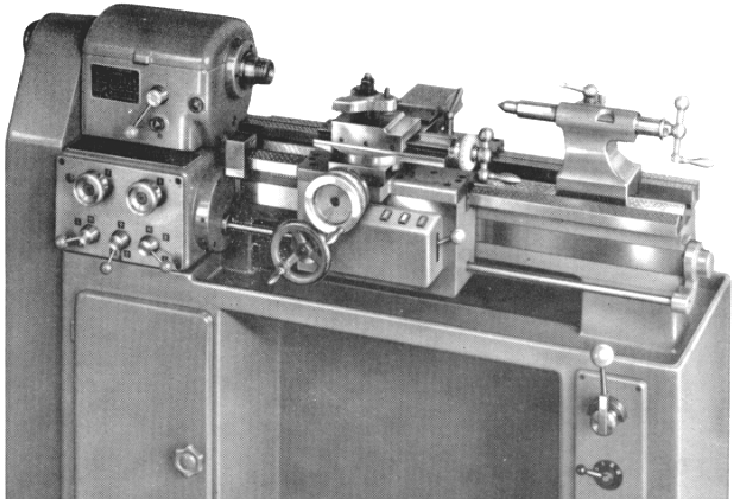
With a centre height of 4.74" the BL27LZ was (alongside the variable-speed B30LZS), the largest of the Lorch precision lathes as first produced from the 1950s - and the only one to include a full screwcutting gearbox and power sliding and surfacing. Although it was based on the plain-turning lathes in the range - it was a different machine in almost all respects.
Very heavily constructed, with diagonal bracing webs and cast from a special grade of iron which was claimed to be wear resistant, the bed had ways consisting of twin Vees and flats. Just one length was offered, admitting 22" between centres, with the machine mounted on a vibration-absorbing , heavy cast-iron cabinet base containing a 3-phase motor with three speeds of 700, 1400 and 2800 rpm. (a welded sheet steel cabinet was optional). The drive from the motor passed to a two-step pulley that drove directly upwards to the headstock by a smooth-running, endless flat belt; combined with the single-lever engaged backgear this arrangement produced 12 spindle speeds from 47 to 2100 rpm.
The leadscrew, enclosed within the bed in a manner not dissimilar to that used on the Schaublin 102VM, was completely protected from swarf and dirt.
Hardened, ground and "Superfinished", the stout No. 4 Morse taper headstock spindle ran in an adjustable plain bearing at the front and an angular-contact (ball) bearing at the rear.
Using hardened and ground gears running in an oil bath, the headstock backgear assembly was controlled by the action of just one lever - there being no pins, nuts or other retainers to undo or slacken before it could be engaged - a single movement simultaneously disengaged the bull wheel from then pulley and brought the gears into mesh. The spindle accepted draw-in collets of 27 mm diameter, with a maximum through capacity of 13/16" - and a non-through of 29/32".
Able to generate 34 metric and 25 English pitches - and with the substitution of one gear 24 module pitches as well - the screwcutting gearbox also produced sliding feeds that varied between 0.0007" and 0.024" per rev - and surfacing feeds from 0.00035" to 0.012" per rev. Besides a gear drive for screwcutting, the box was also fitted with a very fine-feed drive by V-belts for the power sliding and surfacing .
Double-walled, the apron had the expected safety interlocking between power sliding and surfacing feeds to prevent their simultaneous engagement - and consequent mechanical mayhem. Both power feeds could be disengaged by a most useful, pre-set micrometer-adjustable stop - or automatically if overloaded.
The BL27LZ (and B30LZS) were expensive lathes, bought only by the most knowledgeable of toolroom supervisors - and remains to this day most sought-after and elusive machines..
|
|