|
 |
 |
 |
 |
 |
 |
 |
 |
 |
 |
 |
 |
 |
 |
 |
 |
 |
 |
 |
 |
 |
 |
 |
 |
 |
 |
 |
 |
 |
 |
 |
 |
 |
 |
 |
 |
|
|
|
|
|
|
|
|
|
|
|
|
|
|
|
E-MAIL tony@lathes.co.uk Home Machine Tool Archive Machine Tools For Sale & Wanted Machine Tool Manuals Machine Tool Catalogues Belts
MIKRON Miniature Precision Milling Machines Mikron Home Lathes on Stands Lathes & Beds Headstocks Slide Rests & Capstan UnitsTailstocks & Drilling Attachments Milling Machines Milling Accessories Milling Applications Mikron Lathe Photographs
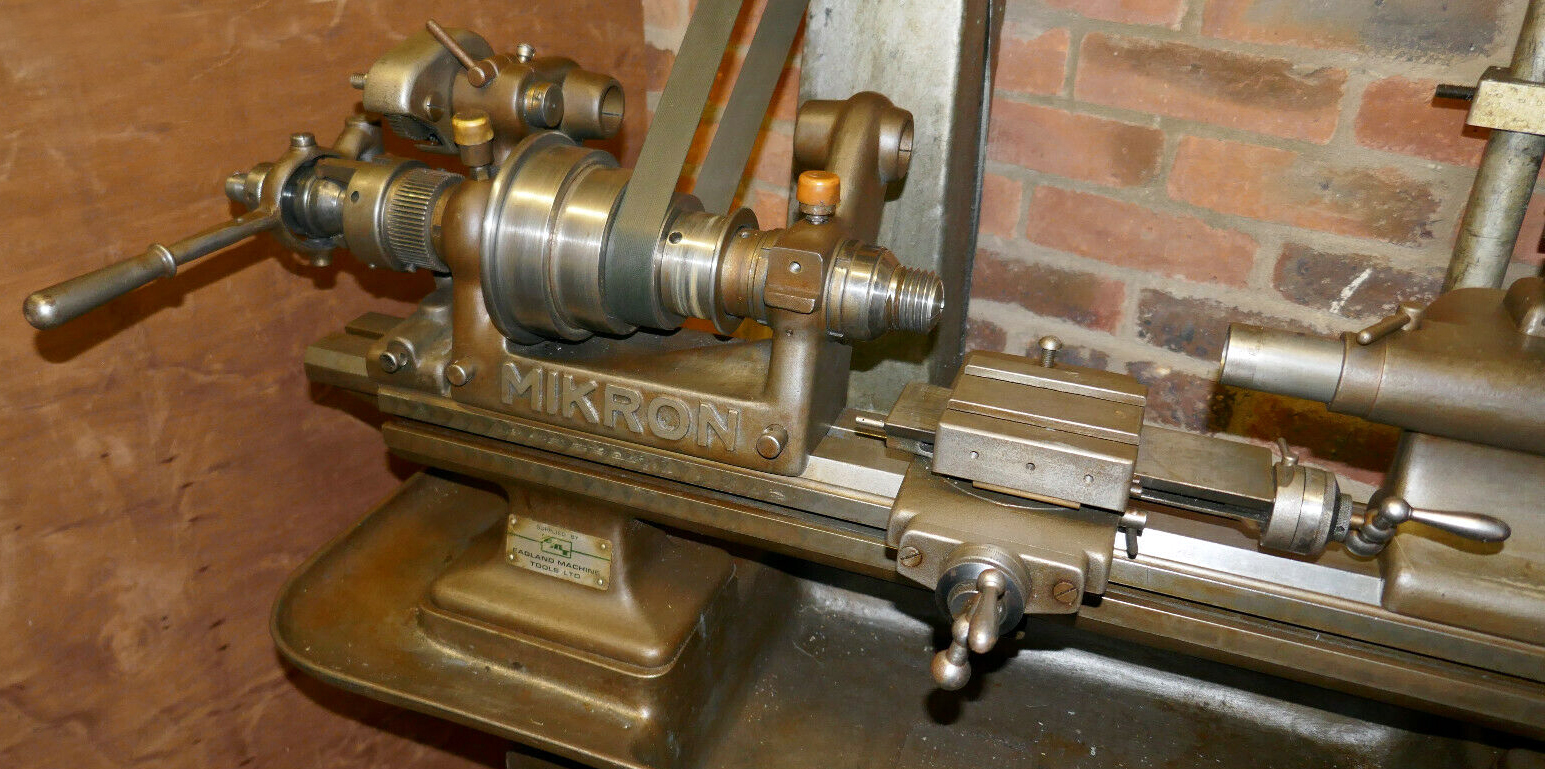
Although Mikron were to eventually build a number of larger precision toolroom-class milling machines of the Deckel FP type (listed as the WF23S, WF3S, WF3-DCM and WF2/3-DCM), for many years they were better known for a range of small bench horizontal and vertical types. Like similar models from Stark, The American Watch Tool Company, B.C. Ames, Wade, Pratt & Whitney and others in the U.S.A. the Mikron millers all used modified lathe headstocks mounted on a substantial main column with a conventional knee and table assembly. The top of the column was formed with the same section as found on the bed of a Mikron precision bench lathe - a fitting that allowed an instant change from horizontal to vertical modes, as well as permitting the use of a customer's existing lathe headstocks. All versions had the same size of table, 360 mm x 115 mm, able to be controlled by either screw or lever feeds. When fitted with screw feeds (Base No. 93) the table travel was 180 mm longitudinally, 70 mm across and 135 mm vertically while lever control (Base No. 94) gave, respectively, 250 mm, 70 mm and 120 mm. Each table axis was fitted with an adjustable length stop. Based on the design of the ordinary lathe headstocks the ones for the milling machine were, however, specially adapted to their task. The basic unit was the No. 95, with no arbor support and intended only for simple stub milling. Instead of the 4-step cone pulley of the lathe headstock this used a wider 3-step type (diameters 85, 107 and 125 mm to take a 40 mm wide belt) with the hardened ground and lapped spindle running in parallel bronze bearings tapered on their outside for adjustment. Run from a 2-speed motor with double-step pulley drive to the countershaft, 12 speeds were available from 120 to 1350 r.p.m. However, when fitted with a 3 : 1 epicyclic reduction gearbox within the pulley (as Headstock No. 95a), this number rose to 24, spanning a very useful 40 to 1350 r.p.m. If the requirement was for a conventional horizontal milling with a supported arbor, headstock No. 99 could be ordered. Again, this used the main components from the No. 95, but with the addition of a built-in, round overarm. For vertical milling headstock No. 97 was provided and, again based on the No. 95, employed the same spindle, bearing and pulley assembly and with the drive from the horizontal spindle to the vertical by bevel gears. The unit could be swivelled through 90° in either direction. Unusually for a small milling machine, a table power-feed unit was available (No. 98) and, driven from a small 3-step pulley on the headstock, gave feed rates of 0.05, 0.10 and 0.20 mm per revolution of the spindle..
|
|
|
|
|
|
|
|
|
|
|
|
|
|
|
|
|
|
|
|
|
|
|
|
|
|
|
|
|
|
|
|
|
 |
|
|
|
|
|
|
Mikron miller mounted on the maker's No. 93 base. Other elements include: Headstock No. 95; automatic table feed No. 98; plain indexing head No. 99; tailstock No. 11 and milling arbor No. 111. This configuration was intended to be driven by a 2-speed 700/1400 r.p.m. motor to give 12 speeds from 120 to 1350 r.p.m. on the No. 95 or 24 speeds from 40 to 1350 r.p.m on the epicyclic-reduction geared headstock No. 95a. Note the considerable distance from countershaft to spindle head - a useful precaution with flat-belt drive that works more effectively the further apart (within reason) the pulleys are positioned
|
|
|
|
|
|
|
|
 |
|
|
|
|
|
Stand No. 124 with countershaft and electrical equipment.
|
|
|
|
|
|
|
|
|
|
|
 |
|
|
|
|
|
|
Horizontal milling machine with the No. 93 all-screw-feed table assembly and the No. 95 headstock
|
|
|
|
|
|
|
|
 |
|
|
|
|
|
|
Vertical milling machine with screw-feed table assembly No. 93 and vertical head No. 97. The head, a particularly rigid structure, was able to run up to 2000 r.p.m.
|
|
|
|
|
|
|
|
 |
|
|
|
|
|
|
Horizontal milling machine designed for the mass production of small parts needing high speeds. The standard headstock supplied was the No. 95 but this could be replaced, if even higher speeds were required, by the 6,000 r.p.m. roller bearing lathe headstock No. 15a. With all-lever control of the table movements the weight of the table and knee was counterbalanced by a strong spring contained within the column. Apart from the automatic table-feed unit No. 98 and the spiral dividing head No. 103 all other standard milling accessories
|
|
|
|
|
|
|
|
 |
|
|
|
|
Milling machine base and screw-feed table assembly No. 93. This unit could accept all the milling headstocks (95, 95a, 96, 96a and 97 as well as the conventional headstocks from the lathe range. It was therefore possible, if a part had been turned on a lathe to keep the part in situ, transfer the headstock to the miller and mount the indexing head No. 101 and the quill No. 112 to complete the job.
|
|
|
|
|
|
|
|
 |
|
|
|
|
|
|
Milling machine base and all-lever-feed table assembly No. 94
|
|
|
|
|
|
|
|
 |
|
|
|
|
|
Milling Machine Headstock No. 95. 3-step cone pulley (diameters 85, 107 and 125 mm) for 40 mm wide belt. The hardened ground and lapped spindle ran in parallel bronze bearings tapered on their outside for adjustment.
|
|
|
|
|
|
|
|
 |
|
|
|
|
|
Headstock 95a. As headstock 95 but with the addition of a 3 : 1 epicyclic reduction gear within the pulley.
|
|
|
|
|
|
|
|
 |
|
|
|
|
|
|
Headstock 96 with built-in overarm. The spindle, bearings and pulley were the same as those used in the No. 95
|
|
|
|
|
|
|
|
 |
|
|
|
|
|
|
Headstock No. 97 Based on the No. 95 with the same spindle, bearing and pulley assembly. The drive from the horizontal spindle to the vertical was by bevel gears and the unit could be swivelled through 90° in either direction
|
|
|
|
|
|
|
|
|
|