|
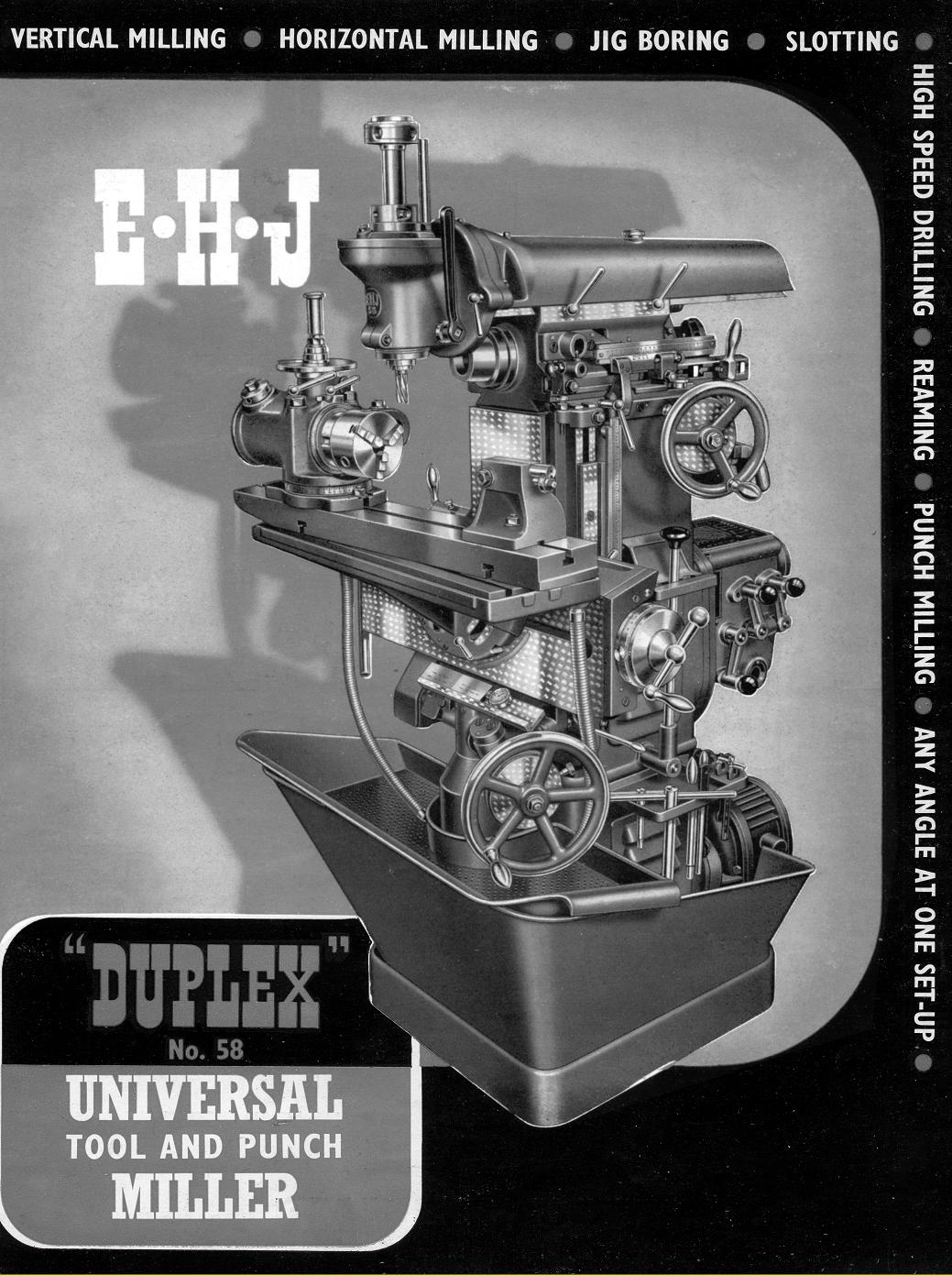
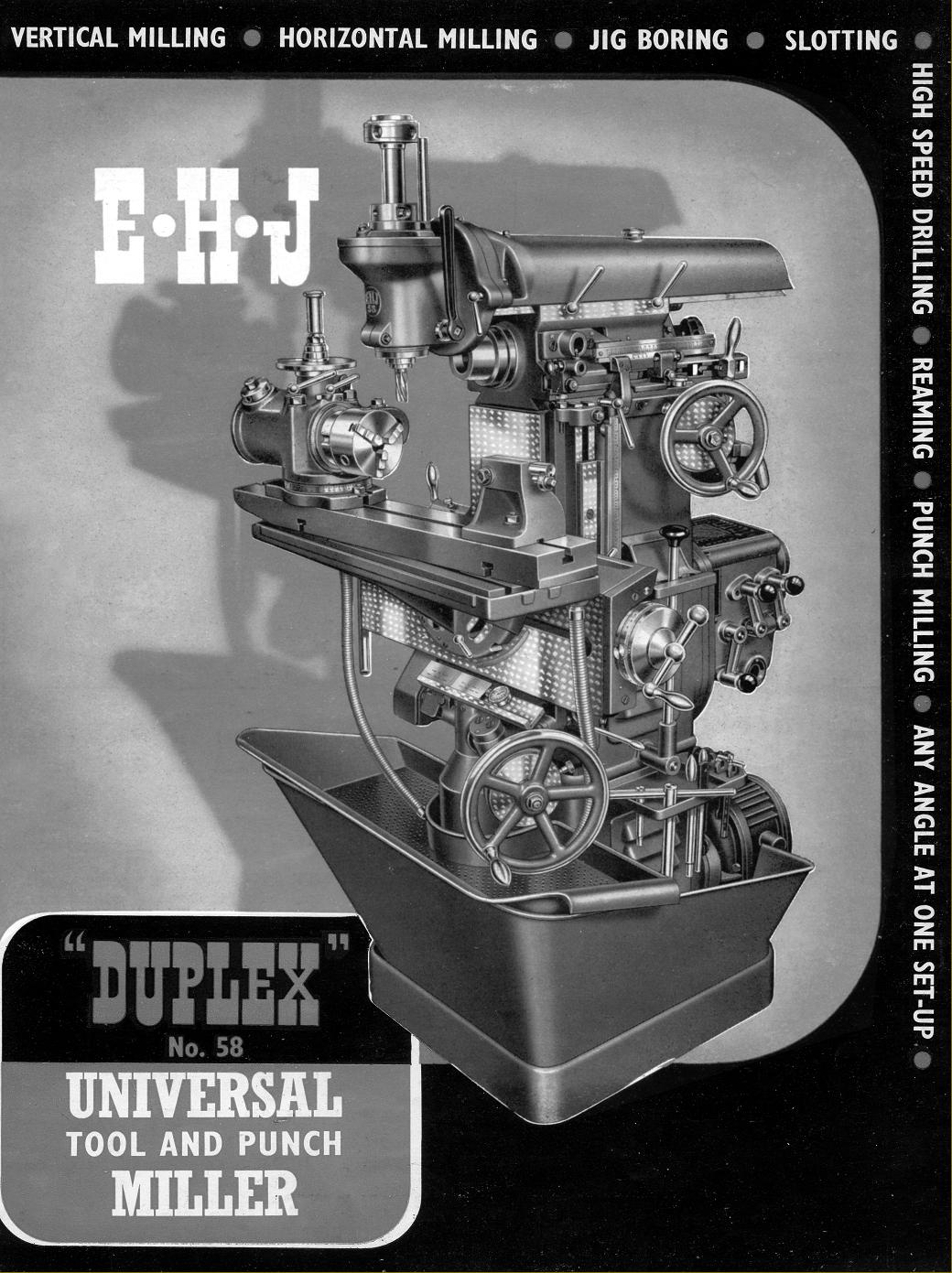
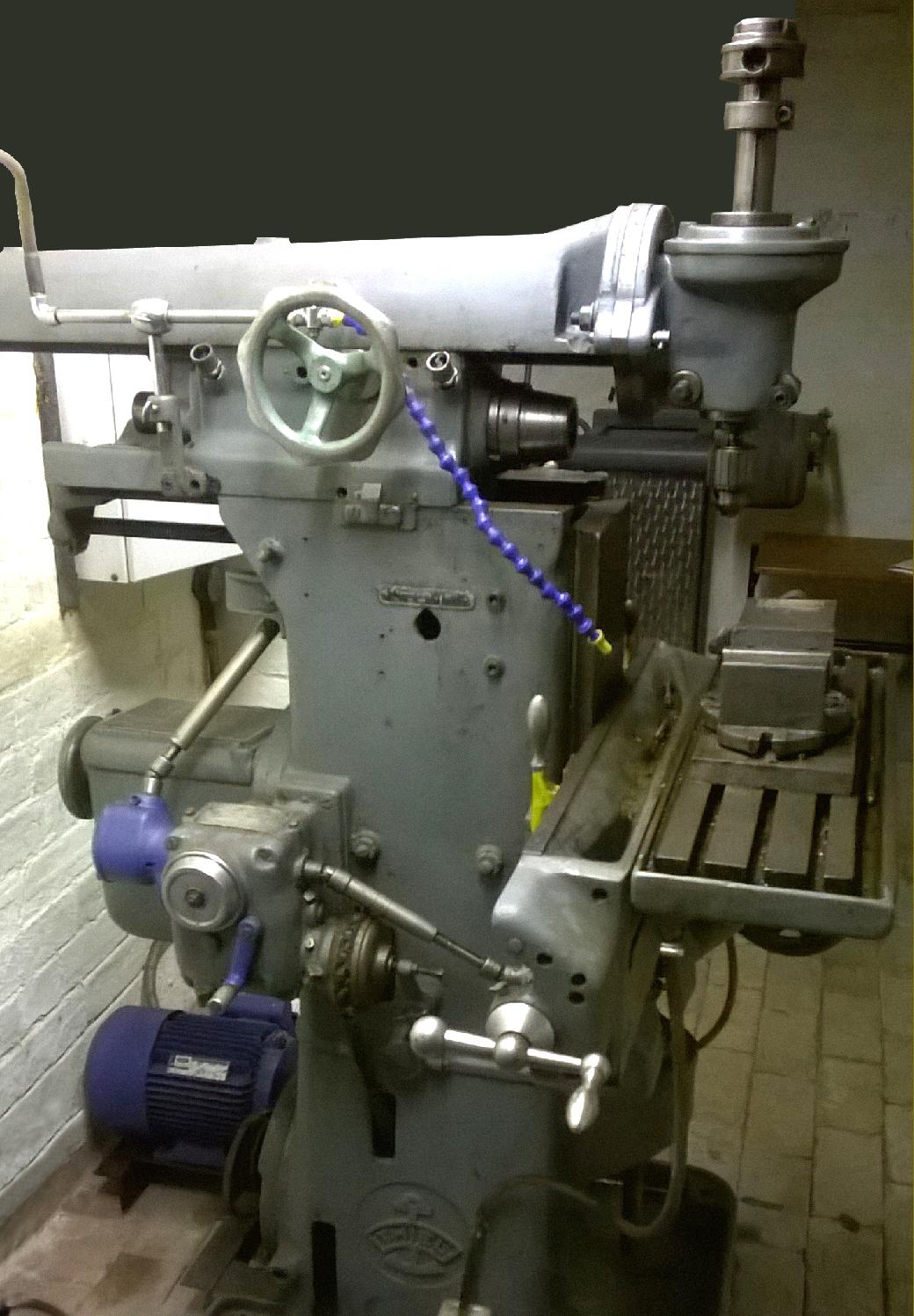
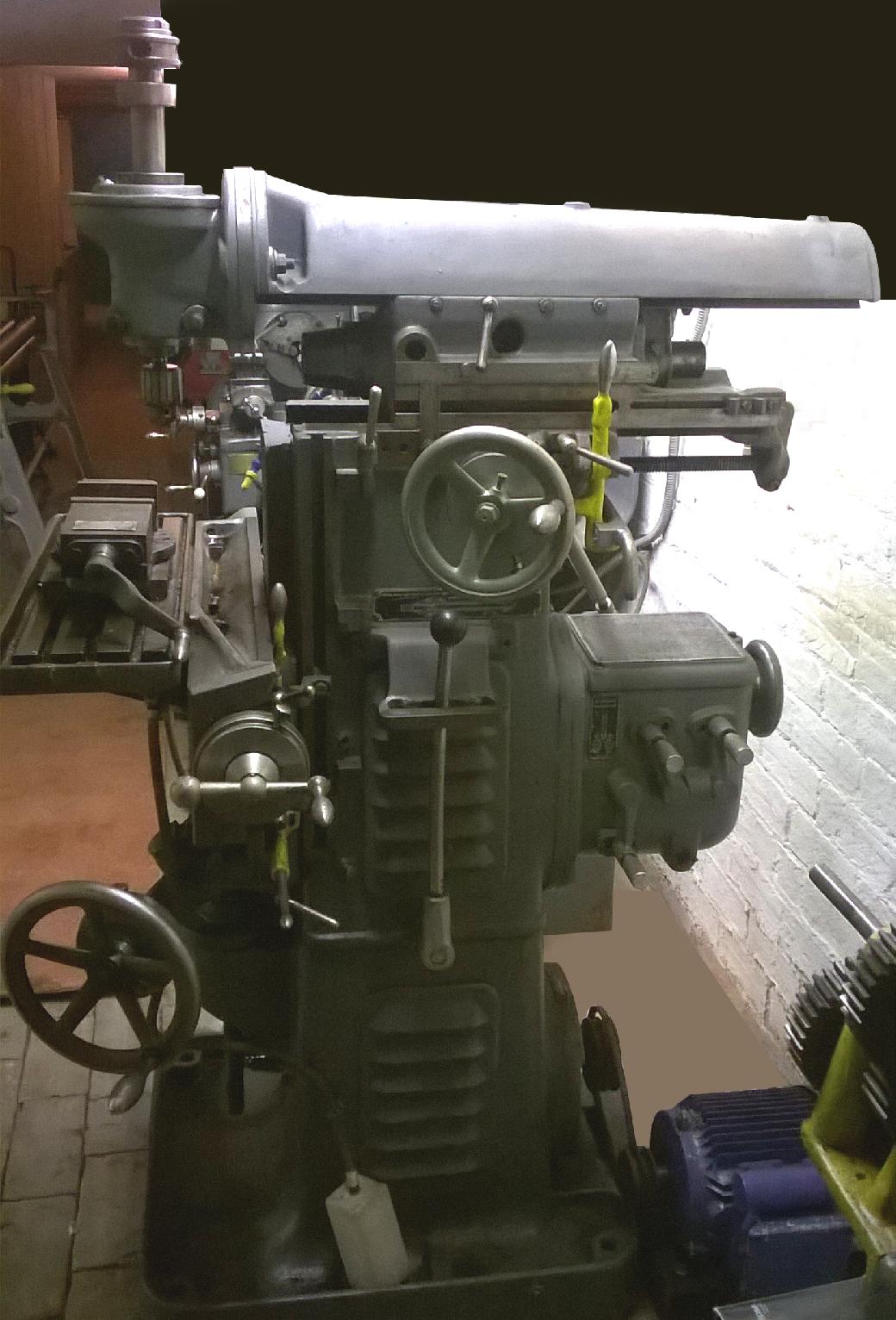
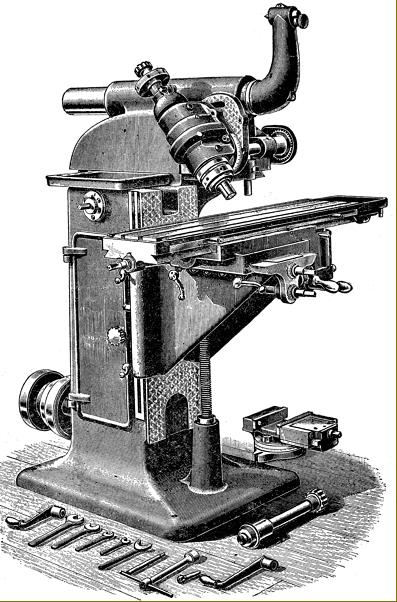
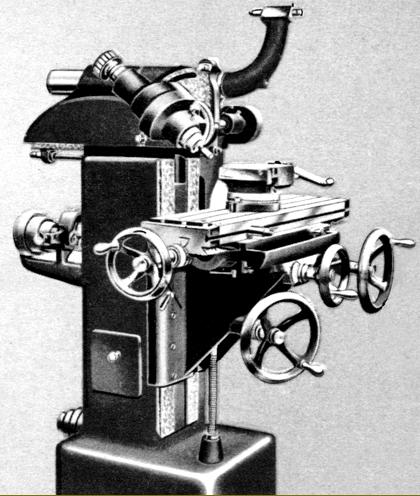
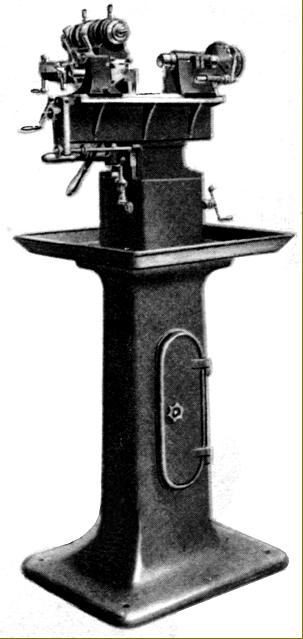
Gerbruder Thiel GmbH began as makers of pocket and wrist watches, toy watches and general metal products and developed their famous machine tools, in the early 1900s, to supply their own factory with more efficient methods of production. Thiel were originally known for their unique filing and sawing machines, and a specially developed metal cutting bandsaw, but it is for their range of superb universal milling machines that they are now best known. The secret of the type's success was its ability to mount a number of different heads - horizontal, standard vertical, high-speed vertical and slotting - in combination with a variety of tables - plain, plain-tilting and compound swivelling. All the heads could be driven backwards and forwards across the top of the main column, by a handwheel working through reduction gearing, to provide an in-out feed, whilst the tables all bolted to a flat, vertical T-slotted knee equipped with power longitudinal and vertical feeds. By juggling the choice of heads and tables, and utilising other accessories, a skilled technician was seldom defeated in his attempts to produce the most complex of milled and drilled components - and all to a very high standard of accuracy. Illustrated on this page is the Model 58 with a 25" x 8.5" table having three power feeds - longitudinally, in traverse and vertically - whilst power backwards and forwards was also fitted to the head. On some versions of the miller, fitted with a clutch, spindle speeds could be changed, or reversed, without stopping the cutter spindle. The head gearbox had three levers: that at the lower left gave forward - neutral - reverse whilst the other two levers were for speed changes by moving gears within the gearbox. The clutch engaging lever had three positions: left for high range - centre for disengaged - right for low range. Typically, with the LHS gear lever in its the central position, the RHS gear lever to its right-hand position and clutch in low range would give 105 r.p.m.--or 210 r.p.m. in the high-range setting. A range of accessories was available including a dividing attachment, supplementary horizontal swivelling table, power down-feed to the spindle, slotting attachment, self-contained high-speed (5000 rpm) vertical head attachment, and the usual range of vices and precision setting and measuring equipment. The whole machine was remarkably similar to, but much larger than, the much copied Deckel** universal miller - and, because of their unique features and superb quality of construction many examples of both types are still to be found doing experimental and development work, nowadays often in the hands of highly skilled, self-employed engineers. After surviving WW2 Thiel was split into two parts with one in the Allied-controlled Federal Republic of Germany and the other in the communist German Democratic Republic. In the west Junghans, a firm of Watch Makers in the Black Forest, built the Duplex 158 and 159 using the Thiel brand name whilst in Ruhla, Thüringen, in the east the Duplex 58 was produced by VEB Ruhla under the long-established WMW brand name.
Christian Bauer from Germany has kindly contributed the following notes: Historical Development of the Thiel Company:
1862 Thiel brothers from Ruhla, a town in Thuringia, Germany, founded a metal-goods' factory 1870 the beginning of toy clock production, followed by mass production with approximately 200 employees when steam power replaced water power in the factory 1890/91 introduction of pocket watches 1897 a second factory started in Seebach, another town in Thuringia 1905 the founding of the machine-tool factory ("Central-Werkstatt") that was to make the following products: filing and sawing machines, milling machines, drill presses, tapping machines, special toolmaker shapers, band saws, screw-production lathes, boring heads and watch-gear cutting machines 1906 first milling machine produced - small machine on the lines of an Aciera F1 1914 second design of miller introduced - floor-standing with tilting horizontal/vertical head but with a conventional knee. 1920 machine tools became the focus of production. 1930 (or 1932 according to some sources) production of the "Thiel Duplex 58" begins with eventual world-wide sales of 30,000 1946 resumption of machine tool manufacture after World War Two 1951 first trade exhibition with "Ruhla" machines in the Federal Republic of Germany ("Ruhla 58") 1969 prototype of the FUW 250 numerical-controlled miller exhibited at the Leipziger spring fair. Demand was so great that only 50% of orders could be met. 1971 a new factory built in Seebach for the production of UFB millers and other machine tools 1976 1050 employees with 1000 machine tools manufactured during the year 1990 start of co-operation with MAHO AG and establishment of the MAHO Seebach GmbH Company. The factory began production on the 3rd October, 1990 1992 takeover of the production of Thiel (FRG) from Emstal, a town near Kassel. 1993 fusion of the DECKEL Company (Munic) with the MAHO Company (Pfronten) to become DECKELMAHO AG 1994 GILDEMEISTER AG (Bielefeld) takes over DECKEL MAHO GmbH 1995 manufacturing moved from factories in Munich and Pfronten to Seebach A prototype of the new vertical milling machine DMU 50 V is shown at the Machine Tool Fair EMO in Milan, Italy with, so far, over 180 machines sold. Since September. 1996 a new "profit-centre" approach to manufacturing has been followed with, in 1997, a consolidation of the product range. At this time the company had 280 employees..
**If the widely-believed chronology is correct, the Deckel FP1 was a smaller, more handy interpretation of an already established design, the Maho SK250 - itself almost certainly derived from the earlier (but larger) Thiel Type 58. Although Maho were strong competitors, Deckel quickly leapfrogged them with the FP1 and its variants to become one of the most desirable millers to install in a toolroom or small workshop - the FP's ingenious, adaptable and versatile design lending itself to solving a multitude of machining problems. Proof of the type's success is evident in the number of similar machines made in various European countries with examples including: Belgium by S.A.B.C.A. (Model JRC-2); Czechoslovakia by TOS (Modesl FN22, 32 & 40 Optic); Spain or Denmark by Metba (Models MB-0, MB-1, MB-2, MB-3 and MB-4); England by Alexander ("Master Toolmaker") and the Ajax "00", an import of uncertain origin; Germany by several companies including: Macmon (Models M-100 & M-200 - though these were actually manufactured by Prvomajska in Zagreb, in what was formerly Yugoslavia; Maho (many models over several decades), , Thiel (Models 58, 158 and 159), Hermle (Model UWF-700 and UWF-700-PH); Rumag (Models RW-416 and RW-416-VG) and Emco (Model F3); Italy by C.B.Ferrari (Models M1R & M2R) and Bandini (Model FA-1/CB); Poland (as the "Polamco" FNC25, FND-25 and FND-32 by Fabryka Obrabiarek Precyzyinych); Switzerland by Aciera (F1, F2, F3, F4 and F5), Schaublin (Model 13), Mikron (Models WF2/3S, WF3S, WF-3-DCM & WF-2/3-DCM), Christen (Type U-O and U-1) and Hispano-Suiza S.A. (Model HSS-143); the former Yugoslavia (in Zagreb) by Prvomajska (Models ALG-100 and ALG200); Japan (Riken RTM2 and the larger Deckel FP2-like model RTM3) - and also by Sinn (Models MS2D & MS4D), Ruhla and "Comet" (Model X8130, imported to the UK in the 1970s by TI Comet). At least five Chinese versions have also been made, including one from the Beijing Instrument Machine Tool Works.
|
|