
|
Home Machine Tool Archive Machine-tools Sale & Wanted Older Harrison Lathes Harrison 10AA (Chipmaster) M300 Photo Essay Instruction & Parts Books are available for most Harrison lathes |
|
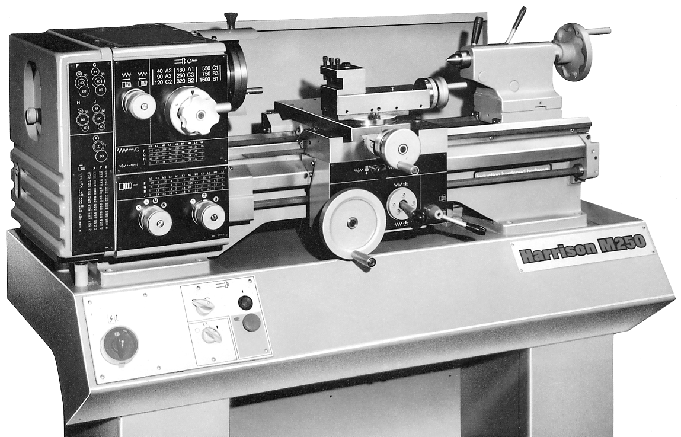
The Harrison M Series lathes have been in production for many years and considerable numbers of the smaller and very popular models, the M250 and M300, are now in the hands of enthusiastic amateurs and second-user professionals. The digits following the M indicate, in all cases, the swing in millimetres, half the swing being the "throw", more usefully described as the centre height. The range has been the subject of continuous development and, by the mid 1990s, consisted of the established and largely unchanged M300 model together with the M350, M450 and M500. By the late 1990s the last three machines became, with alterations to centre height, bed length and specification the M390, M460 and M550 - and two newer, larger machines were introduced (though with a short production life), the M600 and M750. Today the range continues in production but fitted with variable-speed drive (though the M300 continues to be available as a geared-head model) with models numbers of: V350, V390, V460 and V550. Whilst these articles cover the older, conventionally driven M Series lathes they do not concern the up-to-date models; an article about those will have to wait until they become, in some years' time, cheap enough to be accessible to the keener model and experimental engineer. Now out of production, the M250 of 145 mm (5.7") centre height was designed to appeal to schools, training establishments, repair shops and those needing a strong, properly-built but compact lathe for light production work. Never as popular in the educational market as the more robust M300, as a second-hand machine it has enormous appeal to the more enthusiastic home user and hence demand usually outstrips supply with consequently high prices - but of course an excellent investment potential and an easy resale. It was available with a choice of either 500 mm or 750 mm (20" or 30") between-centres and had an induction-hardened bed as standard - but lacked the option of a detachable gap; interestingly, the width of the bed, at 190 mm over the ways, was greater than the centre height, a design feature that many years ago would only have been considered necessary for a lathe built to "toolroom" standards. |
|
|
||
|
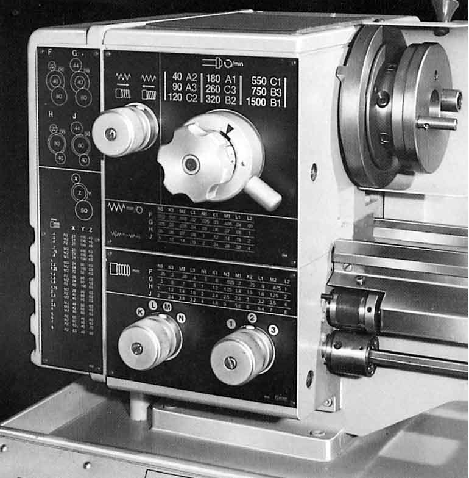
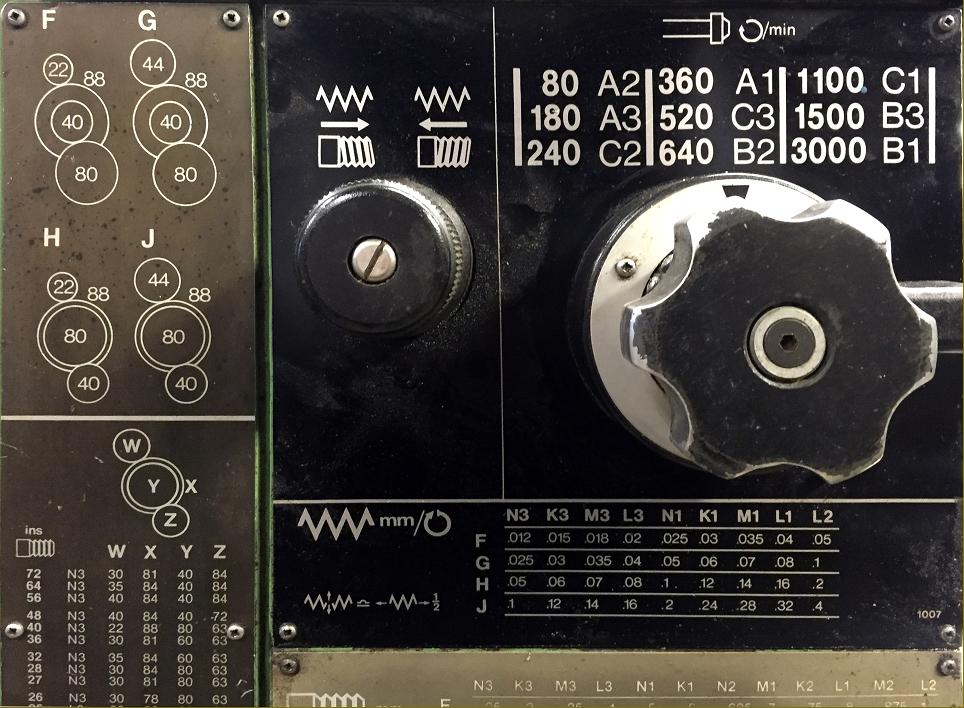
The twin-dial, concentric headstock speed-change knobs were easy to use, even with oily hands. |
||
|
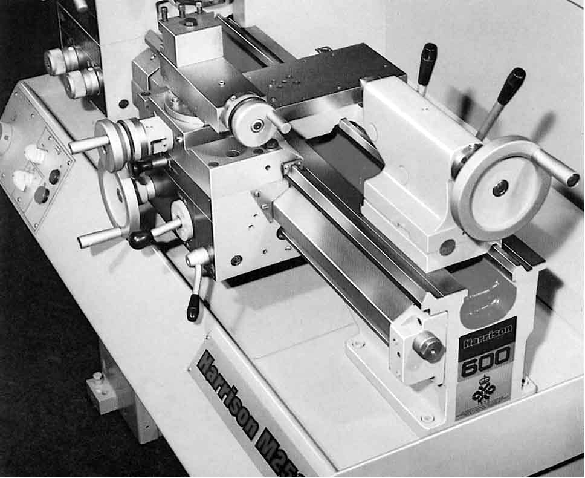
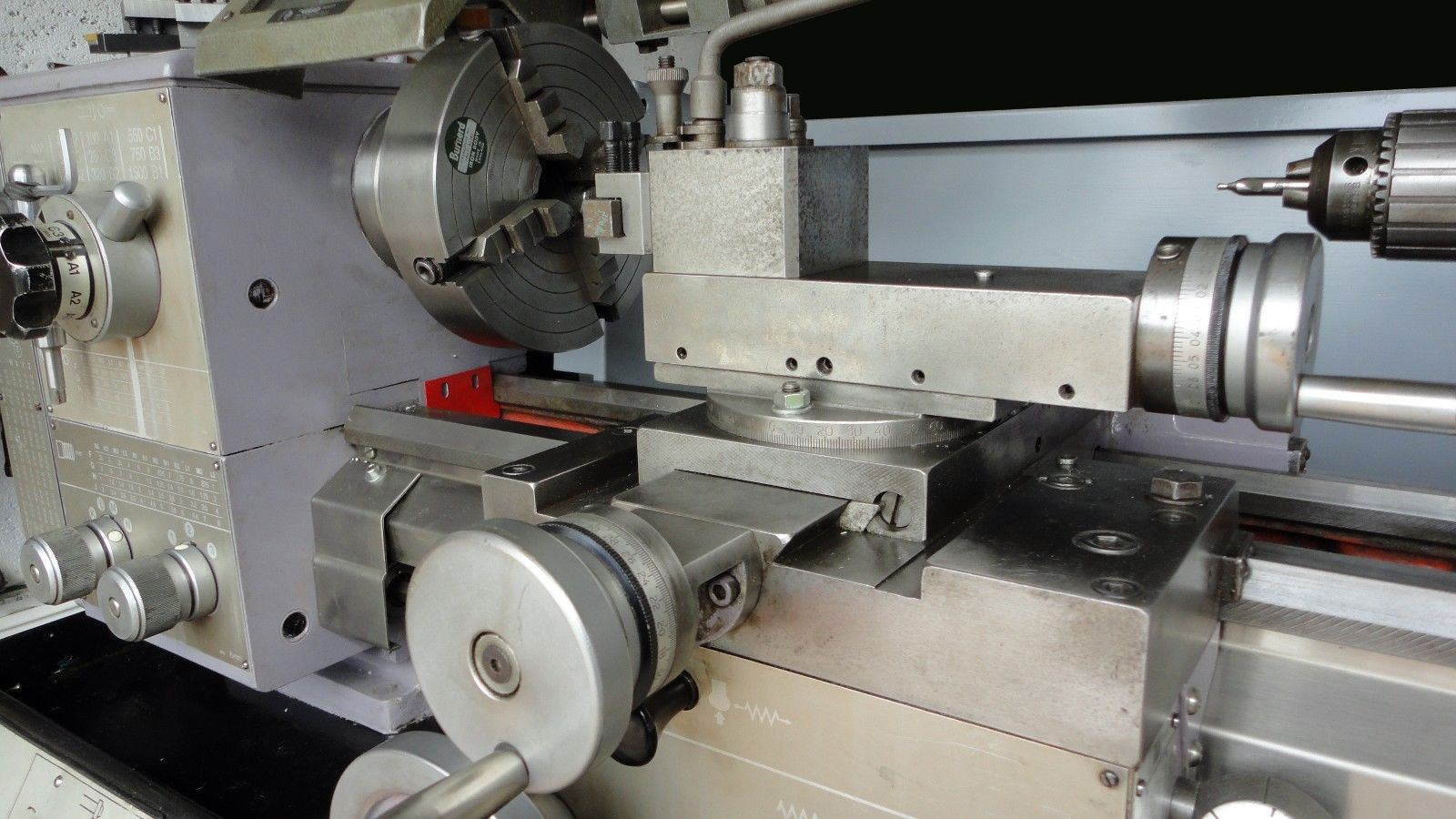
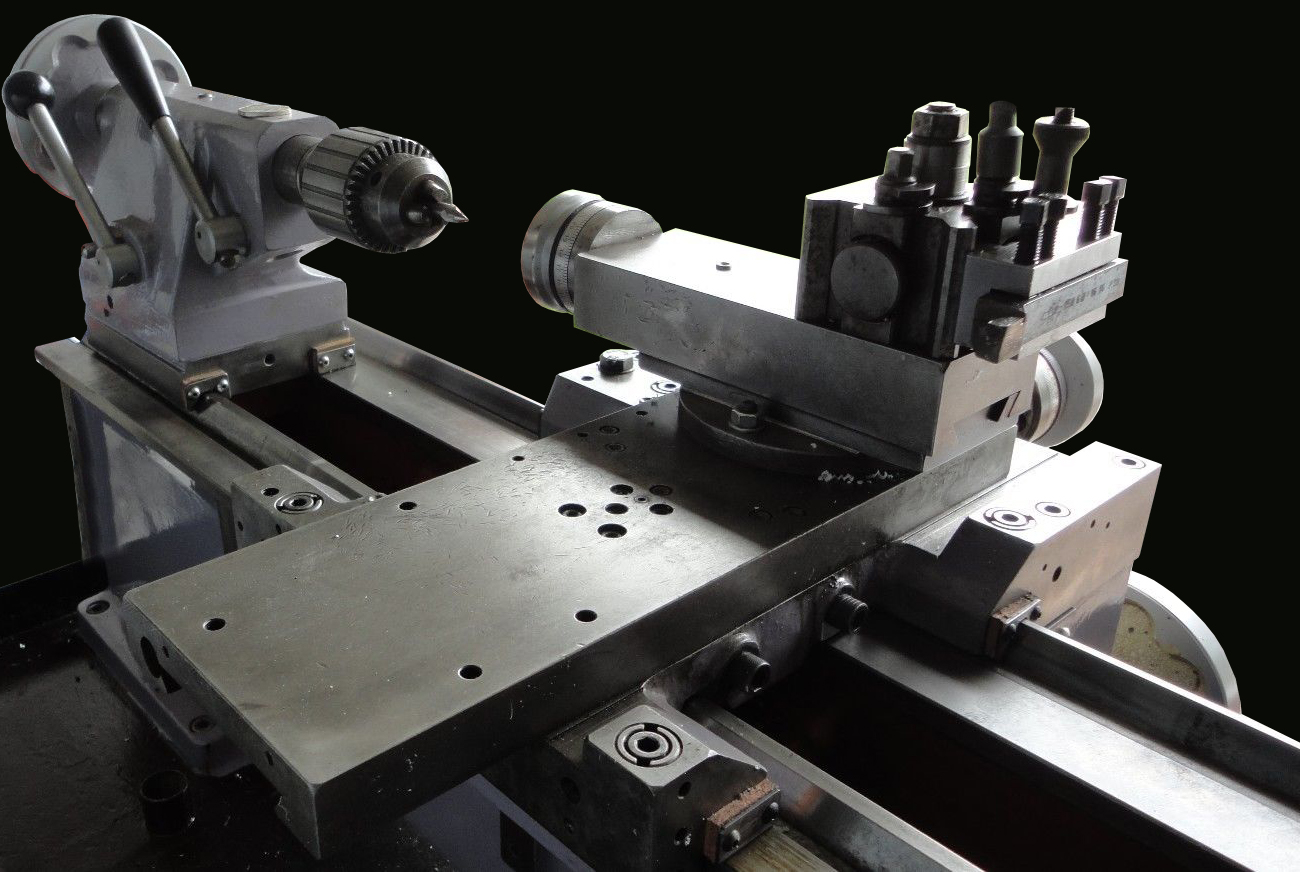
The carriage, fitted with European Safety-Neurosis smooth-faced handwheels, was driven by both a fully guarded, 25 mm diameter leadscrew (in 6 mm or 4 t.p.i.) and a power-shaft; the leadscrew was used exclusively for screwcutting whilst the torque-limiter protected powershaft provides the normal sliding and surfacing feeds with the leadscrew disengaged. Although the top slide had a traditional, parallel-type of screw-adjusted gib strip, the cross slide was fitted with the superior tapered type, able to be set more accurately and provide much better support; both the cross and top slides, as well as the saddle, were fitted with locking screws. |
||

|
|
||

|
|
||
|
|
|
Home Machine Tool Archive Machine-tools Sale & Wanted |