|
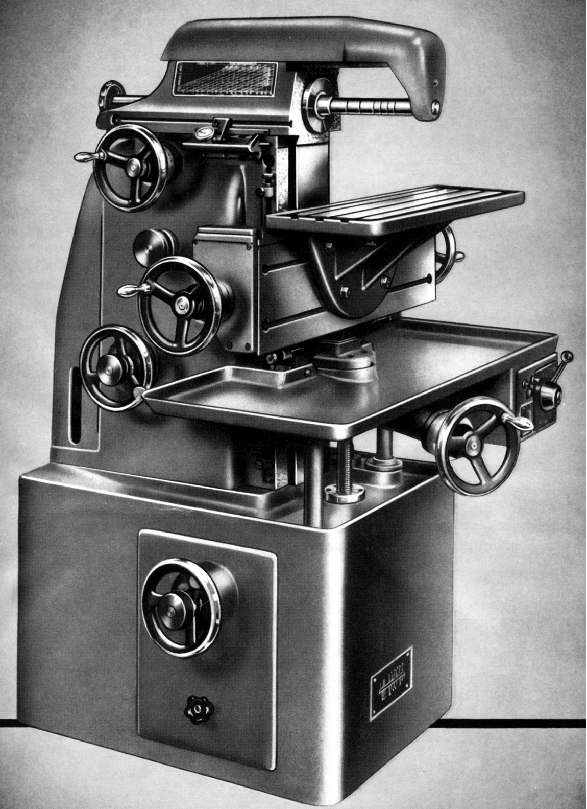
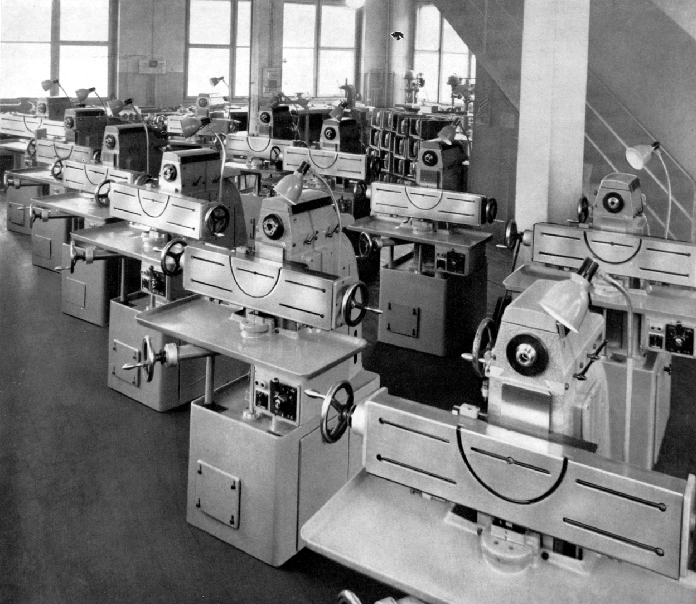
Better known in later years for their beautiful tool and cutter grinders the Christen Company of Berne also manufactured larger machine tools amongst which two models, the pre-war designed "Dan" lathe and universal Type U-O millers are probably the best known. The latter machines, designed and built by Perrin Frèress S.A. of Moutier (ands sometimes sold with Perron Montier and Perrin Freres s.a. Moutier badges) were typical of the precision universal millers that became popular from the late 1940s onwards.
A note on the background to Perrin from "Greg Q" who provided the chronology for the following:
In 1923, two mechanic brothers, Felix and Louis Perrin, started a workshop at the "Corner of the Mill" in Moutier, Switzerland, naming their new enterprise after themselves and producing, first, cutting stamps for timepieces as well as being involved in the local watch-making industry by modifying and repairing watch-makers lathes and developing a rolling machine with pivoting clockwork gears. After some difficulties due to high unemployment in the area, they moved, in 1929, to Rue de la Gare in an old barn that was transformed into mechanical workshop. Despite the harsh economic times some success was achieved with automatic coin sorters, a milking machine, continuously-variable automobile transmission and the manufacture of jigs and spare parts for armaments - including templates and components for the Lebel rifles used by the French Army) In 1939, the company status changed from a limited partnership to a company: Perrin Frères SA. With the advent of WW2 the decision was taken to manufacture of machine tools, first ordinary drill presses some with compound tables (the model TX-25) then a universal milling machine, the PF1. However, it is reported that Deckel, in Munich, makers of the FP1, objected to the name and it was renamed the U1.
During the 1950s and 1960s, very similar machines were introduced by a number of European manufacturers* with some being indigenous designs (that merely followed the general concept) while others were a direct copy of the most successful model of all, the Deckel FP1. The secret of the type's success, and the reason so many versions were built, was its ability to mount a number of different heads (horizontal, vertical, high-speed and slotting) in combination with a variety of tables (plain, plain-tilting and compound swivelling). By juggling this combination of options, and utilising other accessories, a skilled technician was seldom defeated in his attempts to produce the most complex of milled components to a very high standard of accuracy.
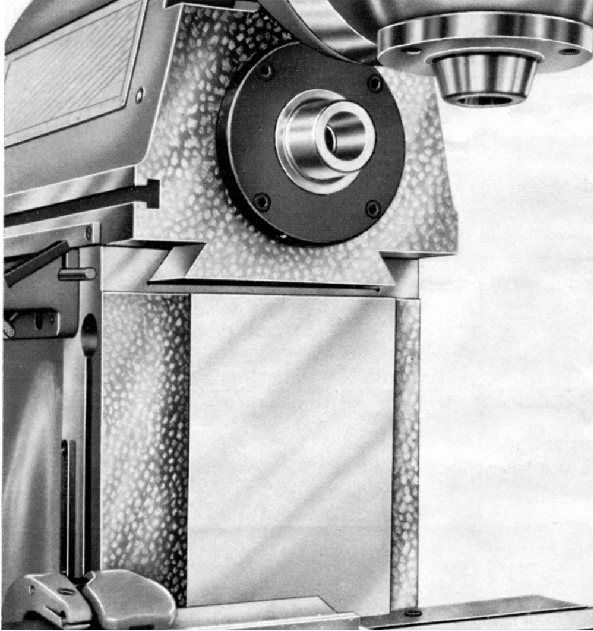
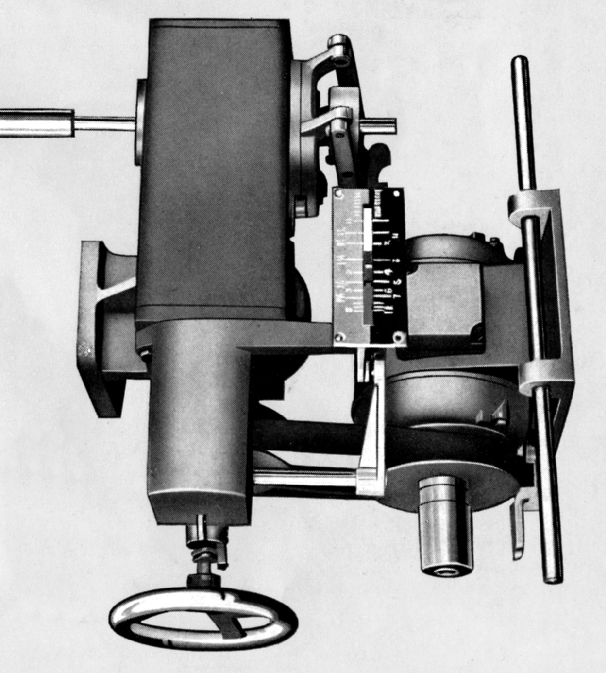
Details of how the Christen miller was constructed and its drive system arranged are interesting: the top of the main column was machined as a slideway to carry a separate housing that doubled both to carry a horizontal spindle and act as a mounting for the various heads. The chrome-nickel alloy spindle was case hardened and ran in two taper roller bearings at the front and one journal bearing at the rear - an arrangement that provided both excellent support and an easy means of making adjustments. To solve the problem of how to drive the spindle when its housing was moved backwards and forwards (to provide lateral travel to the cutter), a long fixed gear was mounted parallel to and underneath it on the final-drive shaft and the upper gear allowed to slide along it. The spindle-mounted gear also drove the various heads that bolted to the top of the sliding housing.
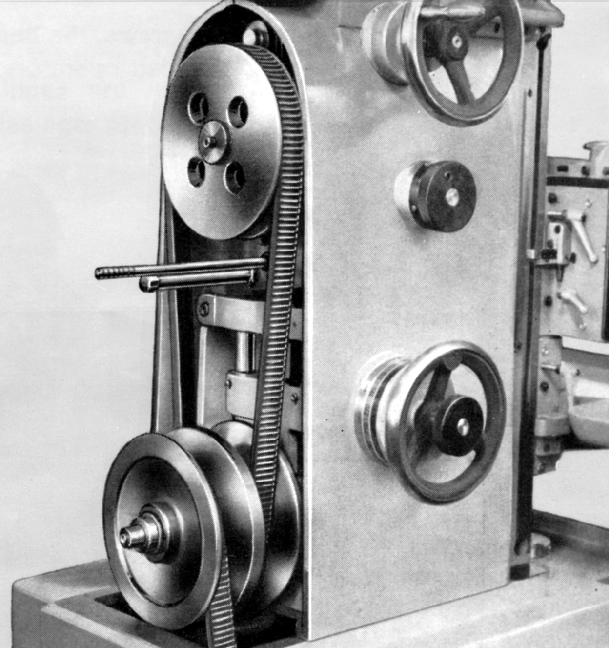
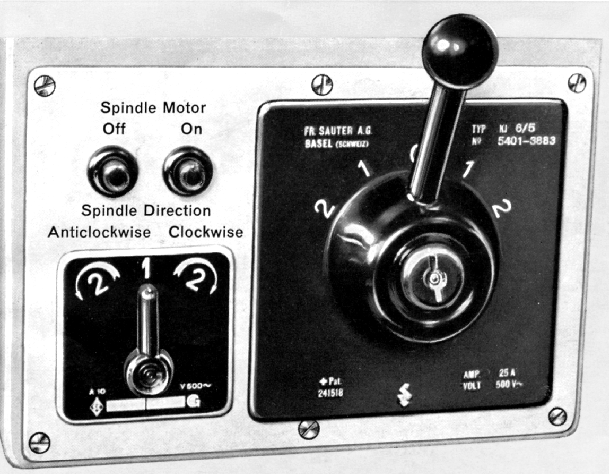
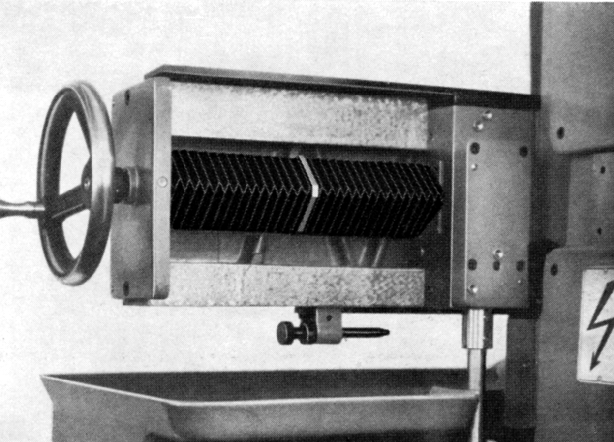
Early models had 2-speed motors and their spindles gear driven, from a box held within the main column. However, like its Swiss-built competitor, the Schaublin 13, later versions were fitted with an infinitely-variable speed drive by expanding and contracting pulleys; this arrangement, powered by a single-speed 2 h.p. 2800 r.p.m. 3-phase motor, gave the final output shaft a speed range from 60 to 2500 r.p.m. A gearbox was also incorporated (containing hardened gears and operated by a handwheel on the miller's left-hand face) that gave a low-speed range and enabled (for the size of machine) larger-than-usual cutters to be used at unusually high rates of metal removal.
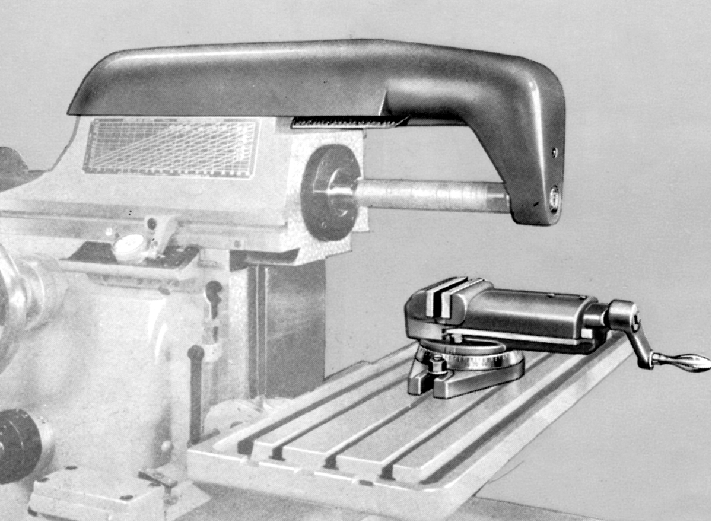
As standard, the miller was equipped with just a simple prismatic overarm with a bronze-bushed drop bracket and a hardened and ground No. 30 INT milling arbor that was available in three sizes to accept 1-inch, 3/4-inch or 1/2-inch bore cutters. The two smaller arbors were provided with a sleeve on their end bearing surface to fit inside the drop-bracket bearing with the smallest 110 mm long against the 145 mm of the other two. With the assembly in place the maximum diameter of cutter that could be mounted was 150 mm (6-inches).
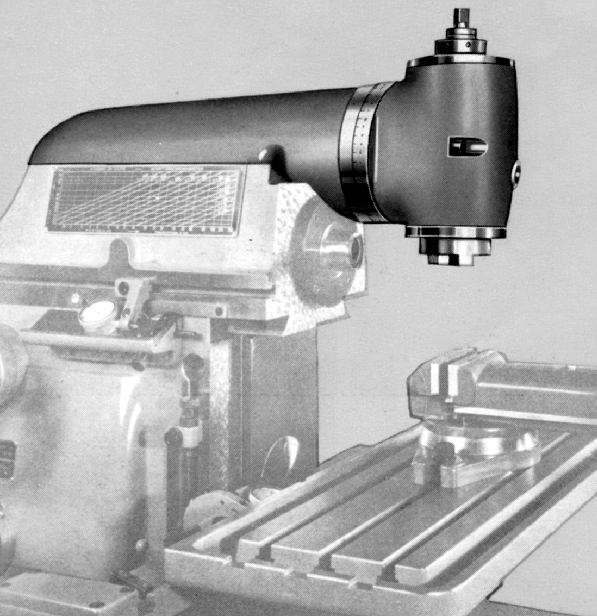
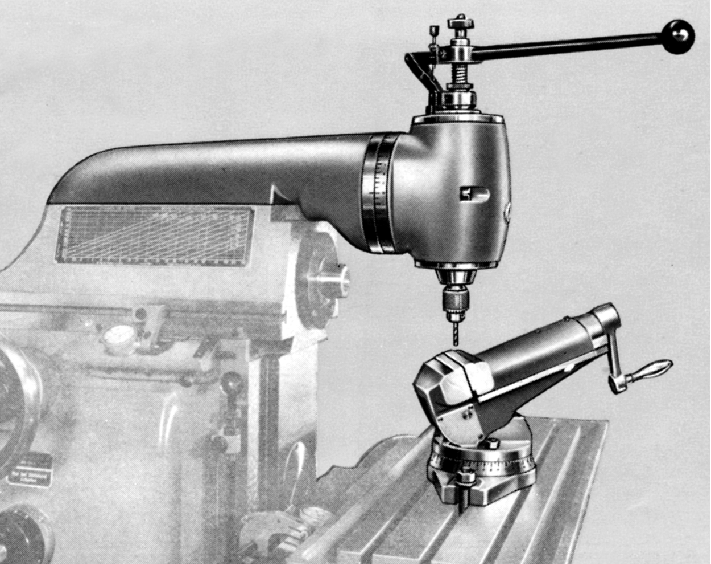
Catalogued by the makers as their Part Number 12, the standard vertical milling head carried a No. 30 INT nose fitting. The front section of the unit could be swivelled 90-degrees from either side of central and, although there was no quill feed as standard, this could be provided by an accessory kit that gave a lever-action drilling feed. The head was driven at a 1 : 1 ratio by the output shaft and so had exactly the same speed range - 60 to 2500 r.p.m. as the horizontal spindle. The maximum clearance between spindle nose and table was 325 mm, the minimum 12 mm - while the centre line of the spindle could be moved as far as 277 mm from the front face of the column, or brought as close as 127 mm.
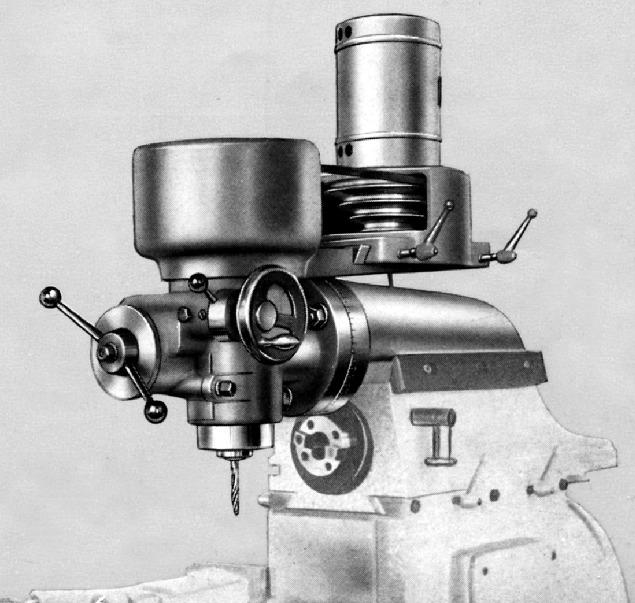
Although useful, the standard head was neither as fast nor as versatile as it should have been for serious die and tool work and to overcome this difficulty the makers offered their Part No. 15, a high-speed head driven by an attached 0.5 h.p. 3000 r.p.m flange-mounted motor that had 8 V-belt drive speeds from 1200 to 6000 rpm. The head was able to be tilted 30-degrees either side of vertical, accepted the commonly-available Schaublin W20 collets and was fitted with a 70-mm travel quill with both lever-operated quick-action and handwheel-driven fine feeds. With this unit it was possible not only to run small cutters at the right speed, but also to have greater control over their manipulation, especially into awkward positions.
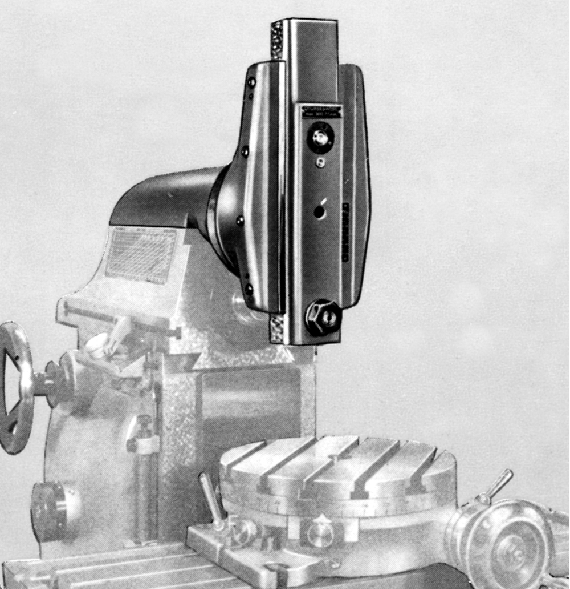
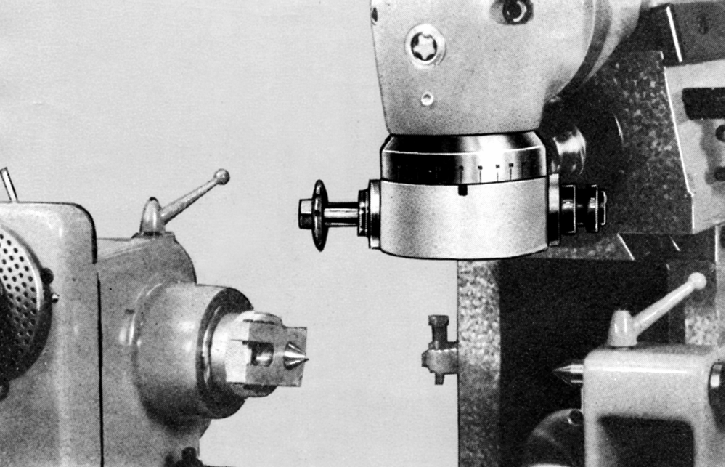
Two other heads were listed: a slotting head - with a stroke of 0 to 80 mm and a stroke rate from 60-300 per minute - and a rack-milling attachment, in essence a simple right-angle drive unit that was socketed into the end of the standard vertical head.
Not only the main spindle on the Christen benefited from a variable-speed drive, on a special version, the Model U-OA, so did the longitudinal and vertical table feeds - powered by a 2-speed (0.75 h.p. at 2800 r.p.m. and 0.5 h.p. at 1400 r.p.m.) pole-change motor that drove a "Reeves" expanding and contracting pulley unit. This was arranged in a neat, self-contained housing, built into the base of the miller but with the control handle rather positioned rather inconveniently on the left-hand face of the stand and the sin compounded by putting the feed-rate indicator low down and out of sight on the front face. The table's longitudinal travel was 320 mm, and the vertical 300 mm - with both ordinary and rapid feeds available, the former at between 11 to 240 mm/min and the latter at the rate of 1200 mm/min. The early table drive units were noisy and lacked power but subsequent development (including the use of two worm gears) resulted in a quieter, stronger and more reliable unit. In a manner similar to that obtainable on a Hardinge HLV Series lathe, having both spindle speed and table feed rates infinitely variable allowed the operator to quickly choose (or experiment with) the optimum settings needed to get the very best results. The table handwheels were elegantly proportioned and the satin-chrome finish micrometer dials crisply engraved and fitted with finely knurled edges. Each table axis was also supplied with a properly engraved precision ruler and an adjustable stop.
Although listed as an optional extra, an essential part of the miller's equipment (at least if its full versatility was to be exploited) was Part No. 21, Universal Milling Table. This, like the other two tables, had a clamping surface of 680 mm x 230 mm but could be swivelled or tilted in three planes. 45°--0°--45° vertically, 35°--0°--35° horizontally (front to rear) and left-to-right 45°--01°--45°. Like all of its kind (with so many clamped surfaces between workpiece and cutter), only relatively light cuts could be taken if flex in the assembly was to be avoided. Three centering dowels were provided and three 10 mm wide T-slots on a 52 mm pitch. The other two tables were the standard-equipment Part No. 20 Plain Tilting and the Part No. 22 Rigid Angle; the latter, being secured by 4 bolts in the knee's horizontal slots and of greater mass than the others, was the best option when simple jobs were being machined or heavier cuts necessary.
Even when equipped with a variety of tables and heads, if the very best was to be got from it, the miller still needed the addition of other very expensive extras, and to this end Christen offered a range of equipment: a swivelling sub-base to mount on the tables, a universal dividing dead for spiral milling, a plain dividing head, a universal dividing head, rotary tables, die-milling attachments and various chucks, faceplates and machine vices.
Each machine was supplied in a ready-to-run state complete with low-voltage lighting, a threaded drawbar (1/2" Whitworth 12 t.p.i. or M12), a cover for the spindle head when run in horizontal mode, 3 eye bolts for lifting, a set of spanners, keys, oil gun and a test certificate. The U-O stood 1400 mm high, required a floor space of 1300 mm by 1520 mm and weighted approximately 800 kg.
*Proof of the type's success - the genus Precision Universal Milling Machine - is evident from the number of similar machines made in various countries including:
Austria:
Emco Model F3
Belgium: S.A.B.C.A. Model JRC-2
Czechoslovakia: TOS FN Models
England: Alexander "Master Toolmaker" and the Ajax "00", an import of uncertain origin.
Germany: Hahn & Kolb with their pre-WW2 Variomat model
Wilhelm Grupp Universal- Fräsmaschine Type UF 20 N/120
Hermle Models UWF-700 and UWF-700-PH
Leinen Super Precision Micro Mill
Macmon Models M-100 & M-200 (though these were actually manufactured by Prvomajska); Maho (many models over several decades)
Ruhla
Rumag Models RW-416 and RW-416-VG
SHW (Schwabische Huttenwerke) Models UF1, UF2 and UF3
Thiel Models 58, 158 and 159
Wemas Type WMS
Italy: C.B.Ferrari Models M1R & M2R
Bandini Model FA-1/CB and badged as Fragola (agents, who also sold a version of the Spanish Meteba).
Japan: Riken Models RTM2 and RTM3
Poland: "Avia" and "Polamco" Models FNC25, FND-25 and FND-32 by Fabryka Obrabiarek Precyzyinych
Russia: "Stankoimport 676"
Spain: Metba Models MB-0, MB-1, MB-2, MB-3 and MB-4
Switzerland: Aciera Models F1, F2, F3, F4 and F5
Christen and Perrin Types U-O and U-1 (Perrin Frères SA, Moutier)
Hispano-Suiza S.A. Model HSS-143
Luthy
Mikron Models WF2/3S, WF3S, WF-3-DCM & WF-2/3-DCM
Perrin Type U-1
Schaublin Model 13 and Model 22
The former Yugoslavia: Prvomajska (in Zagreb with Models ALG-100 and ALG200)
Sinn Models MS2D & MS4D
"Comet" Model X8130, imported to the UK in the 1970s by TI Comet.
United States: Brown & Sharpe "Omniversal"
Sloane & Chace in the USA produced a miniature bench version and at least five Chinese-built models have also been made, including one from the Beijing Instrument Machine Tool Works. A number of the "clones" merely followed the general Thiel/Maho/Deckel concept whilst others, like Bandini and Christen, borrowed heavily from Deckel and even had parts that were interchangeable. Should you come across any of these makes and models all will provide "The Deckel Experience" - though you must bear in mind that spares are unlikely to be available and, being complex, finely-made mechanisms, they can be difficult and expensive to repair..
Additional Christen pictures here
|
|