|
 |
 |
 |
 |
 |
 |
 |
 |
 |
 |
 |
 |
 |
 |
 |
 |
 |
 |
 |
 |
 |
 |
 |
 |
 |
 |
 |
 |
 |
 |
 |
 |
 |
 |
 |
|
|
|
|
|
|
|
|
|
|
|
|
|
|
|
|
|
|
|
|
|
|
|
|
|
|
|
|
|
|
|
|
|
|
|
|
|
|
|
|
|
|
Home Machine Tool Archive Machine Tools For Sale & Wanted E-MAIL Tony@lathes.co.uk Centec Automil & 3 Series Milling Machines Types 3C, 3P, 3R, 3RV, 3V Centec Home Page Vertical Head Pictures Centec 4 Early Centec Horizontal Centec 2B Pictures Centec 2A Pictures Accessories New Vertical Heads Vertical Head Raiser Block An Operator's manual and parts list is available for the Automill
The "Automil" was a modified 2B/2C with hydro-pneumatic drive to the table. It was made in much smaller numbers than the conventional machines and, whilst commonly found on a heavy cast-iron stand as a conversion from the 2C, began life as the Mk. 1 on the ordinary heavy-sheet-steel cabinet as a modified 2B. The later 2C based Mk. 2 and Mk. 3 Automil was fitted with a 30 International spindle, a heavier overarm with a modified bearing in the droop bracket, a wider column, stronger table and knee and 1.5-inches extra clearance under the cutter. If you find an Automil it is, apparently, a relatively simple task to convert it manual "2B/2C" operation. The 3 Series millers were specially designed machines suitable only for repetition production work with hydraulic feed to the table controlled by a simple but effective system of stops. The table could move only longitudinally, the cross and vertical traverses being provided by the head.
|
|
|
|
|
|
|
|
 |
|
|
|
|
|
|
|
|
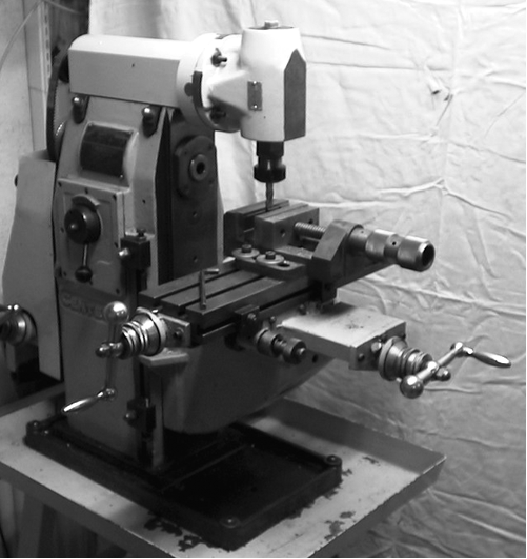
A Mk. 1 Centec Automil with hydraulic table drive. Recognition points for these rare early models include a parallel-sided main column, with a baseplate similar to that used on ordinary 2B, and the sheet-metal cabinet stand.
|
|
|
|
|
|
|
|
|
|
|
|
|
 |
|
|
|
|
|
Centec Mk. 3 Automil Hydraulic Controls
|
|
|
|
|
|
|
|
|
|
|
 |
|
|
|
|
Centec Automil Mk. 2 and Mk. 3. With a catalogue specification and illustrations that appears identical, the differences between the Mk. 2 and Mk. 3 Automil remain a mystery.
|
|
|
|
|
|
|
|
|
 |
|
|
|
|
|
|
Centec 3 & 3R 2-dimensional Production Milling Machines: With a 34.25" x 11.75" table (8" x 30" working area and 14" of travel) and head both hydraulically driven the 3-Series models were considerable larger and heaver than the maker's conventional machines. The spindle was fitted with a substantial 40 International nose, the spindle drive motor 3.5 h.p. and the hydraulic pump motor 2 h.p.. Infinitely-variable speed drive was fitted which gave a range of 50 to 1400 rpm or, optionally, 200 to 2000 rpm. The 3R was fitted with the refinement of a programme control to the vertical motion of the cutter head in addition to that provided for the table. The aim was to shorten production times by combining, where possible, more than consecutive milling operation in one automatic cycle and also to reduce the length of the cutting path by eliminating unnecessary in-feed of the cutter. Approach movements both horizontally and vertically were 300 inches per minute..
|
|
|
|
|
|
|
|
 |
|
|
|
|
|
|
Centec 3R. A rear view with the cover removed from the vertical feed-control mechanism
|
|
|
|
|
|
|
|
 |
|
|
|
|
|
|
Rear view of the Centec 3R showing the vertical travel indexing mechanism. The height of the cutter head at any position of the table or point of the cycle was fixed by six adjustable positive stops mounted on an indexing turret head. If a new depth of cut was required the turret rotated to a new position (as the head reached the top of its travel) and the head moved down until it contacted the new stop.
|
|
|
|
|
|
|
|
 |
|
|
|
|
Centec 3 table-control slide. Normally hidden under the front bed cover the unit consisted of a detachable plate with 6 slots holding adjustable buttons. The position of the buttons in the four lower slots determined if the table was to move at a controlled feed rate, or at a fast traverse. Buttons in the upper two slots set the point at which the table motion stopped and the head motion began. The infinitely-variable rate of feed of both head and table was set by the rotary dial seen below the control slide.
|
|
|
|
|
|
|
|
|
 |
|
|
|
|
Once a job had been set the control slide and its buttons could be removed and stored - in effect a physical memory - that allowed very short set-up times to be achieved
|
|
|
|
|
|
|
|
 |
|
|
|
|
|
|
Centec 3P. This model was of similar construction and configuration to the Centec 3 and 3R but fitted with a mechanism whereby the height of the cutter above the table was continuously controlled by a template and tracer valve. Shapes with angles up to 80-degrees from the horizontal, and very slow tapers, could be accurately copied without steps.
|
|
|
|
|
|
|
 |
|
|
|
|
|
|
|