Home    Machine Tool Archive    Lathes, Millers, Shapers for Sale 
Shapers, Millers & Grinders for Sale
E-MAIL   tony@lathes.co.uk   

Memories of Murad - Two Stories
Murad Home Page   Murad BORMILATHE   The Bormilathe in Use   Bormilathe Photographs   
Murad Capstan   Murad CADET   
Murad Antarctica   Bronson Motor   
Murad Factory   Murad Car   Other Products   

Mr. W. F. Murad in his days as Managing Director of the Murad group of companies

The following article was assembled from conversations between Ben Cook (who has an interest in capstan lathes and early plug-board automatics) and John Beech, the latter having worked for Murad on two occasions during the 1940s.
Mr. Wadia Halim Murad was originally from Jamaica and studied Electrical Engineering at Manchester University, gaining acceptance to the AMIEE. At some point before WW2 he moved to London and set up his first factory in Watford, the organisation eventually being divided into several sections that were, over the years, described as:: "
Murad Developments" - responsible for research and development; "Murad Machine Tools" - machine-tool manufacture; "Technaloy" - a company devoted to the production of castings; "British Bronson" - design and manufacture of electric motors and associated equipment and "Murad International" - a marketing name used after a move to Sheerness.
John Beech was born in January, 1914, served an apprenticeship at John Dickinson's and studied Mechanical Engineering at Regent Street Polytechnic. Having cut his teeth in engineering, and obviously being a gifted individual, he was appointed by Murad as Foreman of the Tool Room, a job of some responsibility for a young man in his twenties and one that involved him in development work on the 3Q capstan. At this stage of his career John's idea was to stay at Murad for a year or so, master the job, and move on; events, however, intervened and two years later (at the start of World war Two in 1939) he was called up for military service. However, being technically capable and qualified he was seconded instead to the Ministry of Supply, his initial task being to check up on munitions factories, largely in the East End of London, that were not meeting their production targets. The finding generally that they were busy making shirts instead (read into that what you will!) At the time any factory could apply for munitions work and with it came the potential of machinery, materials and money, all of which were in short supply.
JB was subsequently placed with the "Higher Appointments Board" as a Manager for up to 60 staff. Towards the end of the war one appointment, whether by accident or design, sent him back to Murad as Manager of Development and it was during this second spell with Murad that JB spent some time working on the car. The project was, with the benefit of hindsight, doomed from its inception for, even if the vehicle had been sufficiently radical in its design to have attracted an enthusiastic cliental (and then developed for production), it could never have competed with the cost-cutting economies of scale enjoyed by the big Midland motor companies. It was however a brave effort with the engine designed and built by in-house (it had an unusual lubricating oil to water heat exchanger) but coupled to a bought-in Moss gearbox with the drive taken though a  De-Dion-type rear axle, the whole being mounted in a chassis by Rubery Owen.
Because the Moss gearbox was mounted beneath the gap between the front seats an usually short gearlever could be used instead of the long wobbly stick so common in family cars before remote linkages or column changes became popular. The position of the gearbox required the use of a short propeller shaft to connect it to the clutch and this caused two problems: the additional inertia of the shaft was sufficient to defeat the gearbox synchromesh (which meant double-declutching had to be employed to get a decent change) and where the prop shaft entered the gearbox an additional support bearing was required - and this tended to overheat, such being the nature of the grease-filled ball races available at the time.
The engine produced 48 BHP at 4000 RPM and was capable of running up to 6000 RPM. However ,above 4000 rpm, torque fell off rather more steeply than was deemed desirable. Being an engineering company in-house facilities for development were, of course, pretty reasonable and even included a dynamometer; extensive research work was concentrated on the engine to improve power and torque and it was notable that the motor responded best to just one make of spark plus, KLG, where an extra 3 BHP was gained with the other makes being described as: "no use at all".
The design and prototyping of the car engine, in the 1940s, was reputed to have cost in the region of £50,000, thought this is suspected to have included the provision of all the special facilities required, including equipment for the manufacture of their own white-metal shell bearings - a unbelievably wasteful thing to have attempted when they could have been bought in the form of "Thin-wall" bearings off the shelf from CAV. Although permission had been granted to build two prototypes during the war it is thought that only one was completed and this was not registered, as KPP 618, until January 16th, 1948. This car was taken on a 2,000 mile test drive over Britain, but was found to have no power over 4200 RPM, thought with the motoring conditions at the time that can hardly have been a serious shortcoming. In an attempt to improve engine breathing, funds were requested to redesign the valve gear; this appeal was referred to the Directors of the Company who said curtly, "No more money." and that was, effectively, the end of car development for Murad. However, the prototype car remained in the hands of Mr. Murad until 1964 and was almost continuously registered for road use. 
Although an exercise without a satisfactory outcome JB referred to the car episode as excellent experience; it had cost the company a great deal of money, and diverted resources that might have been better employed on machine-tool, electrical-equipment or alternative product research - but this was a diversion obviously enjoyed by Mr. Murad as a (rather expensive) hobby for his amusement.
After the car episode, and in order to diversify into other product area, JB was asked to tool up to make electric fires and mincing machines, a less-than-exciting prospect which caused him to resign from Murad's and take up his next Higher Appointments Board posting with the Hatfield Engineering Company. Murad's desire to diversify into "domestic products" was, of course, not unique, and like many other engineering companies, having grown beyond their normal market share on the back of the all-out war effort, needed to diversify into the domestic market where there was an acute shortage of goods for ordinary consumers; even though the products may have been unglamorous they would have provided a steady business into a growing market.
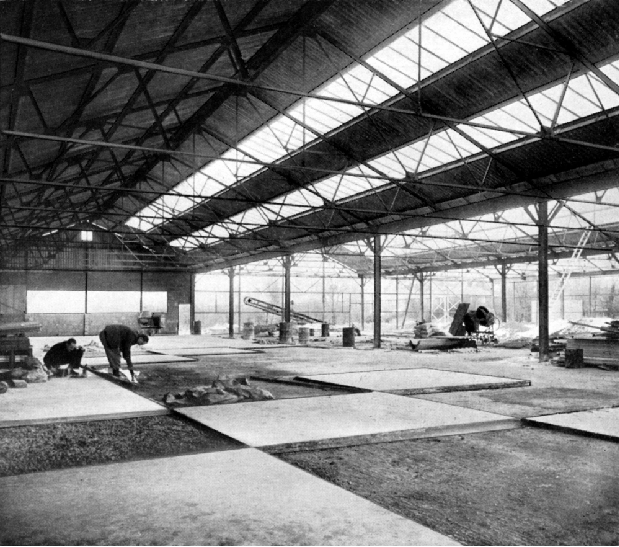
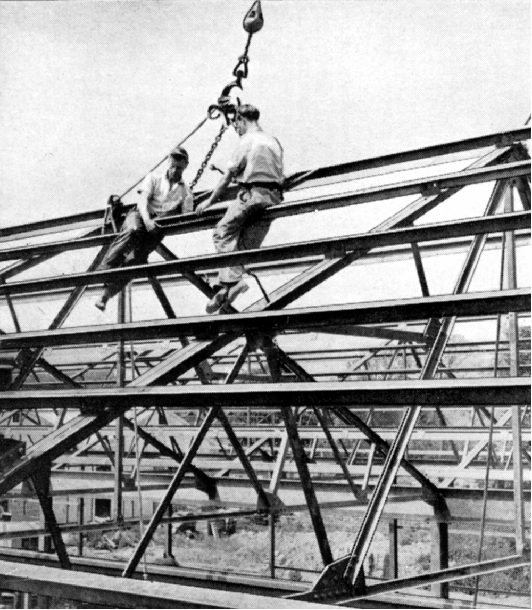
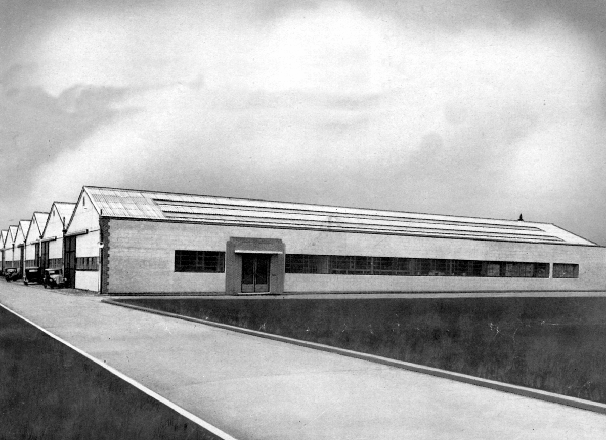
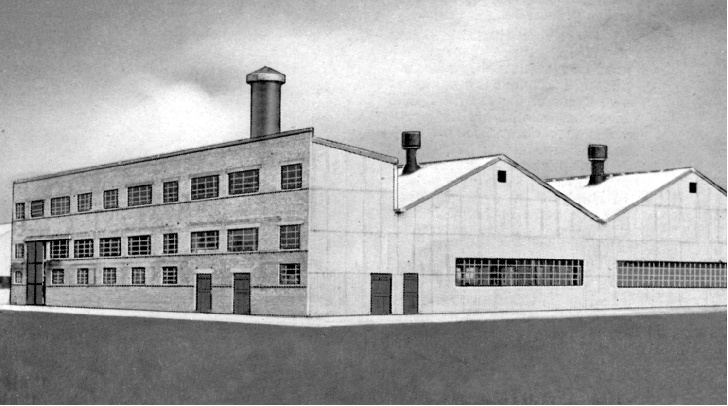
Immediately after the end of the war, in 1946, Murad moved his operation from Watford to Aylesbury, where he had a purpose built factory constructed for the various activities of Murad Machine Tools, Technaloy and British Bronson. Subsequently the Murad organisation moved again, this time to West Minster in Sheerness, Kent, at which point some sales literature was marked "
Murad International".  This move, to an area with few skilled engineering workers, was prompted by Government encouragement and the promise of suitable compensation, which, naturally enough, was never forthcoming. The costs of the move, and the need to divert resources to train new staff, did nothing for the company's profits. Trading difficulties were further complicated as many firms operating in the traditional machine-tool sector saw a huge downturn in the demand for their products during this time. Murad fertile imagination caused him to counter this by a diversification into new fields -a risky undertaking even during good times - and it is suspected that in over-reaching himself in this area saw an excess of expenditure over income. By 1980 Murad Developments had became insolvent, with the situation complicated by arguments amongst the accountants as to how the assets should be split up amongst the various companies - with the result being that no one part could be saved. The end was finally confirmed when, on the 8th October 1980 "Machinery and Production Engineering" magazine carried a full-page advertisement offering the rights to the machine tools and all the production equipment and drawings. At this point JB contacted Mr. Murad who was reduced to living in a "boarding bouse" in London and had virtually nothing left of his business. Murad offered JB the car and some machine tools (which he declined) in exchange for the production of a prototype gearbox for a typing transcription aid powered by a stepper motor--a new technology at the time. JB produced the required parts, sent a pro-forma invoice - but nothing more was ever heard.
Although Murad was an Electrical Engineer he clearly had a flair for artistic engineering design and liked to see his ideas become reality. JB described him as: "Good electrically, completely useless mechanically and a good artist. He would be insistent about the appearance of a machine, down to some trivial line on a casting, to give the look he wanted".
His most successful product, certainly in commercial terms, was the capstan lathe range, especially the 1"-capacity 3Q of which a large number appear to have been made and which found their way into all manner of production shops including those engaged in armament work. Part of the success of these capstans was down to their electrical system; this eliminated the need for an expensive drive gearbox and made them unusually quiet, even when working hard. They were also robust, accurate and compact.
It seems a shame that, after so successful a business career, and doubtless having to overcome more than casual racism, Mr. Murad should slip away into oblivion; if anyone knows more about the Murad story  the writer would be pleased to hear from them..
Further notes below:

LAYOUT of the MURAD FACTORY 1955/56 at Stocklake, Aylesbury, Buckinghamshire.

Some memories of Murad - from notes supplied by John Morris:
Whilst looking through your Archive of machine tool companies I spotted " Murad"; reading on I am delighted to say it was the company I was employed by in the '50s after leaving school at the age of 15 with very little in the way of qualifications. I can remember making a list of local engineering companies and, in my very best writing, drafting letters including one to, " Murad Developments" whose factory address was Stocklake, Aylesbury, Bucks.
I received by return of mail an invitation to attend an interview. As this was my first job offer I tried to look the part, together with advice from my parents on how best to conduct myself when being interviewed and "Don't be late". On the day I duly arrived at the factory and was welcomed by "Betty" who directed me to the office of the "Chief Draughtsman" and was told to wait until called. Murad's offices and foundry were situated a 10 min. walk from the factory next to "Negretti and Zambra", a company of instrument makers who considered themselves a cut above their neighbours. On the dot the door opened and out stepped Mr. Jeeves who announced himself as 'the chief draughtsman' and then introduced me to the boss himself, Mr. Murad. I was a little taken back by his appearance; there were very few coloured people living in the English provinces at that time; he instructed a secretary to make a pot of tea and we settled to the business at hand. Although this was my first ever interview I felt quietly confident as they put me at ease with straightforward questions. Within a day a letter arrived at home offering me a job as a potential apprentice - providing that I first completed a probationary period, of a duration that was not stated. I began work just 48 hours later and my first day in the factory was something of a culture shock after school; there were no attractive young girls wearing tight skirts here! However, I was warmly greeted by the ever smiling face of "Betty" who, I was soon to find, made the whole place tick; she was receptionist, nurse, typist, mail service, secretary for two foremen, confident to all - and finally flashed a nice pair of legs when on her cycle. Betty took me to the office of the two foremen where I was introduced to Mr. Cocking (Alf) and Mr. Dobson ( Harry) who quickly showed me round, telling me at the same time to put on my overalls and, "There's a spare peg in the 'bogs'* to hang your coat. See me when you are ready to start."
*bogs: the lavatory, or, to sensitive American ears, the 'bathroom', 'rest-room' or 'little-boys' room'.
The factory was rectangular in plan-form and divided lengthways by the foremen's office, tool cutter's store (a Mrs Rayner re-ground the cutters) a finished-parts store and the paint shop. To one side was the assembly line with production of components on the other side.
My first job was operating the power saw which I did alongside another new starter, Cliff Ricard; we were also responsible for collecting castings from the foundry, washing Mr. Murad's cars including the black-painted  "Murad" (there cannot have been many factory owners who drove regularly in a car of their own manufacture).
The factory, now occupied by Askey's cream wafer and cornet makers, was a spartan place and in the winter could be very cold; it wasn't uncommon to have night-watchman-type open braziers arranged along the length of the factory - the smoke usually lingering until lunchtime.
Winter tea breaks were spent huddled around the glowing braziers consuming mugs of hot tea, rolls and cakes bought from Mrs. Greenwood, who ran a small refectory opposite the paint shop. Summer breaks were rather more pleasant and we either relaxed outside in the sunshine or played cricket against the factory wall. I worked for Murad from 1956 to the end of August, 1957. After 18 months I was offered an apprenticeship, but did not take this up, preferring instead to join (after successfully passing the entrance exam) an apprentice scheme offered by a rather more exciting establishment that dealt with rocket propulsion systems.
My start pay at Murad's was £1: 14 : 7d a week after deductions, which increased to £1: 18 : 9d after one year. During my time with the company I worked in most sections from pen-pushing and sorting in the stores to more exciting times on the busy 'assembly line' (based economically and efficiently on two old railway rails bolted to the floor) for the 1A, 1B, 1C and larger 3C Models of capstan lathe. Working there I was shown how to install a suds tank, the pump and associated pipe line and ask the electrician to do a dry run. Leak checks were carried when the machine was powered up for its final pre-delivery checks.
A number of Polish tradesmen, displaced from their homeland by the Second World war, were employed and groups of ladies contributed the usual feminine input of the day by operating milling and drilling machine fitted with jigs and fixtures. Many tradesmen remained loyal to the company for years, if they could withstand the almost Victorian working conditions, for Murad was known for paying over the local rate for the job in order to maintain his employee levels. All the lathe beds were entrusted to the hand scraping of just one man, Harry Rickard, with the fitting and alignment of the saddle, apron and cross and top-slide assemblies attended to by Doug Cox. Harry made his own very effective and low-cost scrapers from the outer track of scrap ball races by removing the cage and balls then annealing the outer track before cutting it open and straightening it; the end was shaped to accept a handle and the tip ground, re-hardened and finished with an oil stone.
Mr. Murad had an unpredictable personality and both pay awards and firings were always on the cards in equal measure - though he treated his apprentices well and with sympathy. In the mid 1950s industrial production was finally clear of the supply difficulties that had plagued post-war reconstruction, though in the Murad factory shut-downs due to power failures were not uncommon as electricity was generated in-house with the energy source an ancient solid-fuel furnace.
The electric motors for Murad lathes were manufactured by "British Bronson", a subsidiary company that employed a small number of disabled people in the assembly room within the Murad factory. Extended armature motors were also produced for the two-sizes of Murad off-hand "Dustless" grinding machines; this little known Murad product, with two fans on the motor shaft that drew air down into filter boxed in the machine's base, complimented  the range of proper machine tools. Whilst I was there the company produced, to a Government order, a special a copper-banding machine that resembled a modified capstan lathe; I can recall the unit being demonstrated to a suited "man from the ministry" and the satisfyingly large amount of copper swarf it produced.

Home    Machine Tool Archive    Lathes, Millers, Shapers for Sale 
Shapers, Millers & Grinders for Sale
E-MAIL   tony@lathes.co.uk   

Memories of Murad - Two Stories
Murad Home Page   Murad BORMILATHE   The Bormilathe in Use   Bormilathe Photographs   
Murad Capstan   Murad CADET   
Murad Antarctica   
Bronson Motors   Murad Factory   Murad Car