|
Mars Lathe were made by the Mars Machine Tool Manufacturing Co. Pty. Ltd. of Bridge Street, FortitudeValley, Brisbane, Australia a company originally known as Rapson and Dutton. The firm produced a wide range of machine tools and other products including millers, shapers, planing machines, radial-arm drills, boring mills, hoists, bandsaws and even such items as diverse as paper guillotines and diesel engines. In advertisements they described themselves as ''Marine, Diesel and Aircraft Engineers'' and claimed expertise in the ability to design and manufacture ''Special Machines for all Industries''. One advertisement even boasted: "The widest range of machine tools in the Southern Hemisphere". As with many other company's, various brand names were used to market their products including, in the case of their 5-inch lathe, "Conrik" and "Great Scot" One machine, a shaper, was known to have been named after a particularly skilled mechanic/fitter, Tom DuBoise, who was with the company from 1932 until 1964, while another long-serving member of the workforce was Vic Marsh; he joined the organization in 1924 and retired in 1964, having spent most of his time as the senior machine-shop supervisor. One of the lathe and other machine-tool designers was Bart Bulwinkel who worked in the drawing office during World War Two when, faced with a Japanese invasion, the factory was running three shifts a day and working flat out to meet the urgent demand for machine tools from the Australian armed services.
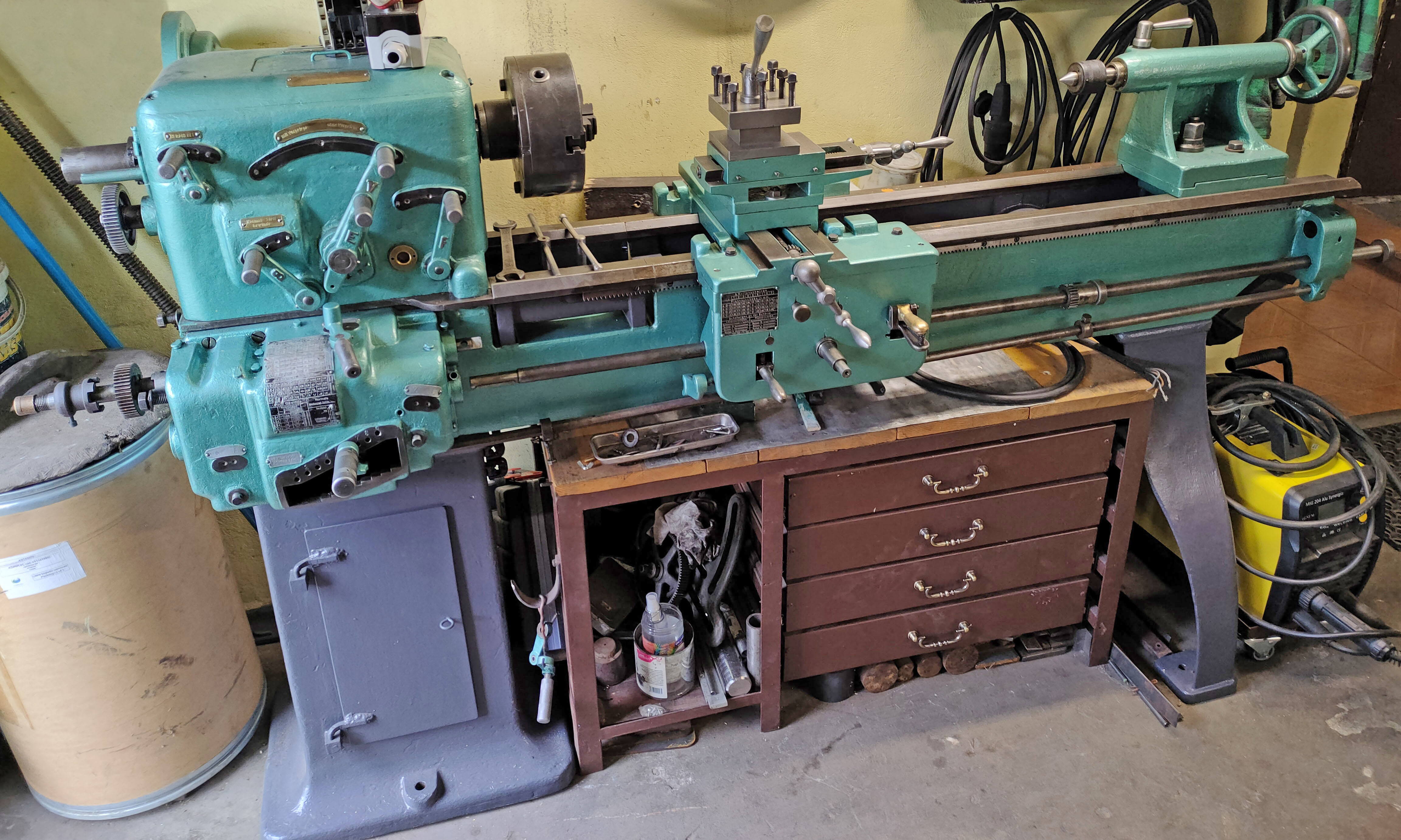
Being so catholic in their enterprises, it is likely that lathes played only a secondary role in the company's product range for, today, examples are rarely seen - and very little publicly literature seems to have survived. However, details of six models are available; the Junior, Venus, Jupiter, Mercury, Atlas and the 'Hercules' 5.5-inch and the 'Mars 6-inch' - the latter two both very close in capacity yet quite different in the details of their construction:
The 5.5 inch centre height by 24-inches between centres 'Hercules' was described by its makers as the 'Little Giant of the Lathe World. Like the English Raglan 'Little John', it was heavily constructed, with a genuinely-useful specification for its capacity and not just a small lathe with headstock and tailstock 'built up in the sand' to stretch the capacity of a lighter, cheaper machine. The 49-inch long V-way bed was ground-finished to within 0.00025'', had diagonal braces between front and rear ways and was fitted as standard with a 7-inch long detachable gap section - this increasing the capacity on the faceplate from 11 to 16 inches in diameter. At its headstock end the bed dipped down below the gap to form a mounting foot that bolted to a cast-iron plinth with a single (rather small) storage cabinet. Because the bed foot beneath the headstock was rather short it left a sizeable proportion of the casting, on the outboard end, cantilevered away from solid support. A generously proportioned and usefully-deep sheet-steel chip tray was fitted as part of the standard equipment.
Running in parallel-bore bronze bearings that could be adjusted by being drawn into their tapered housings, the high-tensile steel headstock spindle was bored through 0.75-inch, had a No. 3 Morse taper nose and axial thrust was taken against a ball race. Interestingly, the makers claimed that: ''All Headstock parts are Dynamically Balanced to ensure vibrationless running at all speeds''. However, whether the same thoughtful precautions were taken with regard to the unguarded countershaft assembly, neatly built onto the back of the bed behind the headstock, is unknown. A V-belt took the drive from motor to the 3-step upper pulley with a flat-belt making the final connection to the headstock spindle. Making a profit on the sale of electric motors cannot have to appealed to the company's accountants for customers were expected to provide their own, the makers recommending a 1400 rpm, 1-hp unit that, in conjunction with a conventional 6 : 1-ratio backgear, gave a speed range from approximately 45 to 850 rpm.
Drive by changewheels from the headstock to leadscrew was through a tumble-reverse mechanism and, with the standard set of hobbed gears, a limited range of pitches ( 8, 9, 10, 11, 12, 13, 14, 16, 18, 19, 20, 24, 28, 32, 36 and 40 t.p.i) could be cut. To obtain an especially fine feed, generate metric or other special pitches, gears with 63, 73 and 100 teeth were available at extra cost.
A separate 'powershaft' was connected to the left-hand end of the leadscrew by a permanently-engaged gear; the shaft drove the sliding and surfacing feeds in the apron through the usual worm-and-wheel arrangement with selection and engagement by a single lever that could be lifted into one of two slots. The design of the safety-interlock mechanism (that presented simultaneous engagement of power feeds and screwcutting) was unusual: instead of being hidden away behind the apron's front wall it was fitted to the outside where, one must assume, it must have proved a tempting device for apprentices to mess with or even remove - with potentially disastrous consequences. On the left-hand face of the apron was a swiveling casting, almost identical to that on the Mk. 1 Colchester Student, that acted both as a swarf guard for the leadscrew and a mounting point for the dial thread indicator.
Continued below:
|
|