 |
|
|
|
|
|
|
|
|
|
|
|
|
|
|
|
|
|
|
|
|
|
|
|
|
|
|
|
|
|
|
|
|
|
|
|
|
|
|
|
|
|
|
|
|
|
|
|
|
|
|
|
|
|
|
|
|
|
|
|
|
|
|
|
|
|
|
|
|
|
|
|
|
|
|
|
|
|
|
|
|
|
|
|
Unlike most other makers of miniature, high-precision machine tools, Louis Levin & Son Inc. are still in business and can be found at:
13550 Larwin Circle, Santa Fe Springs, CA 90670 U.S.A.
Tel: (562) 802-8066
FAX: (562) 802-3778. Web site http://www.levinlathe.com/
Their products now form what is probably the world's most complete range of machines designed for extreme-tolerance work - and so successful has the company been in promoting its product lines that, whilst almost all of Europe's makers of similar lathes have disappeared (with the exception of Schaublin and Bergeon) Levin, founded in 1923, continues to thrive.
The machines illustrated here are not Levin's current line - and the Code Numbers refer to their contemporary catalog listings from the 1950s and 1960s which are now different - but they are typical of those which watch, clock and mechanical instrument builders and repairers might expect to find on the second-hand market.
Levin-manufactured items, like all super-precision machine tools, have always been expensive but so sort after are they that depreciation is relatively modest, and they retain a good proportion of their list price for as long as they remain accurate and functional - no matter how old they are.
Whilst it is possible to buy a miniature lathe for a fraction of the price of a Levin (or other quality machine) if your work demands consistently high standards - or you need access to a range of properly-made accessories - then a precision lathe is a much more sensible choice. Used properly, within its limits, and carefully maintained, such a tool will outlast even the owner - whilst repaying him many times over with its sensitive feel, superb accuracy and pride of ownership.
The Levin lathe is of the "WW" type (after the American Webster Whitcomb lathe of 1889 which set the standard) the principal dimensions of which include a 50 mm centre height (2") with 60 degree bed ways, 1.456" (37 mm) wide on the top and carrying in its spindle, an 8 mm collet with a 40 degree draw-in taper.
There have been many other makers of fine, precision tools in the USA and the largely unchanging nature of highly-skilled lathe handwork over the last one-hundred years can be seen by looking at the beautiful accessories made by, amongst others: Bottum, American Watch Tool Company, B.C.Ames, Bottum, Hjorth, Potter, Pratt & Whitney, Rivett, Wade, Waltham Machine Works, Wade, Pratt & Whitney, Rivett, Cataract, Hardinge, Elgin, Remington, Sloan & Chace, W.H.Nichols and (though now very rare) Frederick Pearce, Ballou & Whitcombe, , Sawyer Watch Tool Co., Engineering Appliances, Fenn-Sadler, "Cosa Corporation of New York" and UND.
If you would like to know more about watchmakers' lathes, and how to use them, obtain a copy of the book The Watchmakers' Lathe by Donald De Carle - a classic publication..
|
|
|
|
|
|
|
|
 |
|
|
|
|
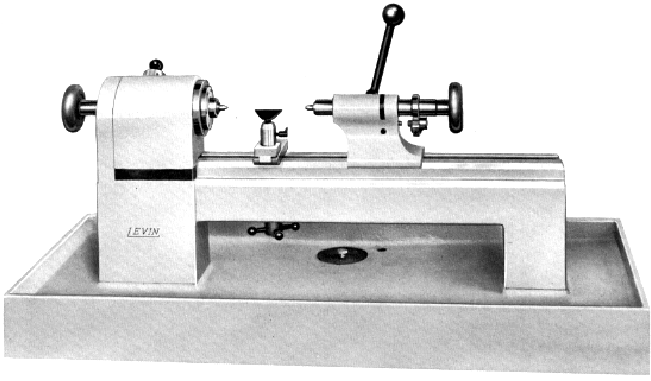
Levin 3.94" swing x 9.5" between centres Heavy-Duty Instrument Lathe - shown without the standard motor-drive unit
The machine was available under Code ACAF to take D Type collets with a maximum capacity of 5.16", or as Code ABMX to accept WW collets with a largest bore size of 3/16".
Standard equipment consisted of:
Rack-feed tailstock barrel with micrometer stop, 2 hard centres mounted on collets, tip-over hand rest, chip tray, bench, variable-speed motor drive and controls.
|
|
|
|
|
|
|
|
 |
|
|
|
|
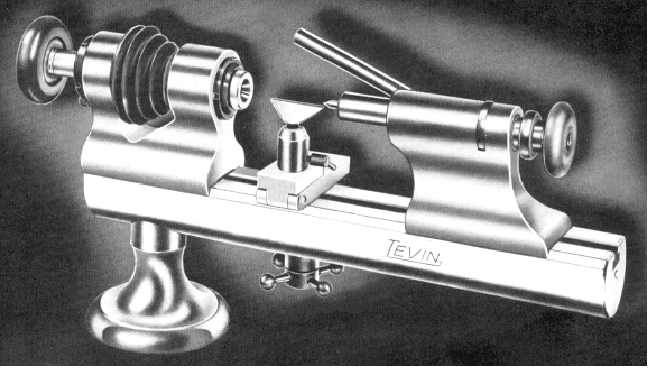
Levin Watchmaker's lathe of 3.94" swing and 3.5" between centres. This particular machine has a ball-bearing headstock and is fitted with a lever-action tailstock barrel.
Besides the ball-bearing headstock, the lathe was available with a choice of two different kinds of plain bearing. Either WW and D type collet fittings could be specified and the lathe bed was mounted on either single or twin supports, depending upon its length.
|
|
|
|
|
|
|
|
 |
|
|
|
|
|
|
|
|
|
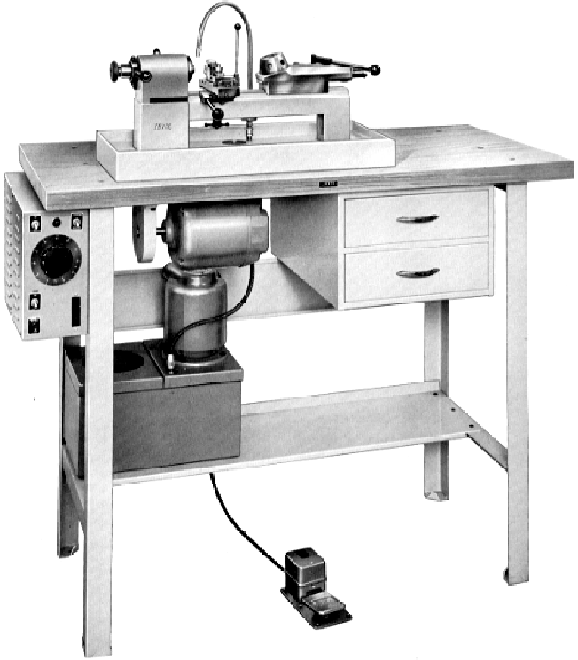
Levin 3.94" swing x 9.5" between centres Heavy-Duty Instrument Lathe with Turret Head and lever-operated Double-tool Slide shown mounted on the maker's underdrive stand with variable-speed motor, coolant unit and electrical control box. The machine was available under Code ACAF to take D Type collets with a maximum capacity of 5.16", or as Code ABMX to accept WW collets with a largest bore size of 3/16". Standard equipment consisted of:
Rack-feed tailstock barrel with micrometer stop, 2 hard centres mounted on collets, tip-over hand rest, chip tray, under-drive bench, variable-speed motor drive and control gear.
Levin Instrument Makers' Lathes
Beautifully made and finished, Levin Instrument Makers' lathes were available in numerous configurations backed by ranges of accessories designed to support various specialist operations. The machines were large and rugged enough to tackle both continuous production work and the heavier classes of instrument turning - yet still retain the fine sensitivity necessary for ultra-precise machining done by hand and eye.
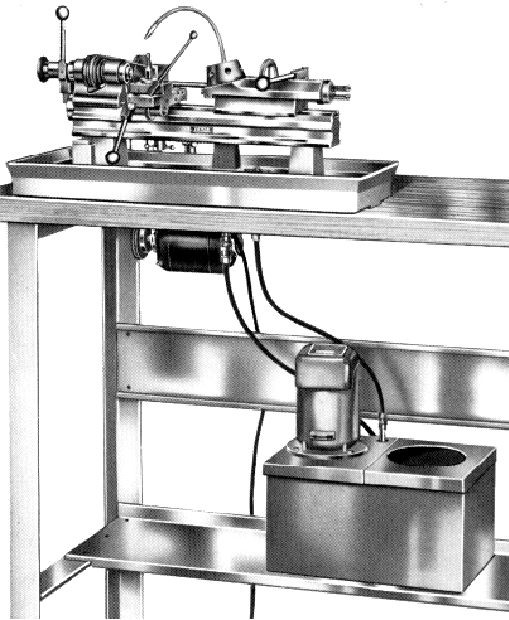
Drive was usually by a single, overhung V-pulley on the left-hand end of the hardened headstock spindle with provision to take the drive downwards to a motor slung underneath the bench - the special Levin stand illustrated below shows how the units fitted together. The motor was often a continuously variable-speed type, fitted with dynamic braking, and able to run at a maximum speed of 4000 rpm. Normal starting and stopping of the motor was controlled by a foot switch, with the speed of the motor controlled by a large rotating knob on the face of the electrical box - which also had switches mounted for reverse and a coolant pump. The standard motor was a 110 volt, 60 cycle 1-phase type.
If one of these lathes is found without the drive system it is a simple matter to rig up either a conventional rear-mounted belt-change countershaft, or employ a heavy-duty motor and its control gear from something like a scrap industrial sewing machine..
|
|
|
|
|
|
|
|
|
|
 |
|
|
|
|
|
|
|
|
|
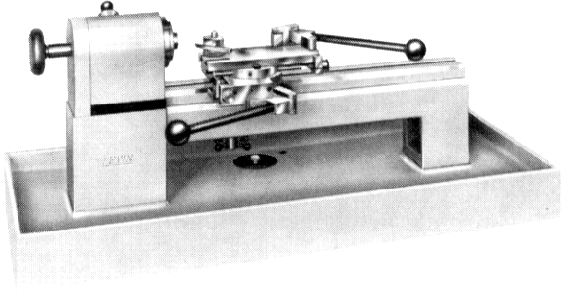
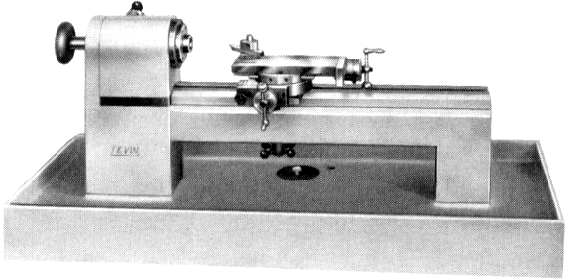
Levin Heavy-duty Instrument Lathe Code ACAF
with the lever-feed slide rest Code ABLX
|
|
|
|
|
|
|
|
|
|
|
|
|
|
|
|
 |
|
|
|
|
|
|
|
|
|
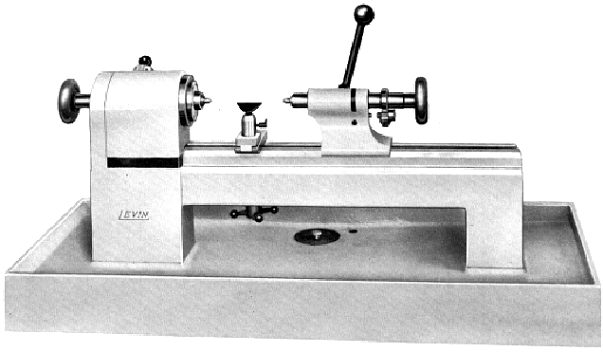
Levin Heavy-duty Instrument Lathe Code ACAF
with the screw-feed slide rest ABLW
|
|
|
|
|
|
|
|
|
|
 |
|
|
|
|
|
|
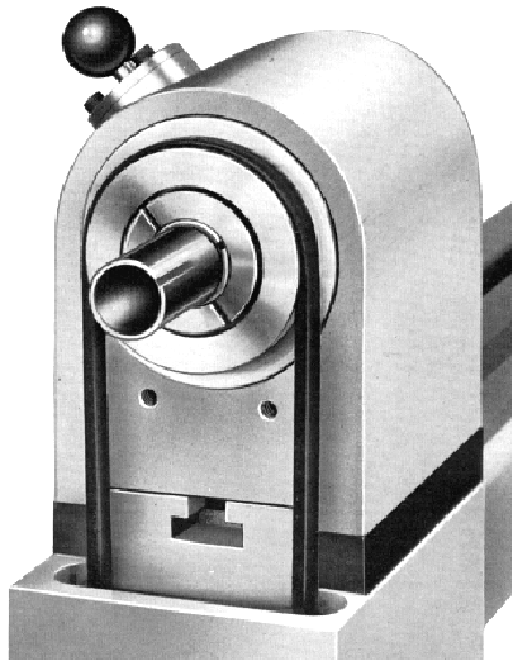
Levin Heavy-duty Instrument Lathe Code ACAF (D collets) or ABMX (WW collets)
|
|
|
|
|
|
|
|
 |
|
|
|
|
|
|
Standard Instrument Maker's Headstock with end cover removed
Headstocks fitted to the Instrument maker's lathes were fully enclosed and fitted with precision ball bearings installed in a pre-loaded condition. The spindle was made from hardened steel and could be specified to take either WW collets, or the larger D type - with either a simple draw-in or Lever-action Collet Closer.
The single V belt from the underdrive motor could be replaced without dismantling the spindle - a great cost saving when the machine is in continuous, professional use.
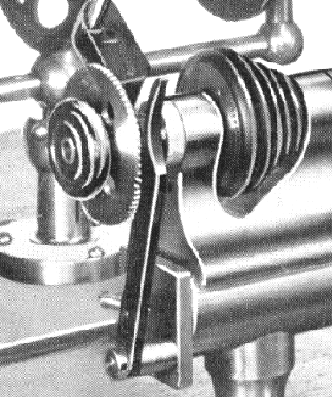
Headstock fittings include Indexing Plates (Code ILSP) and the indexing plate latch (Code ILCO). The indexing plates mount on a central hub, retained by three screws; only one hub is required to mount any of the division plates, which are made to order; the lathe below is shown fitted with a plate having four divisions.
In the case of the open headstock lathes, ready-made plates can be found with the following divisions: 51, 52, 53, 54, 55, 56, 57, 58, 59, 60, 61, 62, 63, 64, 65, 66, 67, 68, 69, 70, 71, 72, 73, 74, 75, 76, 77, 78, 79, 80, 82, 84, 86, 88, 90,
|
|
|
|
|
|
|
|
|
|
|
|
|
|
|
|
|
 |
|
|
|
|
|
|
Indexing Plate (Code ACAD) mounted on its retaining hub (Code ACAA) and the spring-loaded indexing latch (Code ACAB).
|
|
|
|
|
|
|
|
 |
|
|
|
|
|
|
Open Headstock Lathe
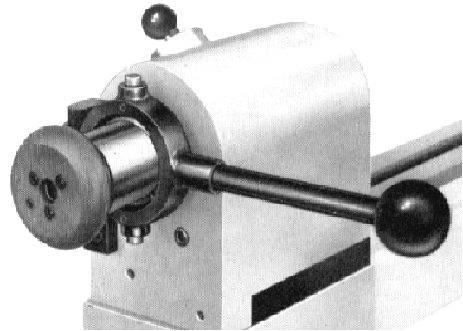
Indexing Plate (set Code ILSP) and the spring-loaded indexing latch (Code ILCO).
|
|
|
|
|
|
|
|
 |
|
|
|
|
|
|
|
|
|
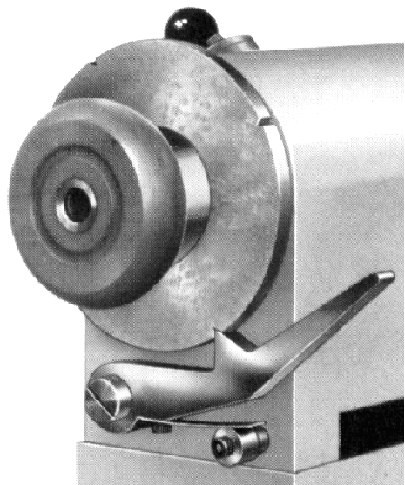
Lever Action Collet Closer - Code ACAO for D Type
collets, and Code ACAN for WW Type lathes
|
|
|
|
|
|
|
|
|
|
|
|
|
|
|
|
 |
|
|
|
|
|
|
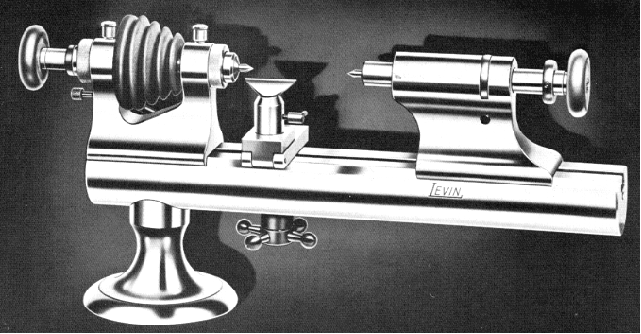
Levin plain cone-bearing "Watchmaker's" lathe
Cone-bearing watchmakers' lathe with 12-inch bed and "push" tailstock barrel.
Code BPCT with WW collets, bronze bearings and push tailstock barrel. Code BLFT with lever tailstock.
Code HPCT with WW collets, Hard-steel bearings and push tailstock barrel. Code HLFT with lever tailstock.
Code ABHM with D collets, Hard-steel bearings and push tailstock barrel. Code ABHN with lever tailstock.
This model was constructed with the long familiar and traditional D shaped bed; the swing was 3.94" and distance between centres either 3.5" with the 12-inch long bed, or 9.5" with the 18-inch bed. The bed was identical in cross section and centre height to other Levin lathes - and so allowed for the economical interchangeability of accessories between them.
Both ball and plain-bearing headstock spindles were available, the latter type with either bronze or hard-steel bearings. The most expensive lathes were fitted with a ball-bearing headstock spindle, the cheapest with bronze cone bearings - the difference in price across the range being some 40%. Whilst the ball-race and hard-steel headstocks could be ordered with either D or WW type collets, the bronze bearing model was restricted to the latter type only.
Tailstocks were offered with either a simple "push" tailstock barrel or one controlled by a lever-operated rack and pinion.
In standard form a conventional tip-up tool rest was the sole fitting on the bed, but a very wide range of superbly made accessories was available, which could turn the lathe into a miniature machining centre.
|
|
|
|
|
|
|
|
 |
|
|
|
|
|
|
|
|
|
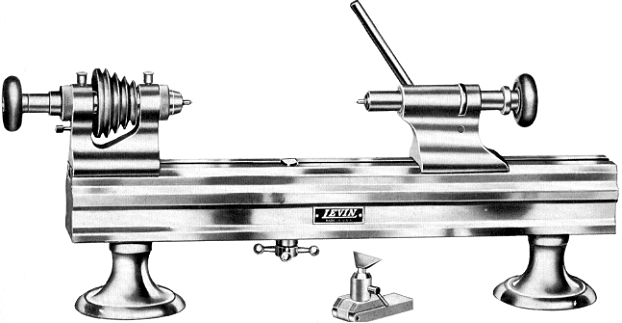
Heavy-type plain cone-bearing headstock lathe with 18-inch bed and lever-action tailstock barrel.
Code ABEM with WW collets, bronze bearings and push tailstock barrel. Code ABEN with lever tailstock.
Code ABER with WW collets, Hard-steel bearings and push tailstock barrel. Code ABES with lever tailstock.
Code ABHR with D collets, Hard-steel bearings and push tailstock barrel. Code ABHS with lever tailstock.
|
|
|
|
|
|
|
|
|
|
 |
|
|
|
|
|
|
|
|
|
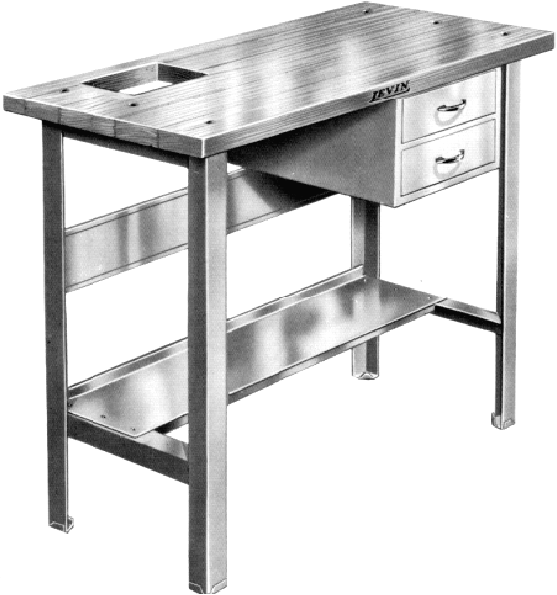
Levin maple-top bench - supplied in knocked-down form for easy of transport.
Levin Stands
The bench (illustrated above) was part of the standard equipment supplied with the Instrument Maker's Lathe - but the Watchmaker's lathes, with open headstocks, can also be mounted on it by using an "AB Type" self-contained motor-drive unit.
Made from 1.5-inch thick maple-wood top, 46" long and 21" wide, the top was available in three different forms to suit the various lathes and their drive systems: a plain without a cut-out; with a cut-out to accept the self-contained motor-drive and with fittings to mount the lathe with a motor-drive unit and chip tray; the 2-drawer fitting was an optional extra.
Self-contained, the motor-drive and countershaft unit with its underslung, resilient-mounted, 1-phase 0.5 HP motor was designed to run a lathe through the most useful and appropriate range of speeds - 350, 600, 950 and 1500 rpm - yet be quickly adaptable by changing pulleys if a faster or slower range was judged more appropriate. A double pulley was available for the motor spindle and countershaft, which generated speeds of: 350, 600, 950, 1200, 1500, 1900 and 3000 rpm. The unit was supplied in two lengths to suit the 12" or 18" bed lathes and included both foot starting and reversing switches.
|
|
|
|
|
|
|
|
|
|
|
|
|
|
|
|
 |
|
|
|
|
|
|
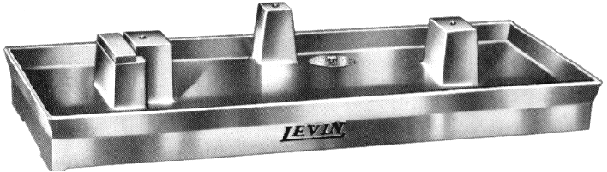
Cast-iron Chip Tray (Code ABJD) designed for the 18-inch bed lathe only. The tray was cast with integral raiser blocks, so requiring the removal of the lathes standard bench feet. Connections and a drain for use with a coolant pump were built in.
|
|
|
|
|
|
|
|
 |
|
|
|
|
|
|
|
|
|
Turret lathe fitted on the cast-iron chip tray and maker's bench with the Coolant system Code ABJE. Note that the lathe bed's standard (round) bench feet have been removed.
|
|
|
|
|
|
|
|
|
|
|
|
|
|
|
|
|
|