|
 |
 |
 |
 |
 |
 |
 |
 |
 |
 |
 |
 |
 |
 |
 |
 |
 |
 |
 |
 |
 |
 |
 |
 |
 |
 |
 |
 |
 |
 |
 |
 |
 |
|
|
|
|
|
|
|
|
|
|
|
|
|
|
|
|
|
|
|
|
|
|
|
|
|
|
|
|
|
|
|
|
|
|
|
|
|
Home Machine Tool Archive Machine Tools For Sale & Wanted E-MAIL Tony@lathes.co.uk
"Smallpeice" Cromwell Precision Lathes An Instruction and Parts Book and the (difficult-to-manufacture) internally-tapered spindle backplates are now available Cromwell Home Page Mk. 1 Cromwell Plain Lathe Smallpiece Multi-cut Lathe Mk. 2 Screwcutting Cromwell
Cromwell Engineering Ltd. were part of the Smallpeice Company - owned by the redoubtable and gentlemanly Mr. Smallpeice - with origins in Pre WW2 Coventry where they had shared a factory with Martonair Ltd. (a maker of pneumatic chucks). Their first lathe, dating from the mid 1930s, was a precision plain-turning type of around 3.5-inch centre height mounted on a massive cast-iron stand with an equally impressive built-on overhead flat-belt drive system. Elements of this lathe - the design of the cross and top slides and tailstock - was carried over to the backgeared and screwcutting Mk. 2 and even to the more highly developed S.800 (in effect a Mk. 3) shown on this page In the same decade Smallpeice also began production of an interesting and useful "Multi-cut" production lathe of American origin from the Reid Brother's Company of Massachusetts. In November 1940 the Luftwaffe flattened Smallpeice's factory, forcing a move to a former dance hall in Parkshot, Richmond, Surrey. Martonair were eventually to build a new factory in Feltham, but the Cromwell/Smallpiece precision lathe (as shown on these pages), whether though necessity due to war-time problems, or by deliberate decision, was built under sub-contract by J. Evans & Son of Portsmouth. Established in Portsmouth in 1920, Evans had their factory commandeered by the Admiralty during the war and were banished to Frome - where they stayed until late 1945. Naturally enough, during the conflict, their engineering skills were turned to war work, including undercarriages for Horsa Mk. 2 invasion gliders, bomb cradles, Halifax undercarriages and numerous other smaller items. It is likely that Evans obtained the Smallpeice work through tender, their managing director writing in December 1944: ….to compete for the production of the Smallpeice lathe we must be careful that our work and the work produced are competitive. This does not necessarily mean low rates. A good quantity of work for a high rate is usually cheaper than a low quantity of work for a low rate. Having received the first lathe built by Evans - in October 1945 - Smallpeice wrote to Evans (on notepaper headed Smallpeice Ltd, branches at Coventry and Bristol England, and Beverly Mass USA): We have already received orders for ten lathes from Turkey, and one from Brazil, and have buyers visiting us shortly from many overseas countries. Our own branch in the USA are confident of being able to send us substantial orders from that country, in spite of competition and duty and also stating that production of this type of lathe ....does in fact form the basis of a new British Key Industry, since the world supply before the war for this particular class of machine was almost entirely met from Germany, Switzerland and to some extent USA.* Our export prospects are therefore excellent. As part of the export drive (an essential component of post war rebuilding) a Cromwell is known to have been exhibited at the June 1946 Paris machine Tool Exhibition. Surviving minutes of Evans' board meetings give no indication that the Smallpeice design was made by anyone other than themselves - though of course all the earlier lathes would have been made by Cromwell Engineering in Coventry - with production ending after the factory's destruction. It is known that the first Cromwell Precision lathe was constructed during July 1945, in Frome, but at the end of that year Evans were able to repossess their works in Goldsmith Lane in Portsmouth and start production in earnest. However, although surviving accounts show that by July 1947 a Cromwell lathes was worth £450 to Evans - the price of a decent family house - even at that figure they were struggling to make a profit. To keep the factory busy - and more profitable - Evans expanded into other fields including such romantic areas as vehicle repairs and the manufacture of machines for making brushes and waxed cartons. Smallpeice had also planned to produce vertical and horizontal milling machines and a grinding machine, although the only mention found of them so far is just stamped on a brochure. Lathe stands were made at the Highland Road works and the lathes at Goldsmith Avenue (the main Evans' works). The stands appear to have been numbered sequentially (can you find yours?) while the lathes were stamped in a series that included all the other Evans' products. Despite careful design and high quality materials the first lathes were not perfect and one of the selling dealers, Herberts (the large machine-tool manufacturers and agents), provided valuable feed-back to the factory. Amongst other things they suggested was that the drive pulleys could not handle sufficient power, the micro-switch to stop the saddle was in the wrong position (this fitting was later abandoned) and vibration from the ball-bearings motors could be cured by the use of plain-bearing Brooks units. They were also critical of the headstock belt tensioning arrangements, asking for improvements to the system so that the action of the knob actually tightened the belt instead of just lowering the motor. Other notes gleaned from contemporary correspondence show that customers were pestering Alfred Herbert for delivery of the established and very successful Hardinge precision toolroom lathes, presumably due to experience of them during the war, and with these in short supply (and very expensive) Herbert must have seen the potential for a home-grown competitor. However, Hardinge were not sitting back, but busy consolidating their position in this segment with the introduction of the superb American and UK-built HLV (later HLV-H) models. A flavour of the hard times might be gauged from the fact that in February 1947 the company were struggling with not only the usual post-war material shortages but also from difficulties with build times - each lathe taking 950 hours to complete against a target of 700. In the company records are many cryptic messages confirming these problems, for example: "The Anglo Iranian lathe was invoiced in January (1947) although it has not yet gone". However, after their new Sheffield-made Snow grinder was installed bed production times not only shortened but (perhaps more importantly) more examples passed through inspection without the need for time-consuming rectification. By April 1947 a total of 90 lathes had been delivered and in May this had risen to 102; unfortunately, by the end of that year the sales were tapering off and it's possible that pent-up demand had been largely satisfied. It took until September 1951 for the 227th lathe to be delivered yet the company were still confident of further orders and undertook to extend production past the planned 300 to 350. Numbers constructed may be summarised as follows: 61 during 1946; 111 during 1947; 47 during 1948 with the remainder (obviously built in small batches) talking until 1955: By 1956 the S800 had been dropped from the range, although records show that in November of that year a few unsold examples still remained in stock. During the post-war years something like 100 Multicut lathes were also built, together with a batch of 20-inch shapers to be sold under the Herbert brand. At some point in the mid 1950s a company called Lancing Tools bought up the manufacturing rights to the S800, so Evans made the very last of the batch for them rather than for Smallpeice. In 1958 Lancing then sought to buy the Cromwell trademark, together with all other tangible assets relating to the lathe, but on the last day of December, 1958, it is recorded that it was Evans, not Smallpiece who had rejected Lancing's offer of £4000. Thus, it would seem that that Evans had already bought the rights to Smallpeicen - who by then had bigger fish to fry being consumed with their interest in Martonair, by then a substantial business that had grown out of an initial involvement with pneumatic chucks and production tooling with a factory based in the village of Marton, near Coventry..
|
|
|
|
|
|
|
|
 |
|
|
|
|
|
|
|
|
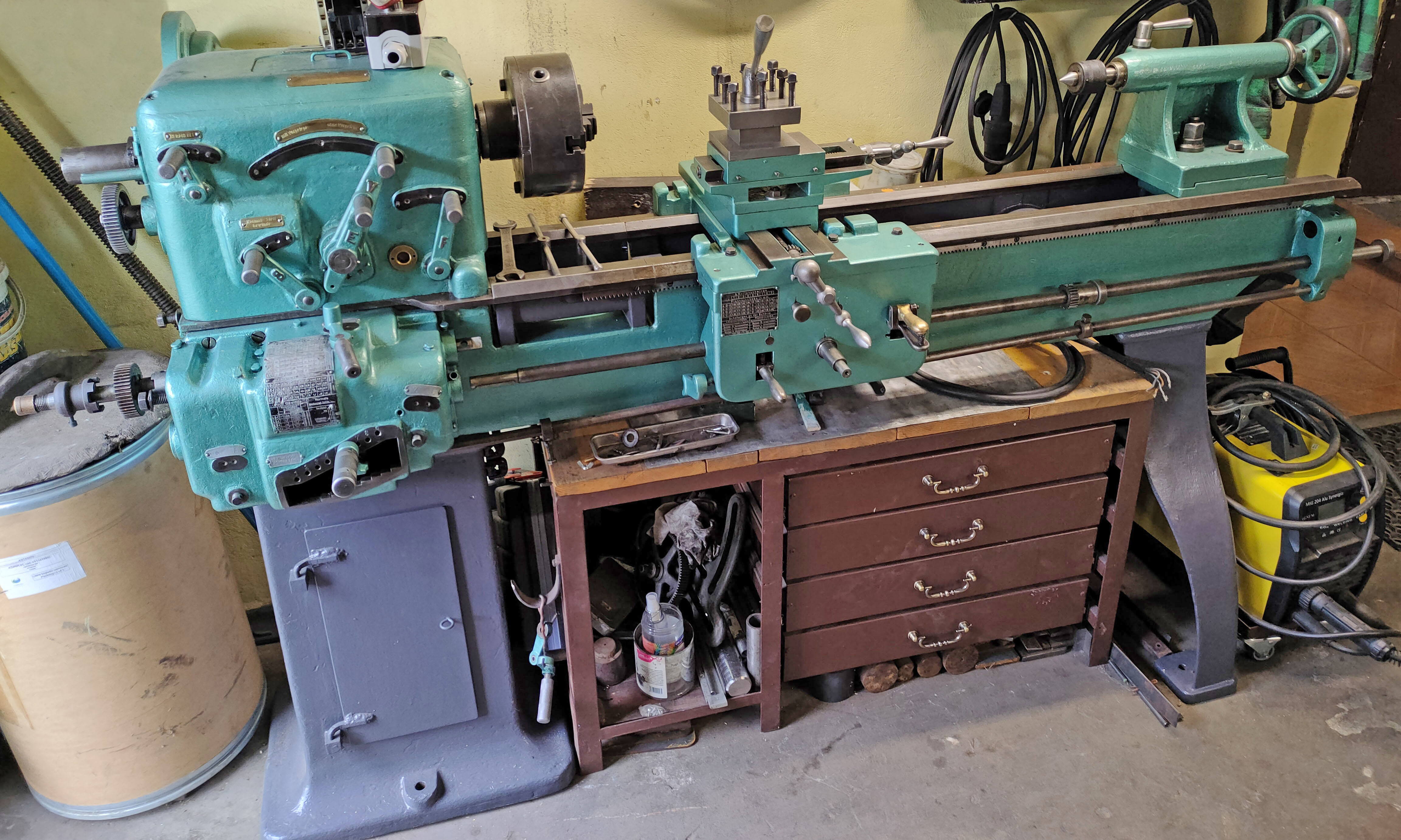
Smallpeice Cromwell S.800 Precision lathe with a rev counter built into the lamp-support tube.
|
|
|
|
|
|
|
|
|
|
|
|
|
|
Continued: The post-war "Cromwell S.S. & S.C. 3.5" x 19" Super-Precision Model S.800", was a very expensive, fine-quality machine designed for use in toolrooms and by instrument, gauge and optical-equipment makers. In 1946 the first machines were advertised at £448 (though few can have been available for delivery) when a Myford ML7 of the same capacity was just £46. As might be expected, the attention to detail and use of fine-quality materials was exemplary - with even the 6 felt wiper housings on the saddle, the vernier scale on the leadscrew handwheel, the end brackets on the cross and top slides the hinges on the changewheel cover being in bronze. Although the lathe and its stand weighed nearly half a ton, almost four times as much as the Myford, it was not designed for heavy-duty roughing work, that would have been done on another lathe and the work transferred to the Cromwell for accurate finishing; even so, in amateur hands, when pressed into general service duty, it will easily outperform any equivalent-sized machine in this respect. The lathe began life in the 1930s as the now very rare Mk.1 flat-belt drive model, developed through the screwcutting (and plain-turning) Mk. 2 to become (with considerable modifications) as the well known and highly-respected Mk. 3 (S.800) with electronic variable-speed drive. The lathe was further developed as a 4-inch centre height "Series 2" with a mechanical variable-speed drive system by the continental manufacturer Prym; in contrast to the often-encountered Mk. 3 this is a very rare model - and few can have been produced. The spindle of the Mk. 3 was driven by a "Ward-Leonard" electrical system that comprised a 3-phase motor attached to a DC generator that in turn supplied current for a DC motor controlled by an early form of electronic variable-speed drive. The result was a step-less speed range, with dynamic braking, from 20 to 2000 r.p.m. as well as a geared range from 3 to 290 r.p.m. The operator controlled the spindle speed with a single black plastic handwheel positioned conveniently to hand on the front face of the stand's headstock-end plinth. Today, unfortunately, very few Cromwells are found with the original electrical system intact for, over the years, as the original components failed, many were fitted with conventional V-belt drive countershaft units. However, now that miniature computer-controlled phase inverters and similar devices are available, it is possible, by using just a single 3-phase motor in place of the DC motor, to completely restore (and possibly improve) all the functionality and wonderful simplicity of the original speed-control system. The final drive to the spindle was by a flat belt, the tension of which could be adjusted quickly and easily by screwing in a large, knurled-edge knob that rose through the chip tray immediately behind the headstock. The headstock spindle was made from nitride-hardened steel, ground and lapped to provide a perfect surface finish; it ran in continuously adjustable, precision plain-bearings of the taper-split type, with internal cones at either end that engaged with cones on the adjusting nuts; this method of construction ensuring that the bearings were held firmly outwards against the taper bore of their housings. The flat-belt spindle pulley, sealed in its own compartment against the ingress of oil and dirt from the backgear assembly, ran on its own, independent ball-bearing sleeve and so removed from the main spindle all effects of belt pull and belt-transmitted vibration. Whilst other manufacturers of precision lathes boasted of finishing the spindle bearings when the headstock had been bolted to the lathe bed, Evans reversed the process and finished the tapered bearing seats first and used those as a datum to mount the headstock on a jig (which replicated the bed mounting) and then machined the headstock casting base relative to the spindle line - the internal taper for collets being ground into the spindle after the lathe was assembled. To enhance rigidity, chucks and other spindle fittings were mounted on a combination of a screw, taper and large-diameter spigot face. The headstock was backgeared with operation by a wheel on the front of the headstock (that disengaged a small gear on the spindle from a surrounding internally geared sleeve) and a second rotary control on top of the headstock by which means the bronze drive gears were slid into mesh with the steel spindle gears. Precision lathes as made by (amongst others): Boley, Lorch (also badged Lorch Schmidt) in Germany, Schaublin in Switzerland and a variety of American manufacturers, foremost of the latter in post war years being Hardinge with their HLV and later HLV-H models, but also including :- B.C.Ames, Derbyshire, Hjorth, Potter Pratt & Whitney, Rivett, Stark, Wade, Waltham Machine Works, Rivett, Cataract, Elgin, Remington, and Sloan & Chace. Continued below:
|
|
|
|
|
|
|
|
 |
|
|
|
|
|
Mk. 3 Cromwell (S.800) Lathe with rear cover removed showing, on the bottom shelf, the 3-phase motor and DC generator and, at the top, the DC motor that drove the spindle by a flat belt.
|
|
|
|
|
|
|
|
|
|
|
|
|
|
|
Continued: Each lathe bed was the subject of considerable attention by skilled craftsmen; the casting was rough machined, seasoned for several months to relieve stresses, machined accurately, hardened and finally ground and hand-finished. Its inspection was rigorous; the maximum permissible error, in convex only, was 0.0002" over the entire length of the ways; the makers claimed to be able to take two beds at random from stock, mount them face to face, and find a variation in flatness of only 0.0001" over their entire length. The bed had, in effect, three V ways: one at the front and one at the back to locate the saddle and another of "truncated" form in the centre with bevelled edges and a flat top (just like that used for the main bed on many precision bench lathes) was used to hold the headstock and tailstock; this arrangement can be seen in the photographs here. Surprising, although the compound slide rest worked very smoothly (especially the 5 inches of top slide movement) its feed screws and micrometer dials were only of modest diameter - although the latter was given a vernier scale engraved into the fixed inner section of the dial assembly. The screw was supported in a bolt-on bracket and, whist cast iron would have sufficed perfectly well for this unit, Cromwell chose instead to use bronze. Power cross feed was fitted as standard, operated by a separate shaft beneath the leadscrew that drove a bronze worm and wheel - the latter with a cone clutch formed in its centre into which was pushed, by a bronze wing nut on the face of the apron, a steel gear that meshed with a gear on the cross-feed screw. Unfortunately, if the faces of the clutch became polished, it could be almost impossible to apply enough pressure on the small wing nut to keep the drive engaged. Carefully thought out, the design of "magazine" screwcutting gearbox offered the same wide range of threads and quick operation of a conventional unit yet managed to eliminate the usual open slots in the front (through which dirt could enter) and allowed the its tumbler gear to run in an oil bath. A rotary dial selected four sliding and surfacing speeds that could be engaged instantly for every position of the main tumbler - whilst a lever (just inboard of the point where the leadscrew entered the box) could be used to switch immediately from fine to coarse feed. Complete with English, BA and metric sections the screwcutting chart was engraved into a thick brass plate mounted on the inside face of the changewheel compartment's hinge-open cover. Instead of the usual split-nut to engage the leadscrew, the apron carried two 'solid' nuts, spaced well apart and adjustable relative to one another, as in a micrometer, to compensate for wear and to eliminate backlash. Two handles were fitted to the saddle traverse, one at each end of the leadscrew (working through worm-and-wheel gearing) with a large 0.0001" vernier scale dial at the right hand end to assist in the accurate turning of shoulders and other lengths and a smaller dial on the headstock-end handwheel. The leadscrew (1-inch diameter by 4 t.p.i. or 6 mm pitch Acme-form) was known to hold true to within 0.0005" over twelve inches - and, if necessary, a lathe could be provided with a N.P.L. certificate guaranteeing the accuracy of the screw to within 0.004" over its full length of thirty inches - however, the normal accuracy over this length, as shown on factory test certificates (where each lathe was individually checked against a N.P.L. master leadscrew) was actually better, at just 0.002". Unlike a conventional lathe there was no quick-action rack feed fitted to the carriage and, when moved under hand control, the leadscrew had to do the work; a separate power shaft was fitted to drive the standard-fit power cross feed. Using cast-iron for its chip tray and floor base the cabinet stand was fitted with heavy-gauge, plate-steel ends and sheet-steel side panels; as the slatted tool cabinet cover on the right hand side was lifted, a light came on to illuminate the inside; even the tool tray itself was not allowed to escape the designer's attention to detail: each spanner and key slotted into its own milled and named recess and, as the tray was withdrawn, it angled downwards to present its contents to the operator. Supplied with each lathe was a dividing plate and indexing plunger; a headstock collet draw-tube with a centre formed on the end of a solid collet; drive plate, tailstock centre, adjustable saddle stop, a light unit, tool tray and tools, a single-tool tool post and "left and right-hand tool rests". Rolls Royce bought numbers of these machines for their tools rooms, and it is not unusual to find their label, or that of NCR (National Cash Registers), Metal Box or various aircraft companies adorning Cromwell lathes. A now-rare Mk. 1 version of the S.800 was also built (and illustrated at the bottom of the page) as well as a simple 3.5" centre height plain-turning lathe with an open 3-speed flat-belt drive. One of the latter is known to have survived in a dismantled condition, and photographs may become available. If you have, or know of, either of these types of early Cromwell lathes, or have access to any Cromwell or Smallpiece literature, the author would be pleased to hear from you..
|
|
|
|
|
|
|
 |
|
|
|
|
|
|
|
Cut-away section of screwcutting gearbox.
|
|
|
|
|
|
|
|
|
|
|
 |
|
|
|
|
|
|
Compound slide rest detail. The bronze wing nut on the apron engaged the power cross feed.
|
|
|
|
|
|
|
|
 |
|
|
|
|
|
Section through the headstock
|
|
|
|
|
|
|
|
|
|
 |
|
|
|
|
|
|
The writer's own Cromwell S.S. & S.C. 3.5" x 19" Super-Precision Model S.800
|
|
|
|
|
|
|
 |
|
|
|
|
 |
|
|
|
|
 |
|
|
|
|
|
The drive pulley was contained within its own compartment sealed against oil and dirt. In this picture the headstock spindle is locked for direct drive with the internally-geared sleeve (moved by the bronze lever) in position over the smaller spindle gear.
|
|
|
|
|
|
|
 |
|
|
|
|
|
|
The sleeve slid back to expose the smaller spindle gear
|
|
|
|
|
|
|
 |
|
|
|
|
|
|
|