|
 |
 |
 |
 |
 |
 |
 |
 |
 |
 |
 |
 |
 |
 |
 |
 |
 |
 |
 |
 |
 |
 |
 |
 |
 |
 |
 |
 |
 |
 |
 |
 |
 |
 |
 |
 |
 |
 |
 |
 |
 |
 |
 |
 |
 |
 |
 |
 |
 |
 |
 |
 |
 |
 |
 |
 |
 |
 |
|
|
|
|
|
|
|
|
|
|
|
|
|
|
|
|
|
|
|
|
|
|
|
|
|
|
|
|
|
|
|
|
|
|
|
|
|
|
|
|
|
|
|
|
|
|
|
|
|
|
|
|
|
|
|
|
|
|
|
|
|
|
|
|
|
E-MAIL Tony@lathes.co.uk Lathes.co.uk Home Page Machine Tool Archive Machine Tools For Sale & Wanted Machine Tool Manuals Machine Tool Catalogues Belts
Zyto Lathes - by Tyzack Tyzack Model F
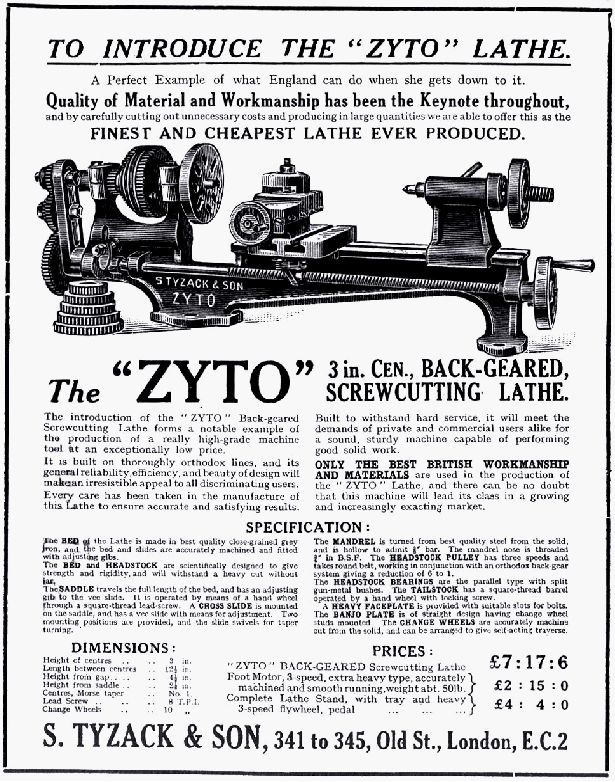
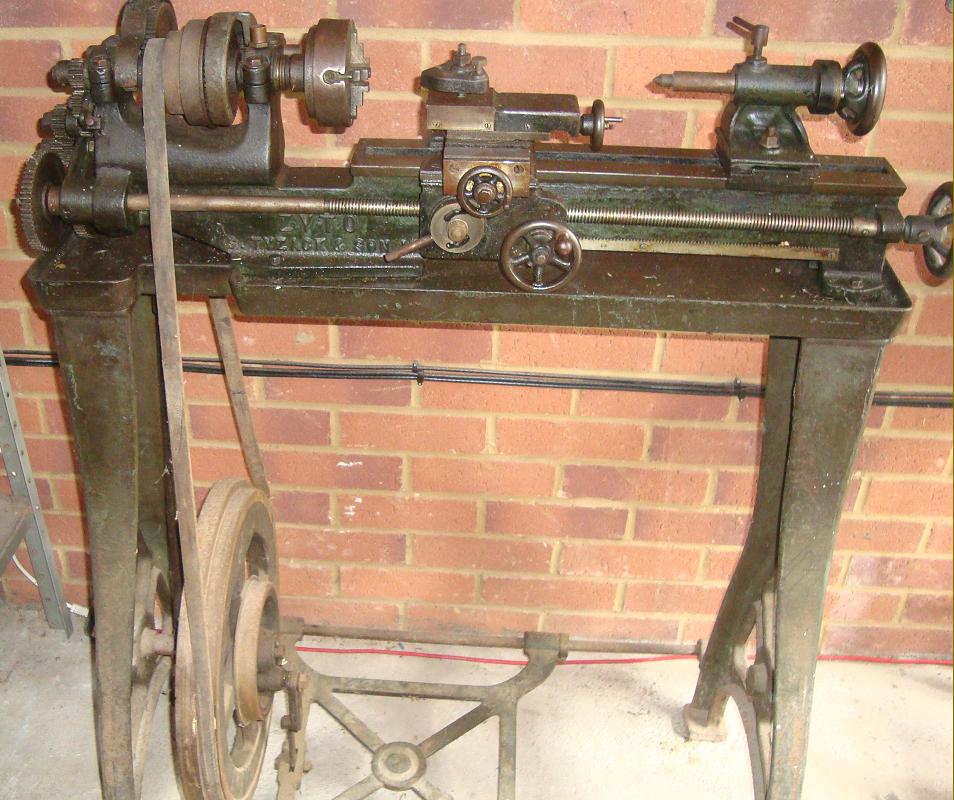
Produced in several forms from the late 1920s until 1959, the Zyto brand was marketed by S. Tyzack & Sons of 341, 343 & 345 Old Street, Shoreditch, London, a large retail mail-order company. Established in 1843, Tyzack not only supplied a vast range of engineering equipment, but also common household goods of all descriptions. Although the final advertisement for the Zyto lathe appeared in the model-engineering press during December 1959, sales trickled on into 1970s as stocks were used up. Ted Jolliffe, later to become editor of Model Engineer Magazine, owned a Zyto and recalls visiting the works in the early 1970s when serving as a policeman. Curious that a "copper" was keen on engineering, they took him under their wing and showed him round what was left of the factory, then down to two employees, with one acting as foreman - a situation mirrored almost exactly at the Portass lathe works 160 miles to the north in Sheffield. Several items of woodworking machinery were under construction, possibly on a sub-contract basis. The basement held a good stock of raw bed castings and in the fitters' shop, under the railway arches, were stored enough spares to enable the manufacture of many more late-model lathes. Although all the castings had been sourced from an outside foundry, machining and building operations were kept completely in-house. On one visit, the MD pulled the covers off a long-bed lathe that, although it had never progressed beyond the prototype stage, had, he said, been loaned to Cowells, who were considering revamping the design and putting it into production. Looking to the future, Ted acquired a number of parts, at a suitably large discount, that keep his lathe running well into the 21st century. While "Zyto" lathes had, generally, a very mixed pedigree, the origins of the breed can be traced back to a 1926 Model Engineering Exhibition advertisement for the Billing Tool Company of 101 Clerkenwell Road, London, who offered a range of items for the model engineer including bench drills, 3-jaw chucks and a fast-and-loose-pulley driven Universal Sawing, Boring and Grinding Machine. However, their most important product was the B.T.C. "Supreme", a simple little 3" x 12" gap-bed, backgeared and screwcutting lathe with a full-nut leadscrew, dog-clutch and a single swivelling (but distinctively T-slotted) tool slide. In 1927 Tyzack took a stand at the same exhibition and, obviously seeing some potential in the design, announced the acquisition of the Billing company and the re-branding of the B.T.C. Supreme as the "Zyto". The machine was described as "The latest all-British Production" and available for £7 : 16 : 6d, exactly one shilling less than Billing's price the previous
|
|
|
|
|
|
|
|
 |
|
|
|
|
|
|
|
|
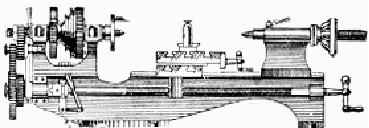
The only known publicity picture of the B.T.C. 3-inch lathe as it appeared in 1926.
|
|
|
|
|
|
|
|
|
|
|
|
|
|
A year later the price of the B.T.C. Zyto had risen to £8 : 2 : 6d, but this did include, due to the increasingly difficult economic conditions of the time, interest-free terms for what was referred to, in the gentlemanly terms of the day, as "deferred payments". Despite their new model, in late 1927 Tyzack announced yet another Zyto, at £7 : 17s : 6d , a 3" x 12" gap-bed, backgeared and screwcutting type - but this time made by Portass in Sheffield. However, the original continued in production - with the re-badged Portass continuing to be offered alongside it throughout the 1930s - with little or no changes to its specification. However, by 1937, the specification was becoming very dated and a thoroughly revised version was introduced, probably shortly after the new "Super" went on sale. Although both early and late models are easily recognised (and the latter commonly encountered today though the former is rare) there were also two other types that sometimes lead to confusion: the smaller was a backgeared, gap bed, screwcutting version of what was to become the 3-inch centre height and 13 or 18-inches between centres Portass Model S and a larger model, probably only sold during the mid 1930s, the "Super Zyto" - a machine with its bed and headstock cast as one (the "Super" name was revived for a short time during the 1950s when it was applied to a version with 16 inches between centres). Although the "Super" offered no improvement on the 3-inch centre height or between-centres capacity of the ordinary Zyto, it did incorporate numerous improvements including a compound slide rest, set-over tailstock, clasp nuts on the apron and a quick-feed rack-and-pinion drive to the carriage. The Super Zyto was also manufactured for Tyzack by Portass in Sheffield and, although it never appears to have been sold badged as a Portass, it can be identified amongst the company's products in the bottom right-hand corner of the only known picture of the complete Portass range. In the mid 1930s the ordinary Zyto cost £8 : 2 : 6d, and the "Super" £9 : 9 : 0d, if a compound slide rest was added to the former to more nearly match the specification of the latter, its total cost became three shilling and sixpence greater - and not such a bargain. As an interesting comparison, and an indication as to why it was so popular, the Myford ML2 (a 3" x 15" machine with a specification almost identical to the "Super") was offered at the same time for just £6 : 7 : 6d - a substantial 33% saving. Various other lathes branded Zyto, both larger and smaller, were also listed in Tyzack's general catalogue during the 1930s, but these would have been bought in for resale and disappeared from later additions. The smallest shown was the Model F, a version of the simple, plain turning Sheffield-made Flexispeed; this was marketed both as the Tyzack Model F and the "Small" Zyto with some advertisements offering that this machine with the same double-reduction worm-and-wheel gearing fitted to the Flexispeed.. Tyzack were not above mixing and matching parts from their other ranges of lathes, notably the larger IXL models, and occasionally a Zyto lathe will be found with a headstock, or other components, marked IXL. One Zyto, with a quite different (possibly home-fitted) saddle and compound slide rest has also been discovered carrying a badge with the letters "Leizure" arranged in a diamond-shaped form - but, again, no further details are known. Continued below:
|
|
|
|
|
|
|
 |
|
|
|
|
|
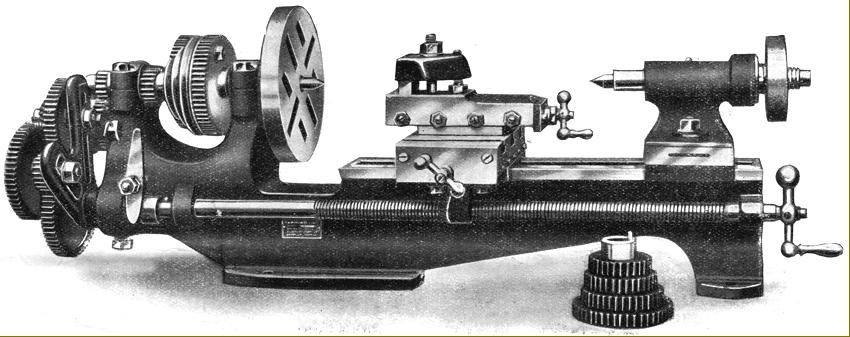
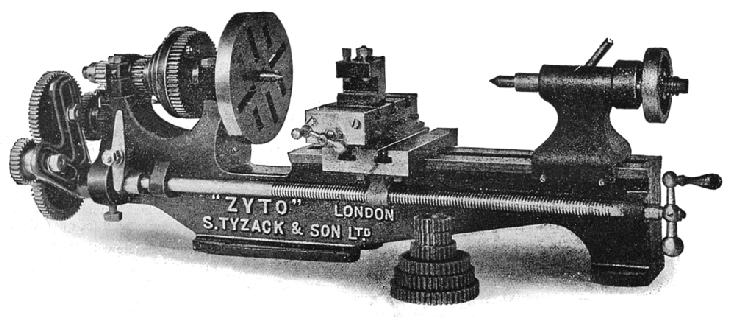
The now rare early Zyto as developed from the original 1927 B.T.C.
|
|
|
|
|
|
|
 |
|
|
|
|
|
|
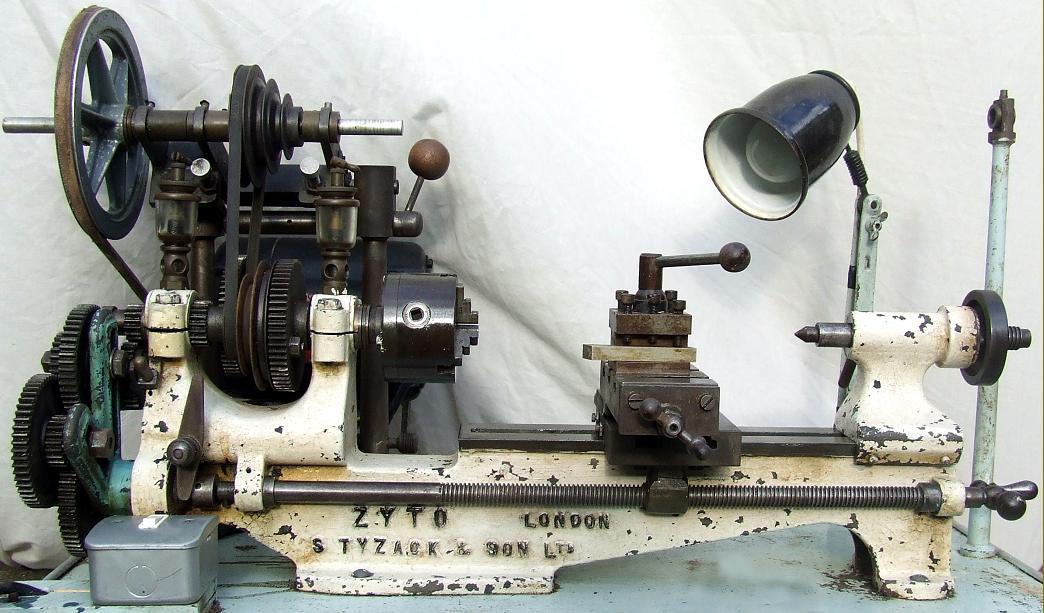
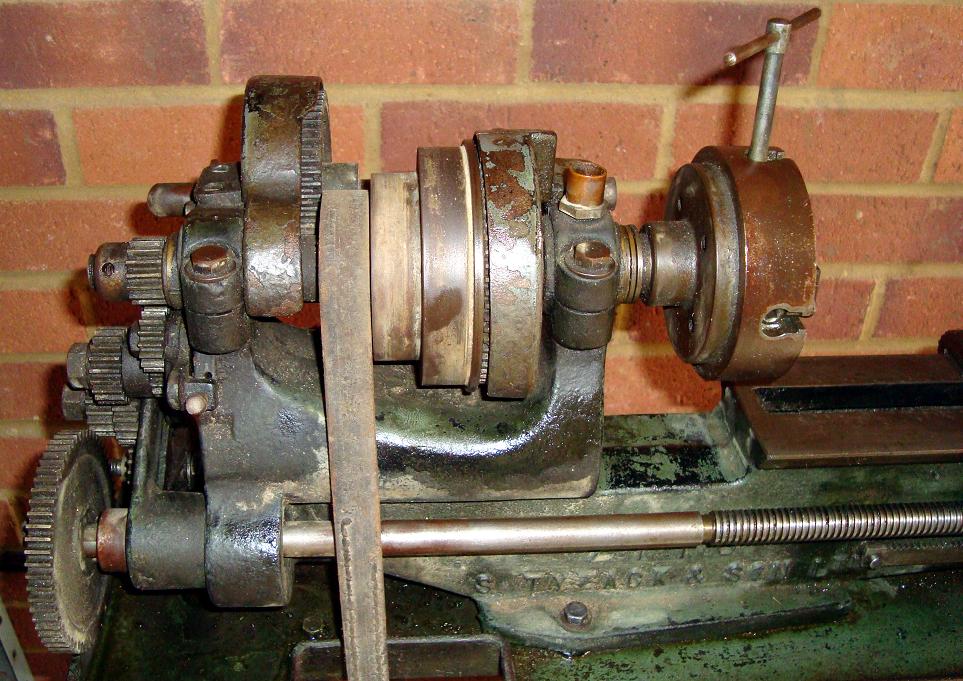
Non-original but essential headstock bearing drip lubricators
|
|
|
|
|
|
|
 |
|
|
|
|
 |
|
|
|
17 March 1927 and the new backgeared and screwcutting Portass/Zyto is announced. This model was a considerable advance on previous Portass models and might be considered the first Portass not to have completely compromised quality on the alter of cheapness.
|
|
|
|
|
|
|
 |
|
|
|
|
|
|
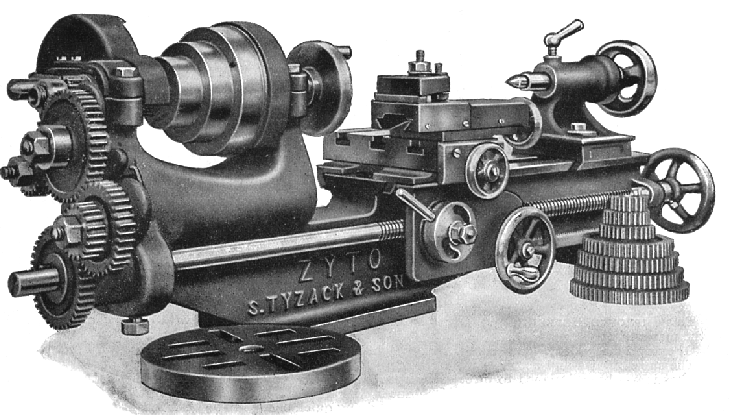
Late 1920s to late 1930s "Standard" Zyto with bed and headstock cast as one Although dimensionally very little different to the "Super", the "Standard" 1920s and 1930s Zyto model-engineer's lathe had many detail differences in comparison with its slightly more expensive brother: a 3-step round-rope "gut" drive was used on the headstock instead of a flat belt, the leadscrew nut was "full" (so demanding a dog clutch on the leadscrew to disengage the drive) the slide rest was a single swivelling type sitting on a saddle formed as a T-slotted boring table (though a compound rest could be specified for an additional £1 : 10 : 0d) the tailstock handwheel was turned from the solid and had rather sharp edges while the handwheel on the end of the leadscrew was, for some unaccountable reason, a proper "balanced" type that must have been considerable more expensive to manufacture than a simple wheel. The range of accessories and drive systems was identical to that provided for the "Super". Continued below:
|
|
|
|
|
|
|
 |
|
|
|
|
|
|
The "Super Zyto" of the 1930s Possibly made for them by Portass (though some elements of the lathe do not reflect that Company's normal practice) this version of the Zyto had bed and headstock cast as one with a centre height of 3 inches either 13 or 18 inches between its No. 1 Morse taper centres. The spindle was bored through with a 3/8" hole and ran in split, parallel gun-metal bushes with a ball-race for thrust. The conventional backgear that reached across the length of the headstock slid into engagement and had a ratio of 6 : 1; combined with the 3-step pulley for 5/16" wide flat belt, and using the standard motor-driven "fast-and loose" countershaft (£2 : 15 : 0d without motor) this would have given 6 spindle speeds from around 25 to 600 rpm. The makers offered both a cast-iron stand with a chip tray and treadle-powered flywheel (£4 : 4 : 0d) and a 3-speed "Foot Motor" (£2 : 15 : 0d) a self-contained flywheel assembly that could be mounted below the customers bench to provide a man-powered drive driven stand. When the final version of the standard Zyto was announced in 1937 (see the 1939 advertisement below) the centre height had been increased to 3 .375", a proper compound slide rest assembly was fitted (with a T-slotted cross slide, but still lacking micrometer dials) the dog-clutch on the leadscrew was replaced by clasp-nuts on the apron (with a handwheel n the leadscrew at the tailstock end) a tumble-reverse assembly fitted to the changewheel drive. Of course, with the full-nut on the apron gone, it was now possible to fit a quick-action rack-and-pinion hand drive to the carriage feed. The revised model was initially available with a very well designed but complex and expensive-to-produce self-contained countershaft fastened to a modified version of the cast-iron stand and complete with a Metro-Vickers motor fitted with a switch on its terminal box. Unfortunately, at £19 : 10 : 0d, this stand doubled the price of the lathe and there can have been few takers for a machine designed for the impecunious end of the market. Although some cheap lathes used weak, as-cast iron gears the Zyto came complete with a set (2 x 20, 25, 30, 35, 40, 45, 50, 55, 60 and 65 teeth ) of properly cut changewheels mounted on a twin-slot bracket and able to generate most common English threads; a 63t wheel that would have given an approximate translation to metric screwcutting was an extra 7/6d. Typical of the time for a small English lathe the cross slide was T-slotted, though its travel was very limited and thus its use as a miniature boring and milling table limited. The toolpost was of the usual triangular-clamp type, being simple but effective, whist the proper square-thread 10 t.p.i feed screws of both top and cross slide were, unfortunately, devoid of micrometer dials. With the ability to be set over for taper turning the tailstock now carried a 5/8" diameter, ungraduated barrel with a No. 2 Morse taper and a square thread that ran though a cast-iron handwheel. Although shown with backgear guards in place, these were (on pre-war models) an extra costing 7/6, the same price as the rarely-specified changewheel guard. Continued below:
|
|
|
|
|
|
|
 |
|
|
|
|
|
|
Revised Zyto as produced from 1937 onwards 3.375" x 12" with separate headstock and many significant modifications Continued: This model shown above, as manufactured during the early 1950s, is without the changewheel guard cover fitted as standard during the very last years of production - but does have the rare plastic handwheels. Although the (still) ungraduated compound slide-rest feed screws and unguarded changewheels and headstock backgears were pretty much standard fare on small, pre-WW2 lathes, by the early 1950s such deficiencies were very much less common and made the lathe look irredeemable old-fashioned. For the final years of production graduated dials were introduced, as well as decent cast-aluminium belt guards, but these latter were no mere lash-ups as used by many manufacturers: the headstock casting was changed to allow the fitting of a substantial retainer to locate the front of the snug-fitting belt cover and the changewheel guard was held by a single but very large diameter stud. Although not in the Myford ML7 category for versatility or capacity, the Zyto filled an important niche and it was nine years before Myford saw the gap in the market and offered (from November 1968) the similar-sized (but non-gap bed) ML10. Continued below:
|
|
|
|
|
|
|
 |
|
|
|
|
|
|
Circa 1937 to 1940 Zyto on an expensive stand originally supplied by the makers for use with a treadle-driven flywheel - note the cut-out in the front face of the cast-iron chip tray
Continued: When the "final" version of the ordinary Zyto was announced, in 1937, the centre height had been increased to 3 .375" (33/8"), the changewheel mounting bracket angled rearwards instead of forwards and there was a possibility that the DP of the gears had been finer to allow a wider range of pitches to be generated . The spindle was increased in diameter to 1-inch and the nose thread was changed from a rather inadequate ¾" by 12 t.p.i. to a slightly more robust 7/8" by 9 t.p.i. Unfortunately, quality control of the headstock was not all it might have been (despite much puff about such matters in the advertisements) and on many examples there was a failure to machine the inside of the left-hand bearing housing. If this face had not been used a simple thrust face it would not have mattered, but it was, and did. If one part of a Zyto is going to show signs of serious wear it will be the front headstock bearing; fortunately, the spindle and bearings are very simple to remanufacture and rectification should be within the compass of any decent machine shop. The lathe was initially available with a very well designed (but complex and expensive-to-produce) self-contained countershaft fastened to a version of the cast-iron treadle stand. The unit (which resembled that used on the light stand for the contemporary Myford ML2/ML4 range) consisted of a thick cast-iron slab that bolted to the underside of the chip tray; at the rear two stout arms rose to end in circular bearing housings pierced by pairs of opposed studs that acted as both bearing locators and alignment adjusters. Although this was a very long-established idea, its first use on a mass-produced lathe appears to have been on the Pre-WW2 American Atlas. Although the drive to the lathe headstock was by a flat belt, the Metro-Vickers motor, slung beneath the tray, used a V-belt to drive upwards to the countershaft. Unfortunately, at £19 : 10 : 0d, this assembly doubled the price of the lathe and there can have been few takers for a machine designed for the impecunious end of the market. The lathe was also offered in a 30-inch between-centres version, a huge increase on the usual capacity of just 121/2-inches. If specified as a long-bed model the price rose by an extra £2 : 6 : 2d. In February 1940, with World War Two underway, the last Zyto advert until 1950 appeared, though it might be safely assumed that, to satisfy a huge demand for small machine tools from the amateur market, production would have resumed during 1947 or 1948 With buyers clamouring to get their hands on any sort of small lathe, and with an 18-month waiting list for a new Myford ML7, Tyzacks rightly did not bother to spend money on publicity until demand had died down. The first post-war advertisement was timed to coincide with the 1950 Model Engineering Exhibition and revealed that the post-war version of the lathe had been given a useful No. 2 Morse taper tailstock, a longer cross slide with an additional T slot together and an increase in price to £25 : 10 : 0d -- a figure that compared very favourably with the £39 : 17 : 6d being asked for the comprehensively guarded, all-V-belt-drive and much more modern-looking (though hard-to-obtain) ML7. With the latter available on a neat sheet-steel cabinet stand, in a ready-to-run state with motor and switch for £61 16 : 6d, Tyzack responded by offering a motorised version (on what must have been a rehashed pre-war cast-iron) stand for £44 : 10 : 0d. There was no mention of the pre-war 30-inch between-centres' option. An interesting point about the display model at 1950 Model Engineering Show was its plastic handwheels; with the adoption by the Acorntools Company of plastic headstock pulleys and changewheel guards for their Sphere and Halifax Atlas 10-inch clones this small step by Tyzack must have been only a short-lived experiment - only a couple of Zytos so equipped have been seen by the writer amongst the many encountered.. In the late 1940s and 1950s the lathe was again offered in a motorised version, but this time on a custom-made cast-iron stand with a straight edge to the front of the chip tray. However, instead of being bolted directly to the underside of the chip tray, the motor was mounted on a hinged plate in line with the countershaft with the latter carried on a pair of upswept arms. Although never mentioned in any advertisement seen by the writer the makers also supplied a heavily-built, cast-iron bench-mounted countershaft unit that carried the electric motor on its rear face. Before the lathe finally ceased production, in 1959 a few minor changes were made: by 1951 the tumble reverse lever was being located by a pin and hole (instead of pin and slot) and in 1954 a long-bed version, the "Zyto 16" was announced with (naturally enough) 16-inches between centres and a longer cross slide with 5 T-slots. While the standard lathe cost £28 : 1 : 0d the long-bed version was considerably more - £35 : 15 : 2d. As indicated before, with its flat-belt drive and old-fashioned appearance, sales must have fallen off steadily during the late 1950s and the last advertisement appeared in Model Engineer Magazine during 1959, when the price had risen to £33 : 0 : 0d for the shorter bed type and £40 : 3 : 0d for the longer. Even thought these were bargain figures for a new small lathe (when an ML7 had risen to £67) model engineers must have realised that the more expensive machine gave a far better return for their money in terms of performance, retained value - and pride of ownership..
|
|
|
|
|
|
|
 |
|
|
|
|
|
|
|
|
|
August, 1939 the month before the start of Word War 2 and Tyzack advertise their long-lived Zyto lathe
|
|
|
|
|
|
|
|
|
 |
|
|
|
|
|
|
1953 and Tyzack advertise a lathe essentially unchanged during its last 18 years of production. The description "Super" was sometimes applied to the 16-inch version
|
|
|
|
|
|
|
 |
|
|
|
|
|
|
|
Zyto Guards and Countershafts Made between 1949 and 1952 this Zyto shows the type of guards available during the final years of production. These were no mere lash-ups, as used by many makers of inexpensive small lathes, but properly constructed items in cast aluminium headstock with the headstock casting modified to allow the fitting of a substantial stud to locate the front of the belt cover and the changewheel cover held by what some might described as a generously over-sized fitting. The heavily-built, cast-iron bench-mounted countershaft had the motor bolted to its rear face. The writer has yet to discover a Zyto advertisement where this unit was listed.
|
|
|
|
|
|
|
|
|
|
|
 |
|
|
|
|
|
|
|
|
|
|
 |
|
|
|
|
|
|
The cover removed showing, for a small lathe, the relatively coarse-pitch changewheels
|
|
|
|
|
|
|
|
|
|
 |
|
|
|
|
 |
|
|
|
|
Motorised Zyto Rear view of the Zyto countershaft unit and motor arrangement as manufactured in 1939. Later versions were completely different with a redesigned, straight-edged chip tray, the motor mounted on a hinged plate and the countershaft carried on a pair of upswept arms.
|
|
|
|
|
|
|
|
|
 |
|
|
|
|
|
|
|
Although the cast-iron legs and chip tray were retained, the motorised versions of the Zyto produced in the late 1940s and early 1950s were arranged in a completely different way to the pre-war versions. The motor was mounted on a hinged plate in line with the countershaft with the latter carried on a pair of upswept arms. If you have one of these lathes the writer would be interested to hear from you.
|
|
|
|
|
|
|
|
|
|
|
 |
|
|
|
|
|
|
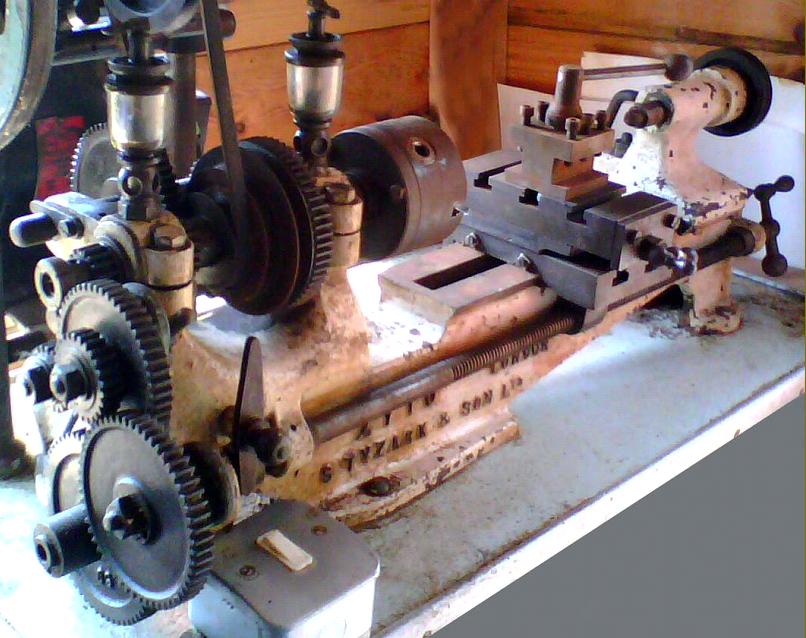
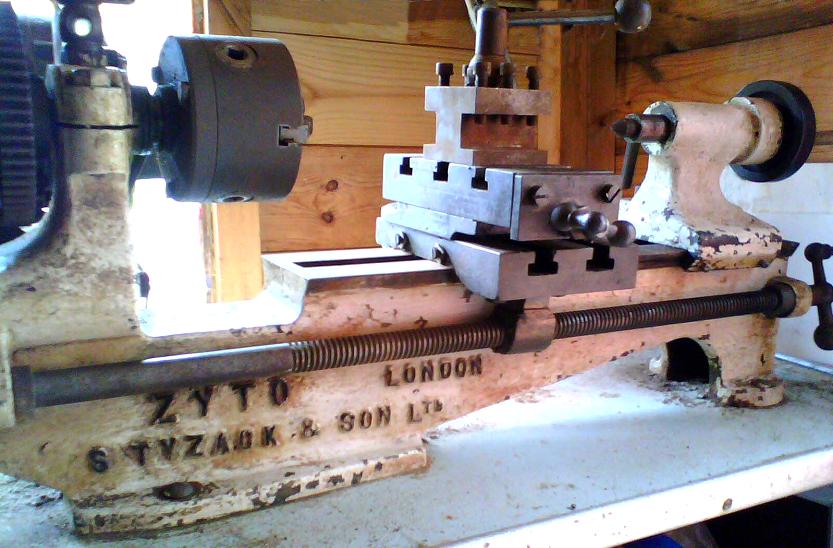
Another example of the early "Zyto" B.T.C.
|
|
|
|
|
|
|
|
|
|
 |
|
|
|
|
 |
|
|
|
|
|
|
|
|
|
|
 |
|
|
|
|
|
|
The "Baby Zyto" (2.125" centre height by 10" between centres) was an attempt to produce a really simple little lathe but, during the 1920s and 1930s, it was in competition with many others and, despite costing only £2: 7 : 6 against the £8 : 2 : 6 of its bigger brother, few can have been sold and today is a very rare find. The lathe was manufactured in Sheffield by Portass.
|
|
|
|
|
|
|
|
|
|
 |
|
|
|
|
|
|
Larger Zyto The 5" x 24" Zyto lathe was of conventional construction with a deep gap in the V bed, screwcutting with tumble reverse and a compact backgear system engaged by a lever which can be seen protruding below the faceplate. Power cross feed was fitted and the lathe was available for bench mounting (with a countershaft unit) or on the treadle stand illustrated; the saddle was T slotted. From its published description the lathe would appear to have been both well specified and equipped - and cost a little over three-times as much as the 3.375" model. The photographer obviously knew little about centre-lathe practice - witness the fully-forward position of the top slide. This lathe was also marketed using the IXL brand name and would almost certainly have been made by Ehrlich in Germany.
|
|
|
|
|
|
|
|
|
|
 |
|
|
|
|
|
|
The same lathe but fitted to a stand with the motor enclosed within the left-hand cabinet leg. The drive to a flywheels was a fad of the 1930s and resulted in a lathe was exceedingly slow to stop from high speeds.
|
|
|
|
|
|
|