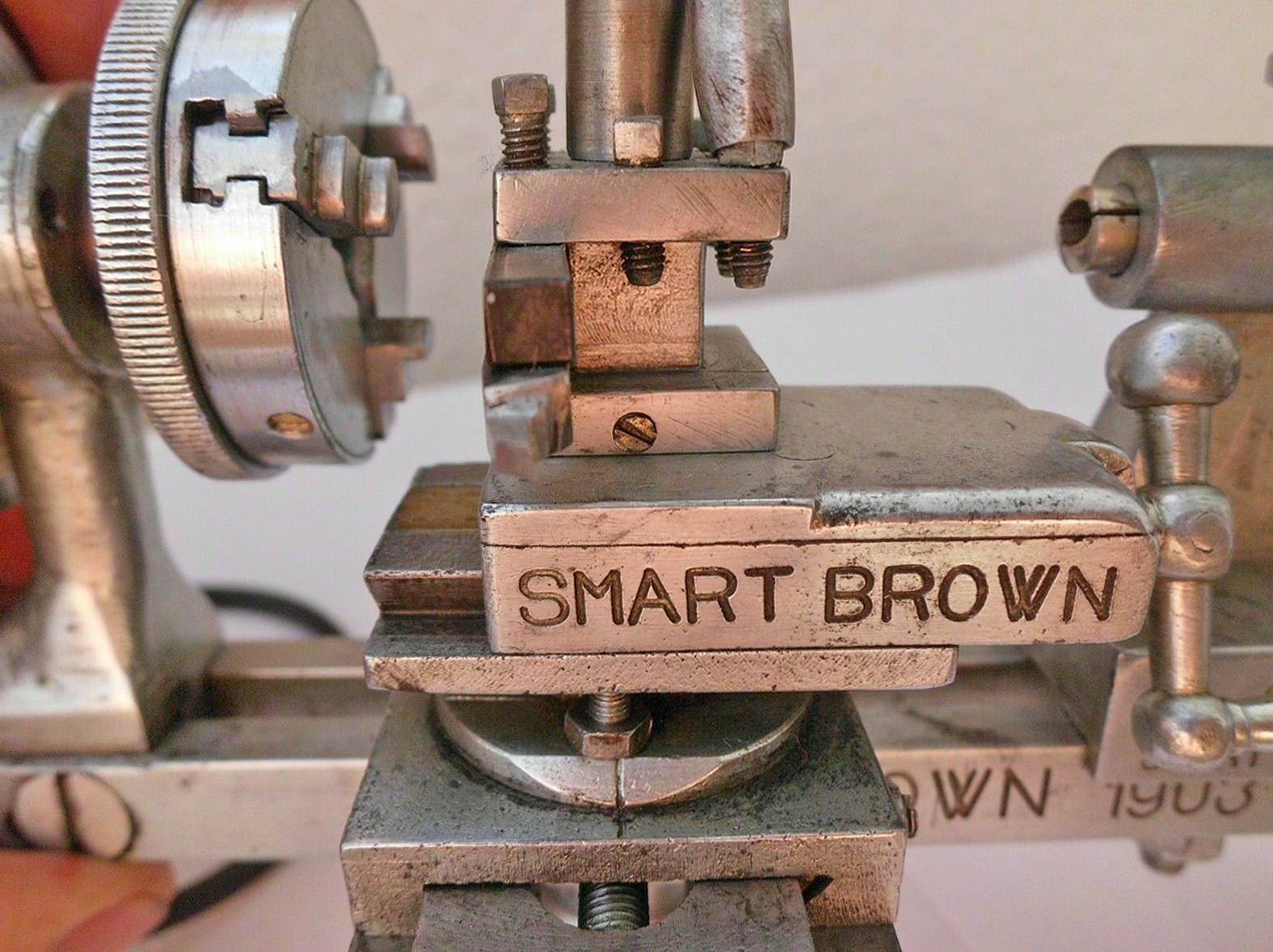
Smart & Brown 1024 Lathe
Model M Mk. 1 Model M Mk. 2 Model A Sabel Model 1024
Smart & Brown Home Page Model L
A 'Spare Parts List and Full General Arrangement Drawings Set' and an 'Operating & Maintenance Manual' are available for this model
Manufactured from the late 1950s and until the early 1990s (in variable-speed drive form) the Smart & Brown 1024 5.5" x 24" toolroom lathe was, and still is, very much sought after today. It was a machine was produced to the highest possible standards and not down to a price, which, as a result, was considerable. On the original Mk. 1 12 spindle speed were available, from 30 to 2500 rpm, and the headstock pulley ran on its own ball journal bearings concentric with, but independently of, the main headstock spindle. A 3-speed, 3-phase motor rated 1/1.5/2 H.P. was located in the base and drove upwards to a two speed gearbox which incorporated a multi-disc friction clutch to smooth out the speed changes. The speed-change gearbox was operated by a lever and all speeds could be changed without having to move a belt from pulley to pulley.
With a Type D1-4" nose and running in SKF type N.N.30.K double-row cylindrical roller bearings the heat-treated spindle was bored 11/4" and accepted collets up to 1" in capacity. Filtered oil was pumped automatically to the headstock, speed-change and screwcutting gearboxes whilst the apron was lubricated by a small pump contained within its base which was activated by the sliding action of the carriage assembly.
Constructed from a high-grade nickel iron and flame hardened the lathe bed was provided with what the designers considered the best combination of V and flat surfaces to locate and maintain the relative positions the headstock, carriage and tailstock over a very long service life. To help rigidity and vibration absorption the lathe was mounted on a cast-iron base of great weight.
Produced as the "1024 VSL" the Mk. 2 version, whilst having the same capacity and being mechanically almost identical to the Mk. 1 (although cosmetically altered to make it look "modern") was fitted with a very effective push-button-controlled variable-speed drive unit that gave both forward and reverse speeds from 40 to 2500 rpm from a 3-phase, 3 hp (2.25 Kw) motor.
Dual metric/English micrometer dials and a coolant system were fitted as standard and the automatic lubrication of the leadscrew, saddle, apron and headstock was fitted to years of production..