E-MAIL   Tony@lathes.co.uk
Home     Machine Tool Archive   Machine Tools For Sale & Wanted
Manuals   Catalogues   Belts


SCOPE Multi-purpose Lathe
by Kneller Engineering

Manufactured by Kneller Instrument & Tools Ltd of Caldecott Street in Rugby (although it appears to have been marketed by a separate Company, from the same address, Scope Engineering Ltd.) the 4.25-inch centre height by 14.5-inch between-centres  backgeared and screwcutting "Scope" was in production by the late 1940s. In 1958 Kneller moved to a new factory, in Daventry, and were eventually to make, from 1964 onwards, a lathe bearing their own name, the Kneller Combination Machine. Kneller, founded in the late 1930s by Mr Kneller, was to become well-established and very successful firm of precision engineers who did much sub-contract work for the aircraft industry including parts for the Concorde prototypes and many jobs for Rolls Royce.
Protected by British Patent No. 580071, the Scope was intended to act as a "semi-universal" machine tool whereby both the carriage and tailstock could be given a reciprocating action of up to 6 inches along the bed by means of a hand-operated lever. Mounted on a very robust cast-iron under-tray, with two ground-finish high-tensile nickel-chrome cast-steel bars used for the bed, the lathe was arranged so that the rear of the pair was solid and the front in the form of thick-walled tube enclosing a 3/4" x 8 t.p.i. leadscrew with a handle at the tailstock end to provide a slow-rate hand feed. Power was provided by  0.5 h.p. motor driving a 4-step V-belt pulley through a countershaft unit bolted to the base plate behind the headstock. The 9/16" bore spindle (1.25" diameter thread with a No. 2  and later a 3 Morse taper nose) had 8 speeds of: 38, 50, 80, 120 r.p.m. in backgear and 190, 280, 450 and 680 r.p.m. in open drive. In addition, a high-speed setting was available - from a double pulley on motor and countershaft - that gave speeds of: 400, 280, 450 and 1420 r.p.m. On lifting the headstock cover to change spindle speeds, a cam mechanism was arranged to automatically slacken both motor-to-countershaft and motor-to-headstock belts.
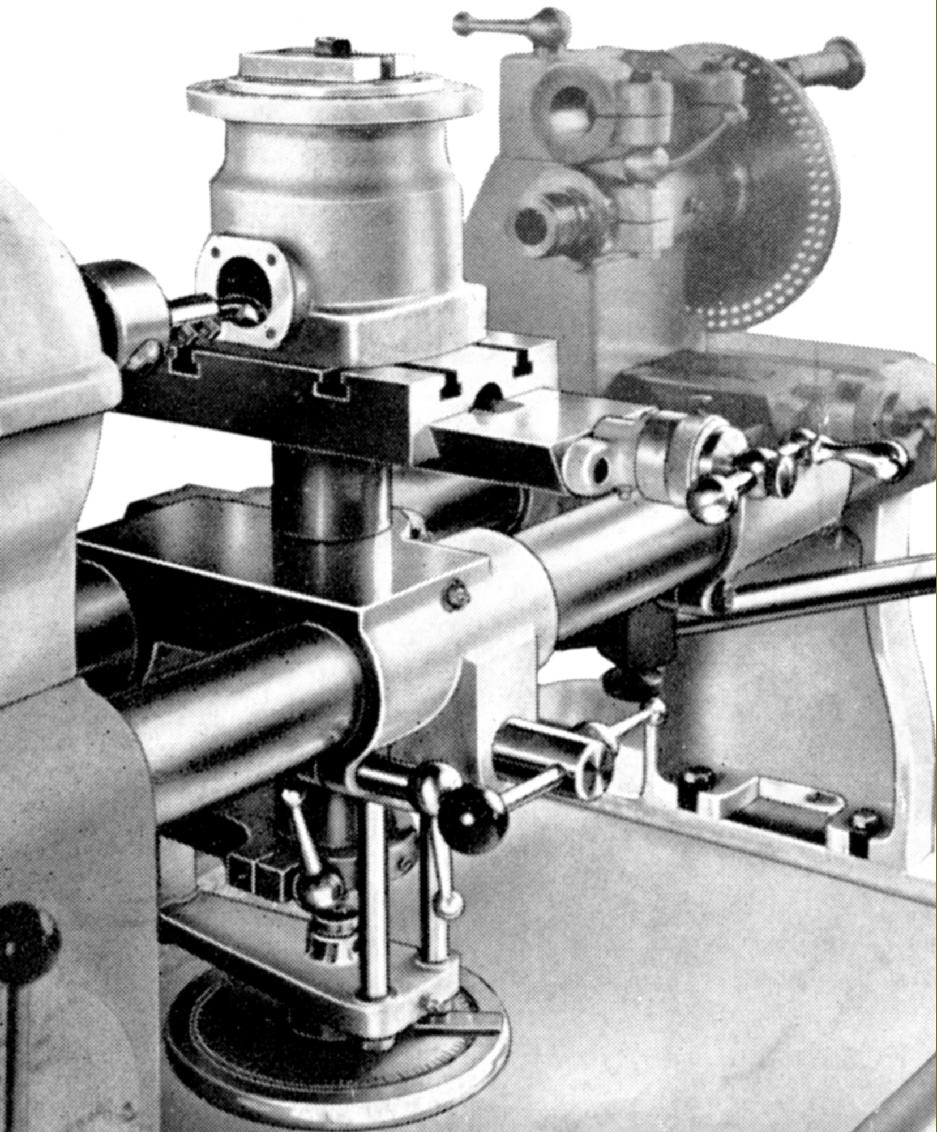
A 6" x 4" rectangular boring table, with four T slots arranged in pairs at 90 degrees to each other ,acted as the lathe's 6-inch travel cross slide and was mounted on a platform that could be elevated through a distance of 3 inches However, instead of using a compact bevel-gear drive of the type used to lift the knee of many milling machines, the designer of the Scope opted for a rather crude and  awkward-to use direct-screw feed. In order to provide a movement to the slide when shaping, an ingenious drive system was created using a cable-operated ratchet assembly that proved feed rates of 0.002" and 0.008". Evidence also points to the provision of electrical feed for other types of work, the electric motor being hung, in a rather exposed and fragile manner, on the back of the assembly. Whether the electric drive was fitted to all machines is uncertain but the maker's general arrangement drawing does show it in place.
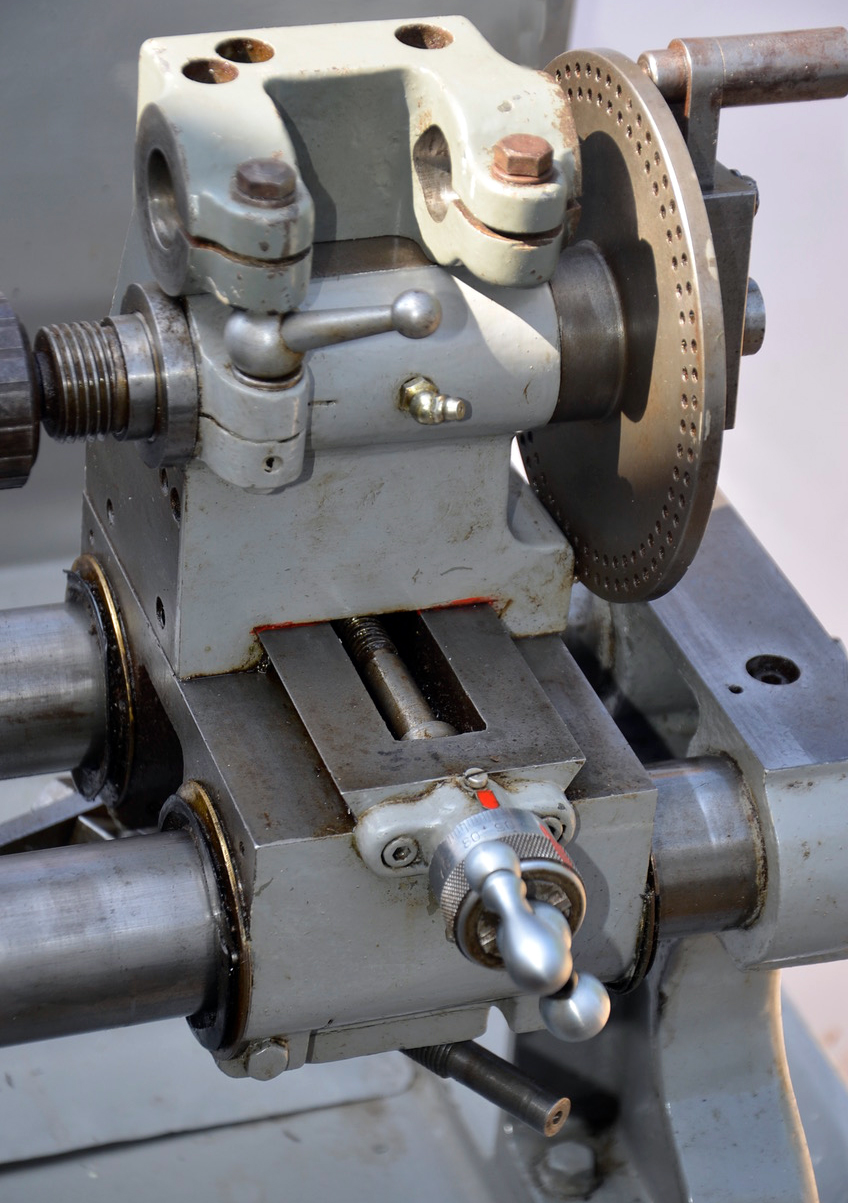
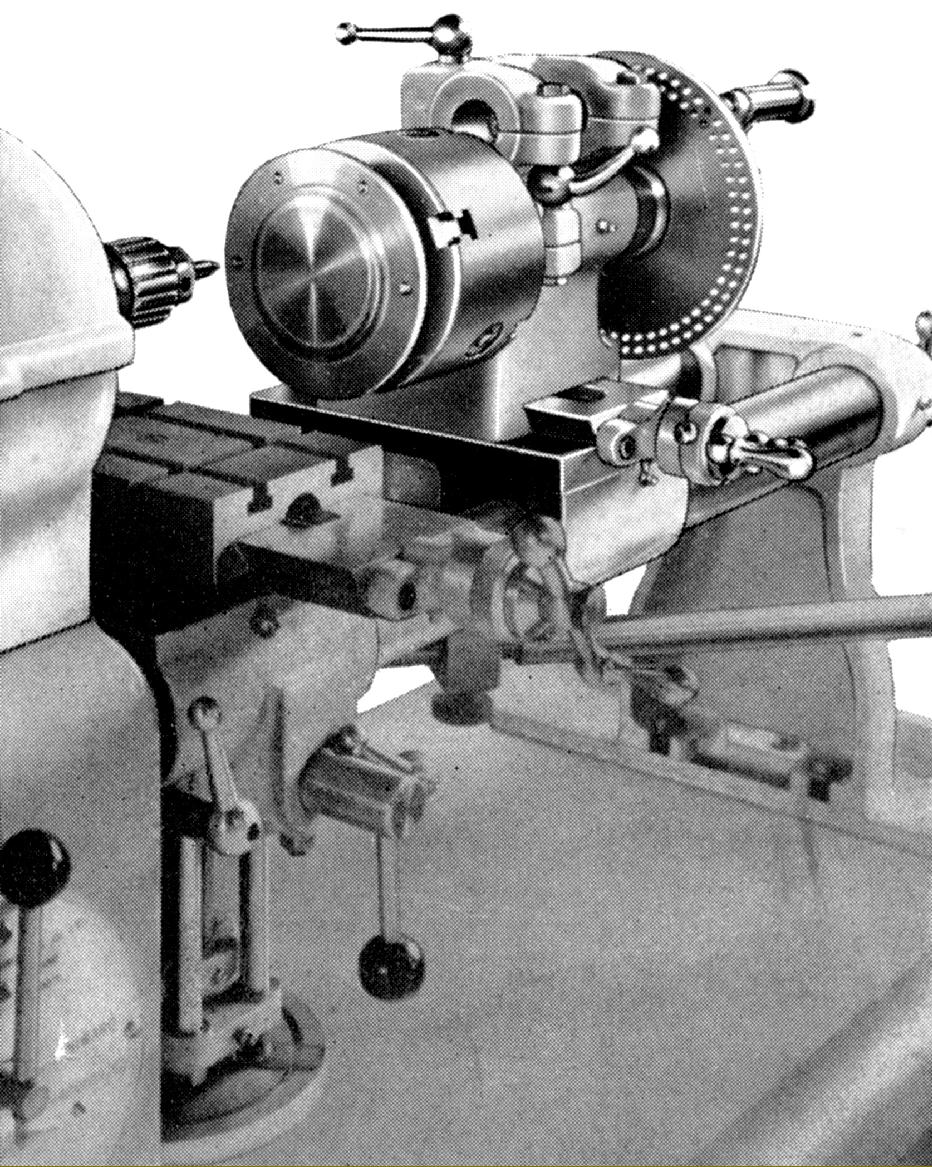
Designed to convert the lathe into a shaping machine the tailstock was very highly unusual in that not only did it have an upper section sitting on a slideway allowing it to be moved several inches across the bed (a system offered as an option on some American precision plain turning lathes), but also carried a barrel, threaded to accept a chuck, and fitted with a 6-inch diameter division plate with rings of 60 and 24 holes or, on some versions, 60 and 56 holes. The top of the tailstock was adapted to accept a dismountable housing to hold a cutting tool and the whole unit arranged to be reciprocated (for shaping work) by the action of a bottom-mounted lever-feed unit.
If you have a Scope lathe, or any literature from the maker, the writer would be pleased to hear from you..

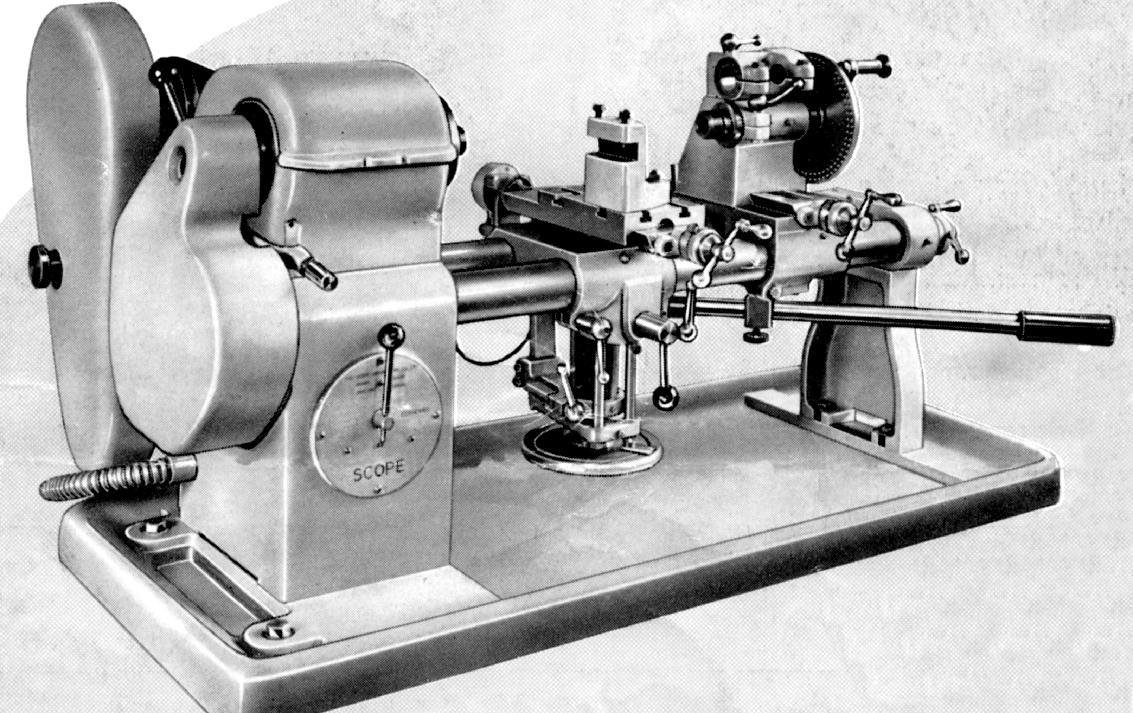
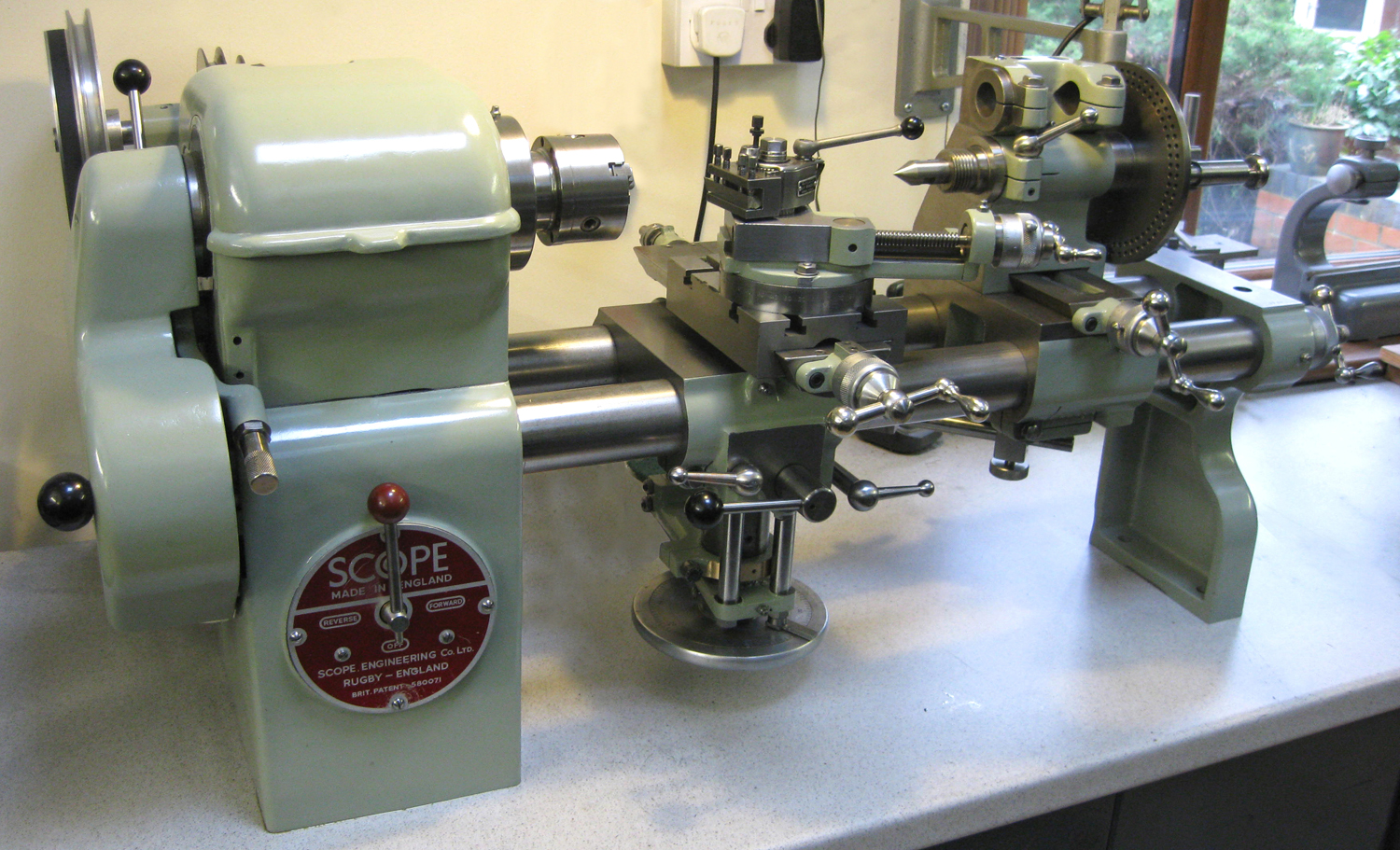
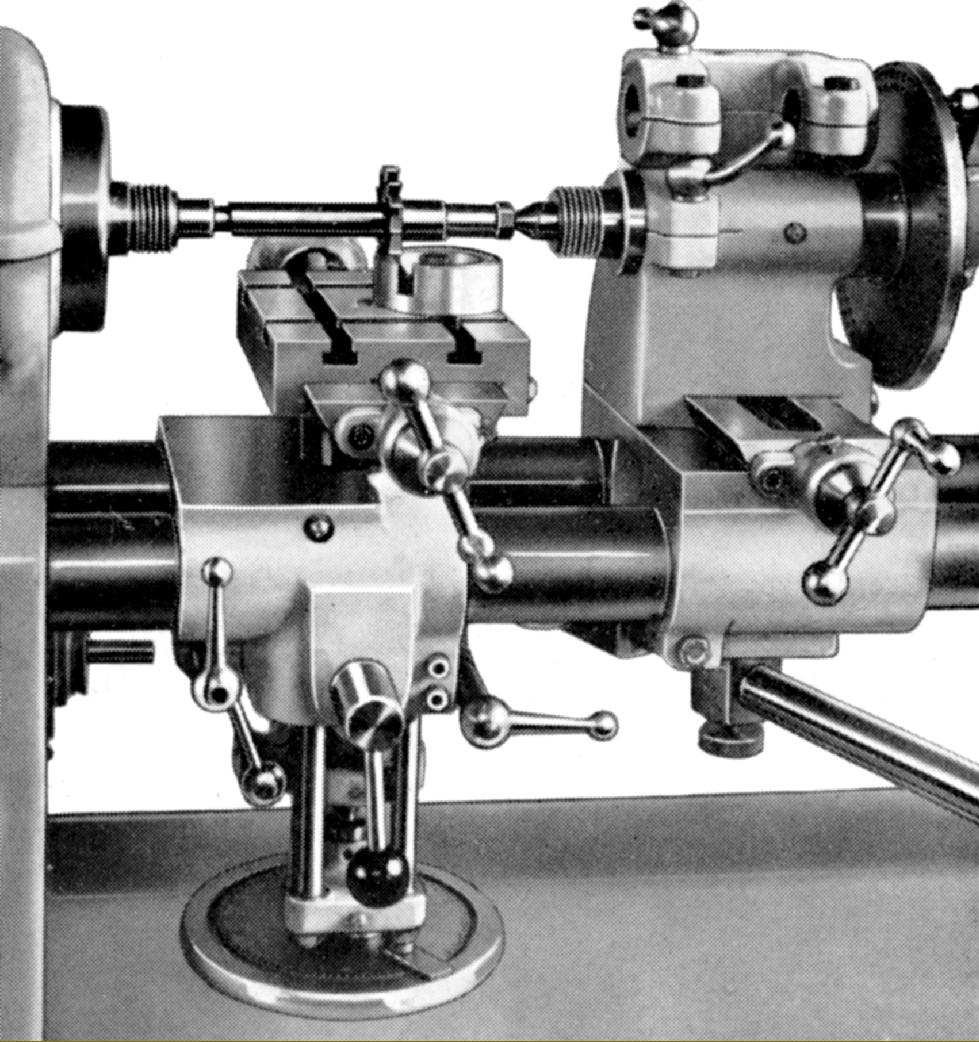
The unusual twin-bar bed Scope lathe with elevating cross slide and a dividing unit built into the tailstock

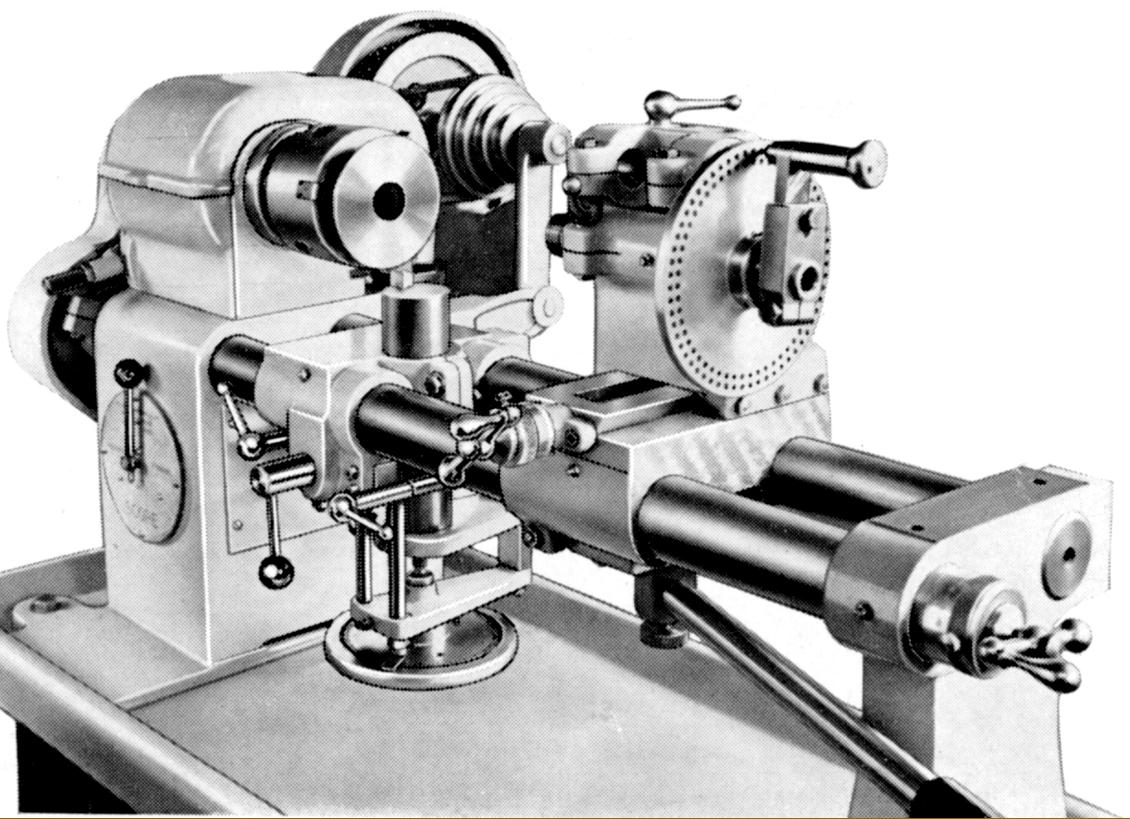
The Scope set up as an ordinary centre lathe--but with the cutting tool held in a slot on a special plain column that replaced the standard unit. By this means discs up to 8-inches in diameter could be turned over the saddle.

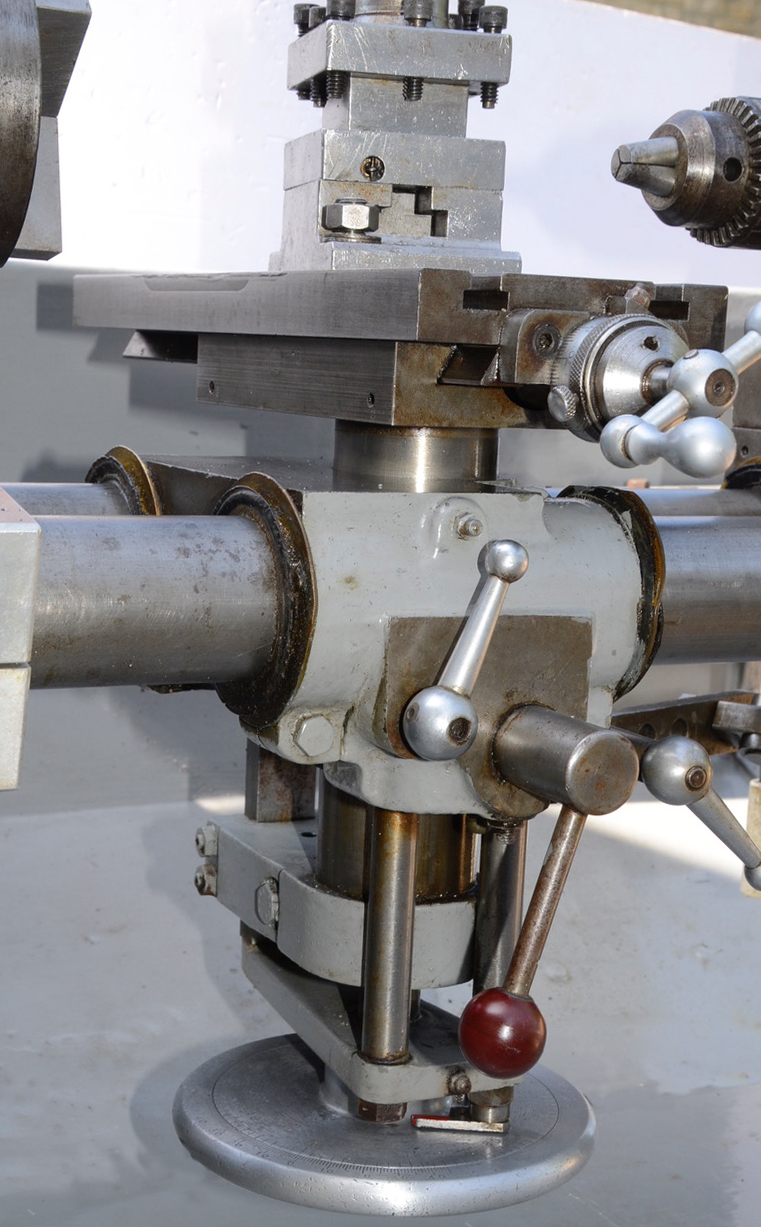
Instead of using a compact bevel-gear drive of the type used to lift the knee of many milling machines the designer of the Scope opted for a rather crude and  awkward-to use direct screw feed to elevate the boring table through a range of 3 inches.

Designed to convert the lathe into a shaping machine the tailstock was very highly unusual in that not only did it have an upper section sitting on a slideway that allowed it to be moved across the bed (a system offered as an option on some American precision plain turning lathes), but also carried a barrel threaded to accept a chuck and fitted with a 6-inch diameter division plate with rings of 60 and 24 (or 60 and 56) holes. The tailstock was arranged to be moved along the bed by the action of a bottom-mounted lever-feed unit. Not shown in the photographs, but included in the drawing below, is the top mounted bracket that carried a long bar into the end of which was mounted the shaper cutting tool.

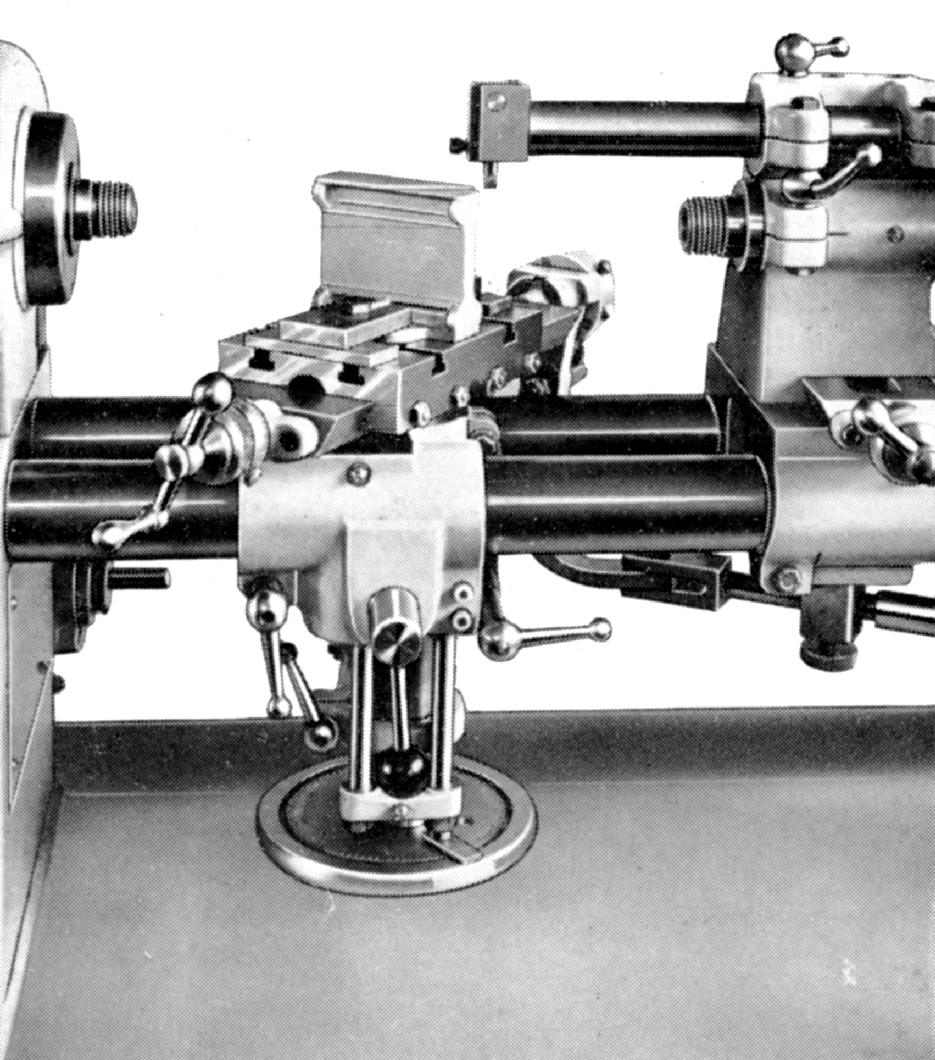
Horizontal milling. A transverse feed was obtained by hand operation of the cross-slide screw.

Arranged as a boring machine

Shaping. The detachable shaping head is shown fitted into its carrier bracket on top of the tailstock. The ingenious use of a cable-operated ratchet feed was used to move the table.

Drilling using the indexing and set-over tailstock to space out holes. The unit being drilled has been turned on the lathe and, still attached to its chuck, transferred to the tailstock spindle.

Tailstock complete with top-mounted bracket and tool bar

Headstock end elevation

Section through carriage assembly showing the leadscrew inside the front bed tube and the power-feed motor attached to the back of the cross slide.


E-MAIL   Tony@lathes.co.uk
Home     Machine Tool Archive   Machine Tools For Sale & Wanted
Manuals   Catalogues   Belts


SCOPE Multi-purpose Lathe
by Kneller Engineering