|
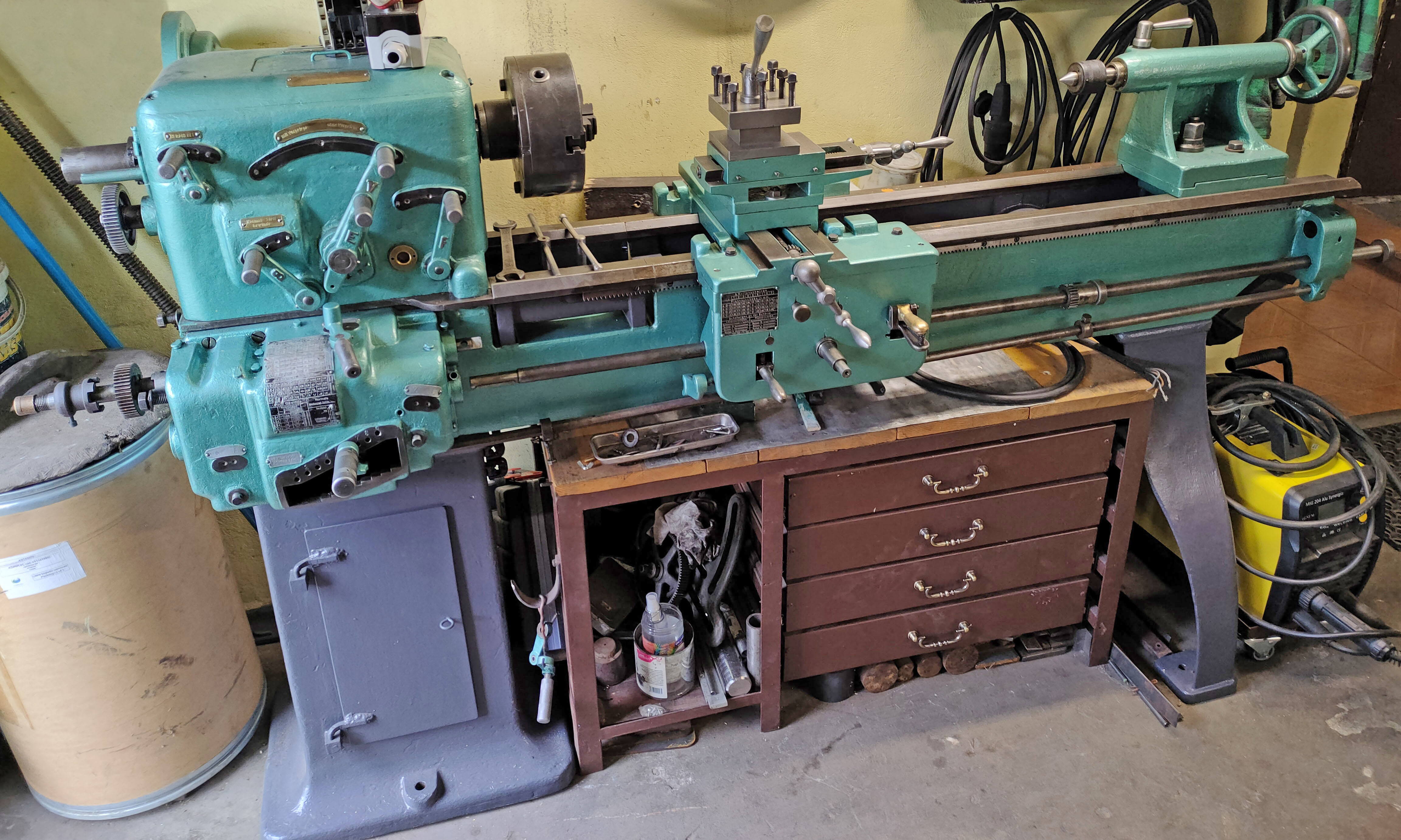
Made by the Riken Machine Tool Company of Japan the 70 mm centre height by 267 mm between centres Riken appears to have been a copy of the early 1930s and 1940s Schaublin 65 and 70 models - indeed, it is easy to confuse the two. As such the Riken was typical of late 19th until mid 20th century precision bench lathes design* as originated in America by Stark. The Company appears to have kept up manufacture until at least the 1970s and in later years produced a rugged little toolmaker's lathe mounted a heavy cabinet stand.
Unlike a number of other lathes of this class (where the bed had bevelled faces at front and back to located the headstock, carriage, tailstock and other items) on the Riken (and Schaublin) bed fittings were retained by a single central slot with one 90-degree and one angled side. The "nuts" beneath each of the various clamping screw had a matching angled face that, as pressure was applied, caused the fittings to be drawn hard against the bed's front vertical face. The Riken was built in at least two versions with a later model using the much simpler (though requiring great precision in manufacture) "full-width" bed clamping system.
Collets were of a nominal 12 mm diameter (11.8 mm actual) and pulled into the headstock spindle by a draw bar. At 80, 64 and 48 mm across their crowns the 3-step of the headstock pulley had diameters identical to those used on the Schaublin 70 countershaft and were possibly supplied by the Swiss Company.. As usual, the largest diameter headstock pulley was to the left and its outward facing flange drilled with circles of indexing holes - in this case one of 36 and the other 60. The indexing pin was well supported - it passed through the end face of the headstock casting - and could be further stabilised by being locked with a convenient thumb screw.
Fitted with knurled-edge micrometer dials the slide rest (stamped with the Riken name) used covered ways with the cross slide being a full-length type (that helped to even out wear and impart extra rigidity) with a very reasonable 69 mm of travel. On this type of lathe the maximum length of cut is governed entirely by the travel of the top slide and in this respect the Riken fell down, the amount of movement available, just 48 mm, being somewhat less than useful. In addition, lathes of this type were invariable conceived as multi-purpose machines able to be employed in both precision toolroom and production use. As a consequence they often had arrangements on the headstock to take a lever-action collet closer and T-slots machined down the front or back of the bed (and sometimes both) in order to carry various accessories including thread-chasing and power-feed attachments. The fact that the Riken's was not so equipped suggests that the designer's brief was to produce a simple but accurate lathe for use in repair shops and for one-off jobs.
If any reader has a Riken lathe the writer would be interested to hear from them.
* American makers included: Levin, Bottum, American Watch Tool Company, B.C.Ames, Bottum, Hjorth, Potter, Pratt & Whitney, Rivett, Wade, Waltham Machine Works, Wade, Pratt & Whitney, Rivett, Cataract, Hardinge, Elgin, Remington, Sloan & Chace, W.H.Nichols, Crystal Lake and (though now very rare) Bausch & Lomb, Frederick Pearce, Van Norman, Ballou & Whitcombe, Sawyer Watch Tool Co., Engineering Appliances, Fenn-Sadler, "Cosa Corporation of New York" and UND.
Riken Continued here: Riken Page 2 Riken Page 3
|
|