 |
|
|
|
|
|
|
|
|
|
|
|
|
|
|
|
|
|
|
|
|
|
|
|
|
|
|
|
|
|
|
|
|
|
|
|
|
|
|
|
|
|
|
|
|
|
|
|
|
|
|
|
|
|
|
|
|
Eventually to become a member of the well-known B. Elliott & Co. Ltd. Group, the Victoria Milling Machine Company manufactured Pallas millers at their Willesden works in north west London and also badged a number of continental imports using the same name. Designed to fill a gap in the Company's product line beneath the more expensive and better specified "Victoria" models (and to compete with "Denbigh", who sold most of their machines in the same market segment), the Pallas range was intended for training schools, repair and maintenance shops or lighter-duty production work. The smallest Pallas listed was the simple hand-operated horizontal Model C, a now seldom-found pre-1940 machine intended for bench or stand mounting. More common are the later and heavier H.O.O. and H.O. Models, described by the makers as a: "High Speed Hand Lever Plain Milling Machines" and intended for: "production milling of small parts… ideally suited for aircraft and small arms component manufacture, all light milling, slitting and sawing operations.". However, the most frequently encountered Pallas, and a machine that must have been manufactured in some numbers, is the V1 vertical.
Continued below:
|
|
|
|
|
|
|
|
 |
|
|
|
|
|
|
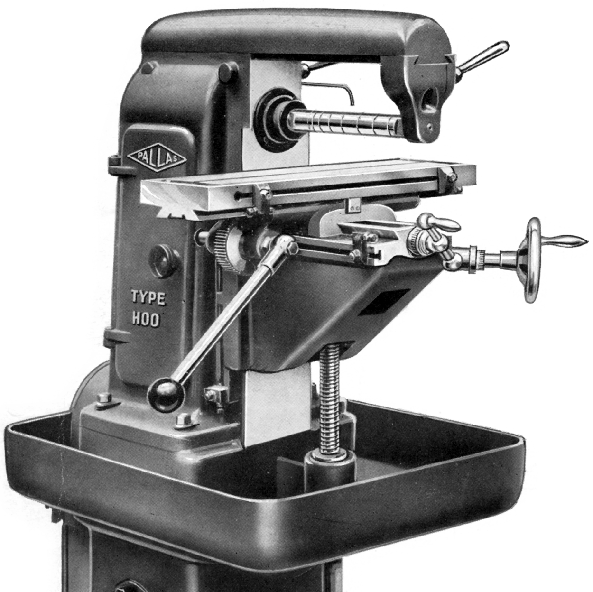
Early Pallas HOO Miller circa 1946
|
|
|
|
|
|
|
|
|
|
|
 |
|
|
|
|
|
|
|
|
|
|
|
|
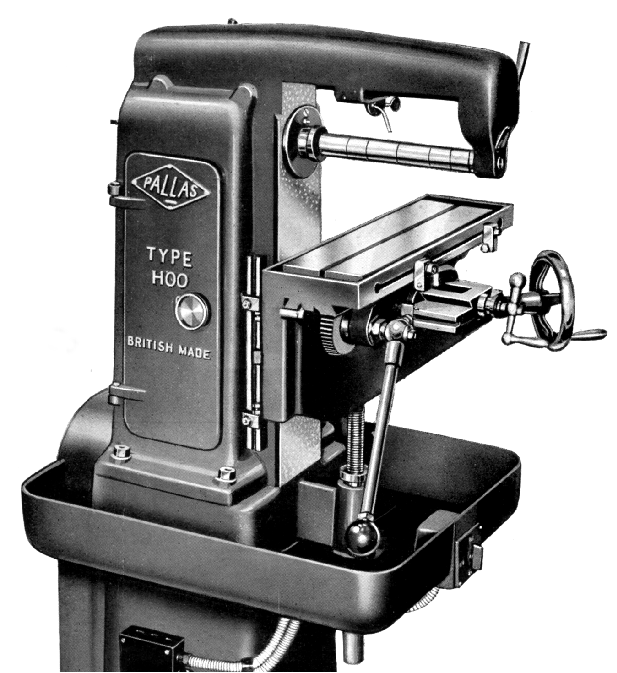
Later Pallas HOO Miller as advertised from 1948
Continued:
The HO Model had a single T-slot 22" x 6 ½" table with a surrounding coolant-collection trough, two stops on its front face and was lever-operated by rack-and-pinion gearing along its longitudinal feed. The design was intended to facilitate ease of use when jobs were mounted in jigs with one or more slitting or forming cutters being pulled over them by a cheap-to-employ female worker. The table travel was 12-inches and the operating lever (which could be mounted at either the front or back of the table) gave 5-inches of movement for one revolution - though, of course, as it was impossible to make it rotate fully, the maximum travel that could be obtained by one stroke of the lever would have been less than three-quarters of that. Both the table cross feed and knee were screw driven with the former having 6-inches of travel and knee 7 inches (by a telescopic screw). The knee guide was especially wide but unfortunately this desirable state of affairs was gained at the expense of support - the 60º edges extending (as it did on so many cheaper millers of the era) beyond the width of the main column. Only a single clamp locked the knee, though it did have a good-sized, permanently-fitted handle.
The nickel-chrome steel spindle was ground-finished and ran in a roller bearing at the front and a ball race at the rear. The nose was bored No. 3 Morse taper and a draw bar held the 1-inch diameter arbor. Whilst most small millers of this era used a simple steel bar as an overarm (as did the next-larger Pallas in the range, the H.O.) the H.O.O. had a proper rigid cast iron assembly with a prismatic base that socketed into the top of the main column. The overarm and its drop bracket were both locked in place by levers rather than nuts - this seemingly insignificant point making the life of the operator or setter far more efficient for, with no lost spanner to hunt for when setting up a new job, valuable production time was saved.
Especially neat and completely enclosed the drive system consisted of a 1-h.p. 1400-rpm motor, with a 4-step V-pulley, mounted on an adjustable plate within the cabinet base and able to be reached though a large door at the rear of the machine; unfortunately the electrical switch was mounted on the left-hand face of the machine, dangerously out of the operator's reach. From the cabinet the drive went vertically by V-belt to an intermediate shaft running in bearings held within the rear section of a particularly deep, open-topped 28" x 23" cast-iron coolant tank sandwiched between base and main column. At the other end of the middle shaft the drive was taken up to the spindle from a 3-step cone pulley by a smooth-running flat belt tensioned by a jockey pulley. The 12 speeds, though without any form of gearing to help with slower rates, nevertheless spanned a very useful 160 to 2800 rpm.
A slot cut in the right-hand face of the base casting allowed a round belt, driven from the intermediate pulley shaft, to reach an externally mounted coolant pump.
Later versions of the H.O.O. were improved by the fitting of a more rigid vertical stop, a boss cast into the underside of the overarm to hold the coolant pipe in a more effective and vibration-proof position, the repositioning of the electrical switch to the front of the machine - and the addition of a script saying "British Made" to the column door. The H.O.O. miller required a floor space of approximately 26" x 23" and had a weight of around 1008 lbs.
Although most examples of Pallas millers encountered are marked "British Made" (usually on doors or other removable parts) others has been discovered labelled "Foreign Made". Obviously, the door was very easy to change…
|
|
|
|
|
|
|
|
 |
|
|
|
|
|
|
|
|
|
|
|
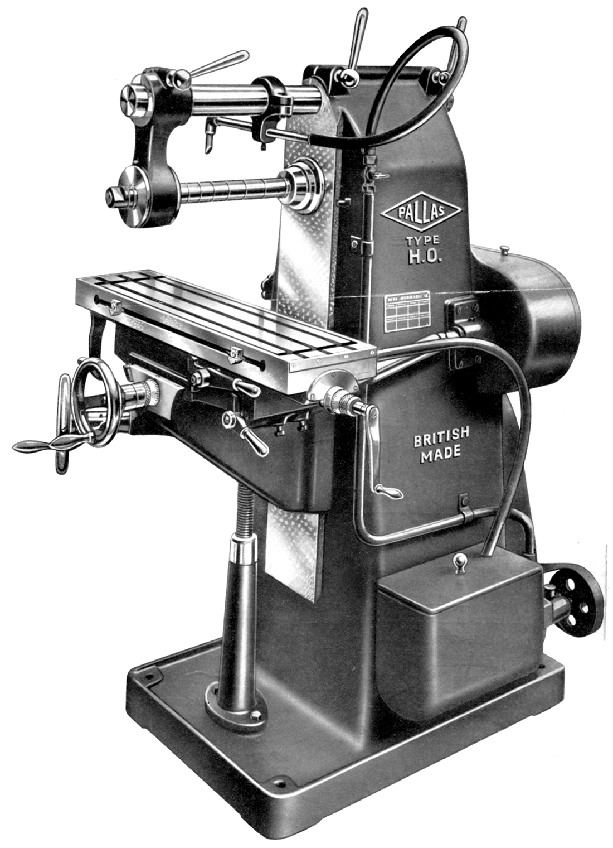
Pallas H.0. as sold during the 1940s
A considerable improvement in size and strength when compared to the Model H.O.O., the next larger machine in the Pallas range, the "H.O." horizontal, was intended as a general-purpose miller for both general engineering workshops and training establishments. The 30" x 7" table had a narrow coolant-collection trough that allowed the whole of the surface to be used as a working area; three 9/16" T slots were spaced 2" apart and the front face was fitted with the usual slot in which were parked two adjustable stops. Power feed to the table was not from an independent electric motor and gearbox but taken from the machine's intermediate drive shaft via a pair of interchangeable 3-step flat-belt pulleys that gave 6 feed rates from 7/16" to 14" per minute. From the output pulley the drive passed through the usual type of universally-jointed and splined shaft to a (lever-controlled) worm-and-wheel mechanism that engaged with the feed screw under its right-hand end.
Rather than use a conventional wheel the hand feed was operated by long cranked handles fitted at each end of the table; though giving plenty of leverage for heavier jobs this type of control lacked sensitivity of touch and would have made the application of delicate, slow cuts somewhat difficult. Although the micrometer dials were all on the small side their tapered faces went some way towards making them easy to read. The table's longitudinal travel was 17-inches with 7¼-inches in traverse and 7-inches vertically through a telescopic screw fitted with ball thrust race to take the weight of the knee. Instead of a separate base stand the main column of the miller reached right to the floor, tapering from top to bottom and wide enough to give the knee guide plenty of supporting metal at each side.
Ground-finished and running in twin Timken taper roller races the 0.25 carbon steel spindle had a nose bored with a B.E.S.A. taper (an apparently unpopular idea from the British Engineering Standards Association) and the 1-inch diameter arbor retained by a draw bar. In common with most small millers of the period a simple steel bar was used as an overarm and, whilst perfectly adequate for the strength of the machine, could not be considered as rigid as the proper cast-iron unit fitted with a prismatic base used (surprisingly) on the smaller and cheaper Pallas H.O.O. The overarm and its drop bracket were both locked in place by levers rather than nuts, this seemingly insignificant point making the life of the operator or setter far more efficient for, with no lost spanner to hunt for when setting up a new job, valuable production time was saved.
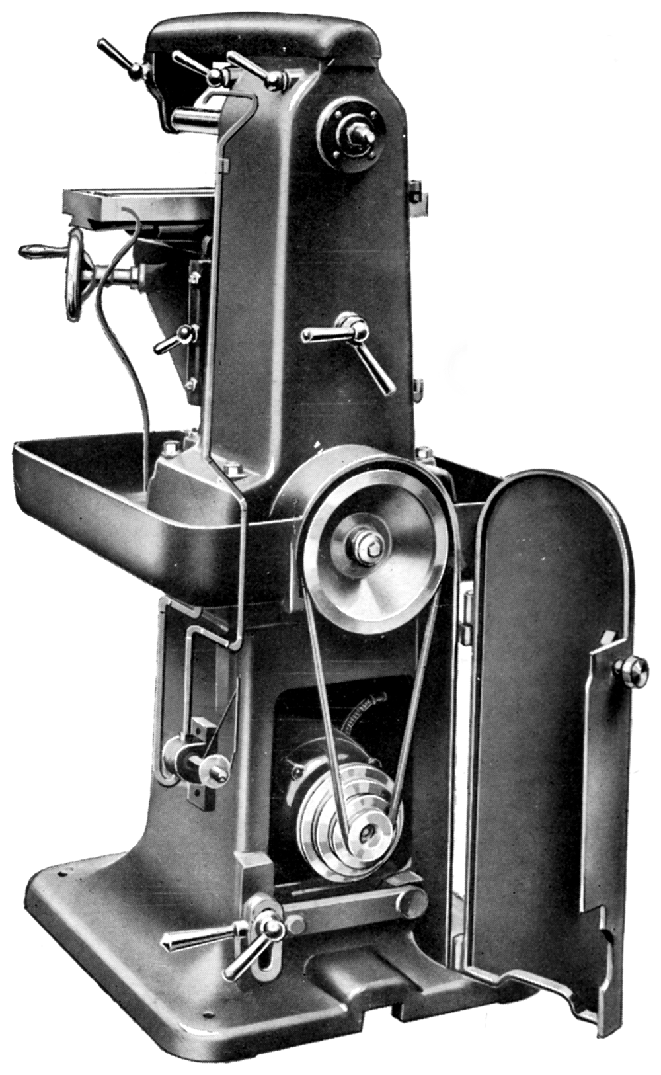
Arranged at the back of the machine, the first part of the drive to the spindle was by a 1½ -hp motor held within the bottom of the base on an adjustable plate with a hinge-open cast-iron cover to guard the complete system. From the motor a double V-belt ran to an intermediate shaft and from there to the spindle by a wide flat belt running over a 3-step pulley. A jockey pulley ensured a better "wrap-around" of the belt onto the pulleys (and provided a quick and simple method of adjusting the tension), while the 6 spindle speeds ran from 200 to 1,200 rpm with access to change them provided by a door on the machine's left-hand face. Coolant was stored in an external tank, bolted to the lower right-hand face of the machine, with a simple belt-driven geared pump to distribute the fluid.
The H.O. required a floor space of 30" x 27" and had a weight of approximately 1150 lbs without an electric motor..
|
|
|
|
|
|
|
|
 |
|
|
|
|
|
Late Model Pallas Model HO. A neat and simple drive system with the 1-h.p. 1400-rpm motor
and V and flat-belt drive system completely enclosed within the cabinet base.
|
|
|
|
|
|
|
|
|
|
|
 |
|
|
|
|
|
|
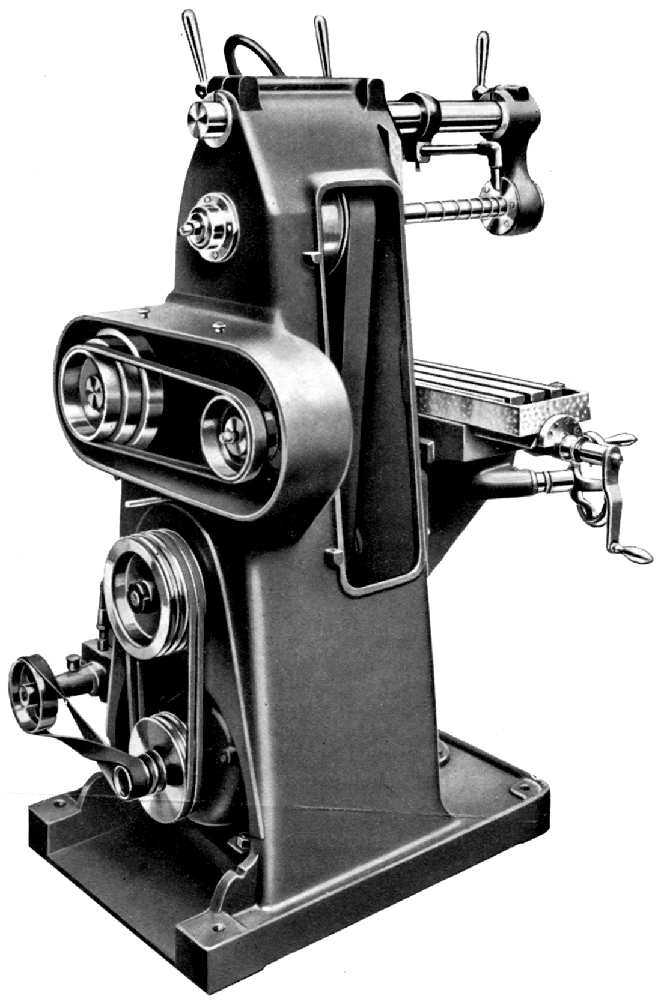
Pallas H.O. Miller.
Drive from the motor was by a double V-belt to an intermediate shaft and from there to the spindle by a wide flat belt running over a 3-step pulley. A jockey pulley ensured a better wrap-around of the belt while also providing a quick and simple method of adjusting the tension.
|
|
|
|
|
|
|
|
|
|
 |
|
|
|
|
|
|
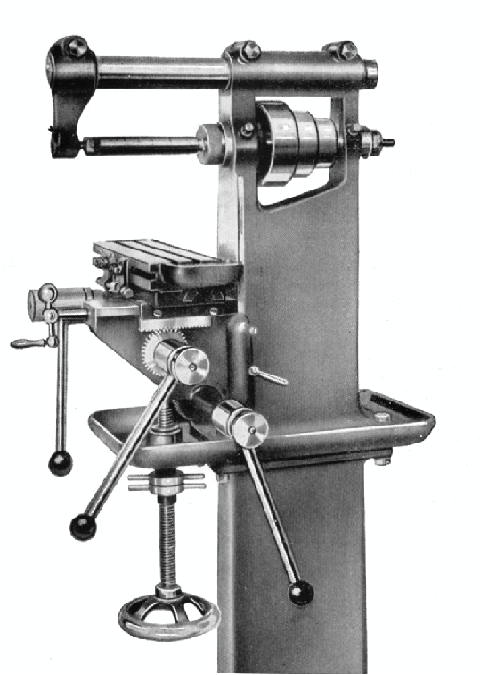
Pallas Horizontal Milling Machine Model C
Available as either a bench or floor-standing unit the Model C Pallas was manufactured from the late 1920s. The table had a working surface of 14" x 5" (the early, rather lighter machines had a shorter 12-inch long table) and carried two T slots with a coolant-drain reservoir at its right-hand end. Quick-action lever feed was fitted to all three directions of movement with screw feed to the cross and vertical travels and adjustable stops on all axes. The longitudinal travel was 10.7", the cross feed 3.5" and the vertical 5,125". In the late 1920s Bakelite was still a sufficiently novel material for the makers to mention that the operating levers were all fitted with moulded "Bakelite grips".
Running in bronze bearings the spindle was fitted with a screwed nose that allowed a chuck or other convenient fitting to be mounted. For an extra charge a "high-speed" spindle, capable of up to 1500 rpm, could be ordered - but whether this improvement was down to better material and finish, or the use of roller bearings, was not revealed by the maker.
All turned surfaces (plus the slideays and the top of the table) were ground-finished. The miller was supplied as standard with a 1-inch diameter arbor and hardened spacing rings, a set of spanners and a countershaft for wall or ceiling mounting with 13/8" wide pulleys and ring-oiled bearings..
|
|
|
|
|
|
|
|
|
|
|
|
|
|
 |
|
|
|
|
|
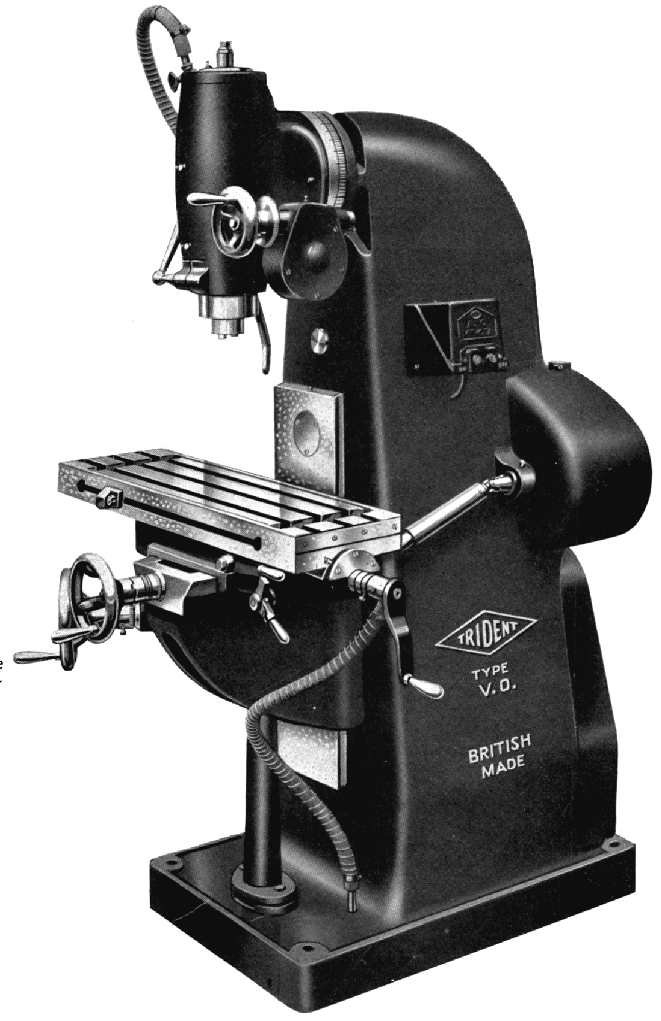
Pallas (and Trident V0) Vertical Miller from the late 1930s and 1940s
Also marketed as the "Trident" the smallest Pallas vertical miller was the Model "V0". This was a vertical-only machine, probably built from the late 1930s until the mid 1950s and used in both industry and training. The machine was based on the H.O. horizontal and, as far as the top of the knee guide, was almost identical with only the spindle speeds, table feed rates and vertical travel differing. For its intended purpose and price range this appears to have been an effective machine, although its all-belt drive system would have limited its ultimate metal-moving ability especially when compared to the more efficient (but much more expensive) all-geared American machines offered by companies such as Cincinnati and Kearney & Trecker.
With a narrow coolant-collection trough that allowed the whole of the surface to be used as a working area the 30" x 7" table had three 9/16" T-slots spaced 2" apart and the front face fitted with the usual slot to hold two adjustable stops. Power feed to the table was not from an independent electric motor and gearbox but, as a cost-saving measure, taken from the machine's intermediate drive shaft via a pair of interchangeable 3-step flat-belt pulleys that gave 12 feeds from 7/16" to 14" per minute - 6 more than the H.O. but with identical maximum and minimum rates. From the output pulley the drive passed through the usual type of universally-jointed and splined shaft to a (lever-controlled) worm and wheel mechanism that engaged with the feed screw under its right-hand end.
Rather than a conventional wheel the table's hand feed was operated by long cranked handles, with one fitted at each end; though giving plenty of leverage for heavier jobs this type of control lacked sensitivity of touch and would have made the application of delicate, slow cuts rather difficult. The micrometer dials were all on the small side, but their tapered faces went some way towards making them easier to read. The table's longitudinal travel was 17-inches with 7¼-inches in traverse and 11-inches vertically through a telescopic screw fitted with a ball thrust race. Instead of a separate base stand the main column of the miller reached right to the floor, tapering from top to bottom and wide enough to give the V-edged knee guide plenty of supporting metal at each side.
Bolted to a round flange at the top of the column the swivelling vertical head could be inclined 45º each side of upright. The spindle ran in Timken taper roller bearings, carried a No. 3 Morse taper in its nose and was moved through its 2½" of travel by a handwheel working through worm-and-wheel gearing; unfortunately there was no quick-action drilling feed but a very large micrometer dial was fitted, presumably to make up for the lack of a micrometer-collar depth stop. The distance from spindle centre to the column's knee guide was 65/8" and from spindle nose to table 15".
Arranged at the back of the machine the first part of the drive was by a 1½ -hp motor held, on an adjustable plate, in the bottom of the base. A hinge-open cast-iron cover guarded the complete system with the drive from the motor to an intermediate shaft by a double V-belt and from there to the spindle by a wide flat belt running over a 3-step pulley. A jockey pulley ensured a better wrap-around of the flat belt (and provided a quick and simple method of adjusting the tension), whilst the 6 spindle speeds ran from 120 to 800 rpm with access to change them provided by a door on the machine's left-hand face. Unfortunately the rather slow top speed would have limited the miller's ability to handle small-diameter cutters.
Coolant was stored in an external tank, bolted to the lower face of the machine, with a simple belt-driven geared pump to distribute the fluid.
The V0 required a floor space of 30" x 27" and a weight of approximately 1500 lbs without an electric motor..
|
|
|
|
|
|
|
|
|
|