|
Beginning life in 1679 as "Artillerie Inrichtingen" (the Dutch Government's ordnance works intended to make the state independent of outside suppliers) the Hembrug Company have long enjoyed a reputation for high-quality engineering with their diverse activities even including being one of the makers of propellers for the English Sopwith Camel fighter aircraft of WW1. However, it was not until the 1930s that the company branched out into machine tools, at first specialised products for the manufacture of ammunition. In 1973 (and still under state ownership) the machine-tool, general engineering and ordnance activities were split, with all but the latter designated as the "Hembrug" company that became, in 1982, the privatised concern "BV Gereedschaps-werktuigenindustrie HEMBRUG B.V." Having moved to the city of Harlem the company dropped its miscellaneous activities (including the Figee crane department) and began to concentrate on an increasingly important sub-set of lathe production, ultra-precision, fine-finish hard-material turning machines, the origins of which can be traced back to 1969 and the company's first "Ergomonic" and "Mikroturn"models (these lathes are shown towards the bottom of the page).
In 1990 a new research facility and production plant was built where development and production of ultra-precision hard-turning machines could be concentrated - and by 1994 small-scale series production of the Slantbed-Mikroturn 100 CNC. had begun. The range was then steadily expanded with the introduction of various models for both small and large diameter work and vertical machines to handle even bigger jobs. In 2000 a new building was erected on Figeeweg 5a together with an enlargement of the existing assembly area. Today work continues, helped by an association with the Technical University of Delft, with recent Mikroturn developments including the integration of boring and honing and production of a complex 4-axis version with the ability to simultaneously turn inside and outside diameters.
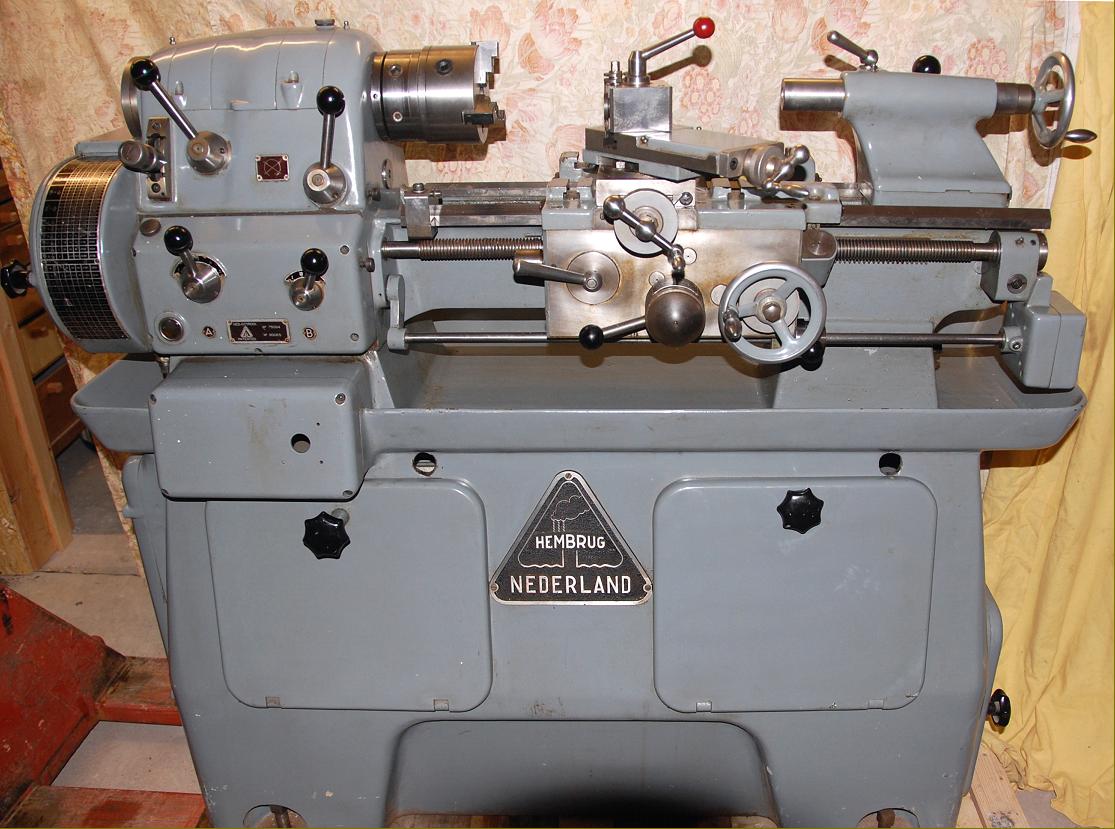
Over many years Hembrug has manufactured a wide range of ordinary and specialised machine tools including a very desirable precision toolroom lathe, the "DR1", of 5.25 inch centre height by 18 or 30 inches between-centres (133 mm x 470/750 mm) that was manufactured in Hembrug-Zaandam. A machine of superb quality, with headstock and V-way bed cast as one massive unit and mounted on a heavy cast-iron stand, the A1 is now sought after by knowledgeable enthusiasts and prized for its great attention to mechanical detail, handsome appearance, rigid construction, ease of operation and wide speed range.
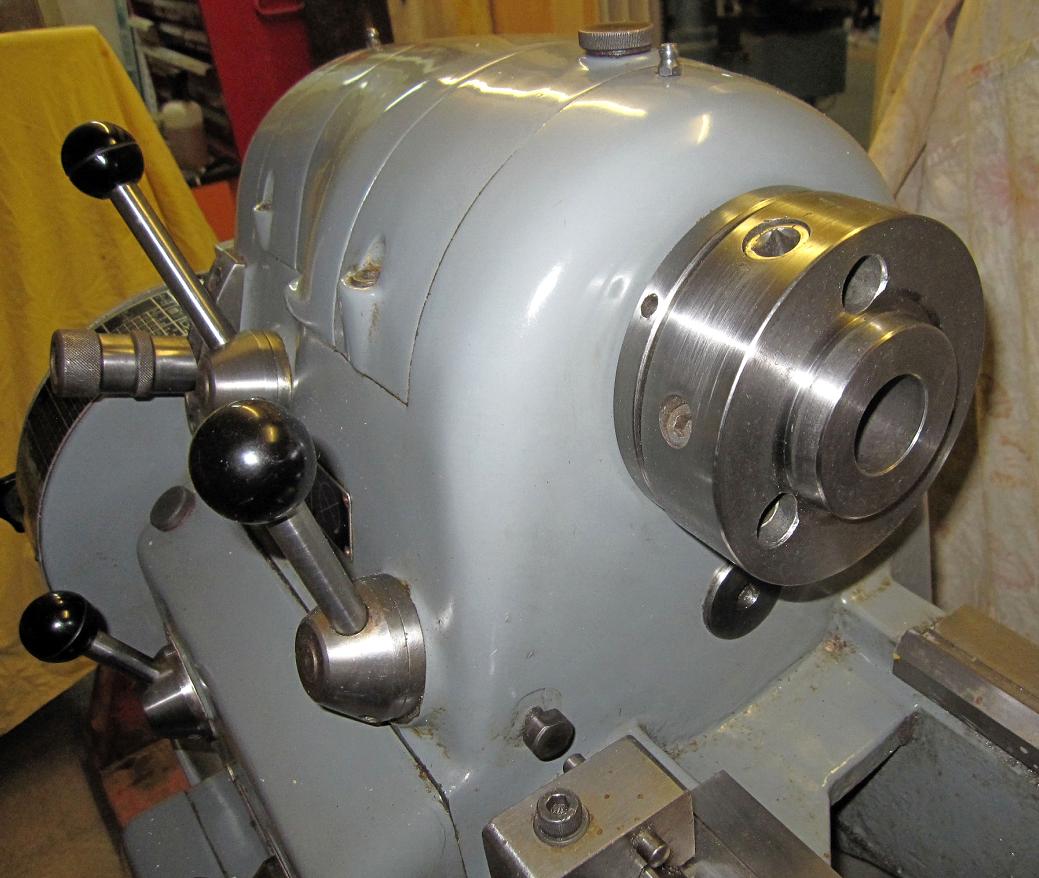
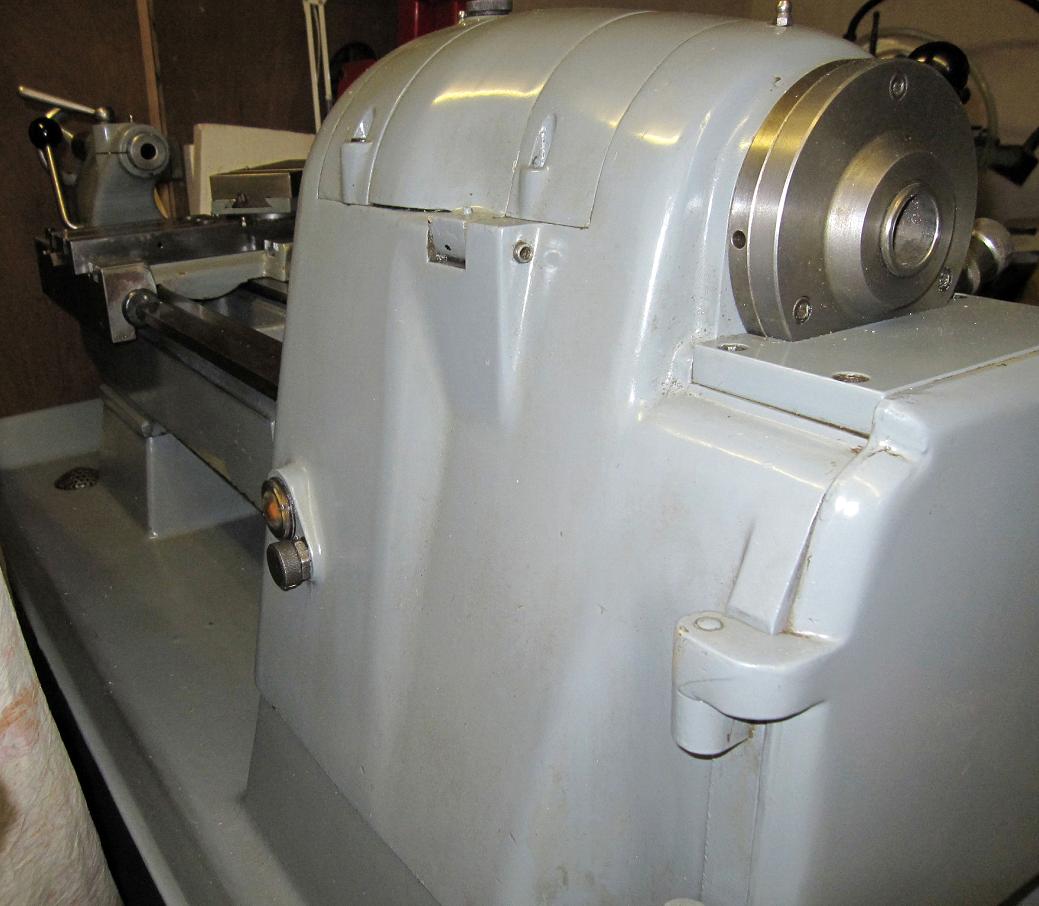
With a D1-4" nose, 26 mm (just over 1 inch) bore and a No. 4 Morse taper, the spindle ran in a double-row cylindrical roller bearing at the front and a pair of single-row angular contact bearings at the rear; as an option, a set of ultra-high precision bearings could be supplied that the makers guaranteed would allow a surface finish to be obtained on a 1-inch diameter brass bar - over a length of 1.25 inches and using a diamond tool - of better than 0.075 microns. The maximum collet capacity was 0.75" (18 mm).
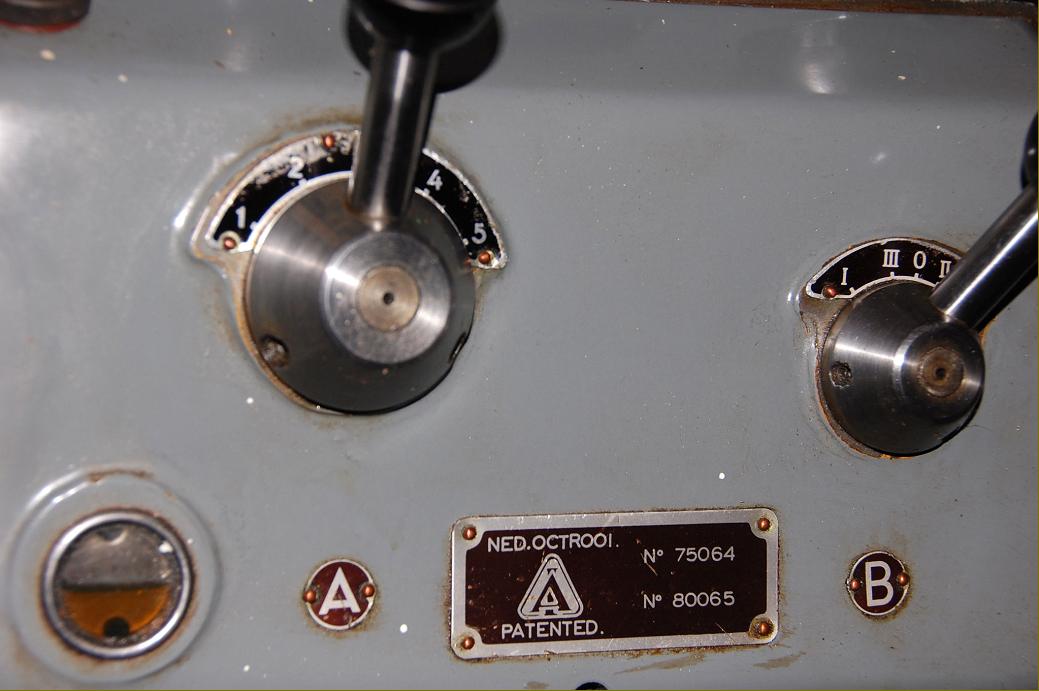
A 3-speed, 1 h.p. motor with its 4-step V pulley was mounted inside the cabinet stand on a height-adjustable plate pivoted on a bracket fastened to the substantial cast-iron door; opening the door automatically relaxed the belt tension allowing the speed to be changed. The drive to the headstock was by a single-stage V-belt and this drive arrangement - a three-speed motor, 4-step pulley and single-lever engaged backgear - produced an impressive range of 24 speeds from 45 to 4000 rpm. If required, a more powerful motor could be fitted - or even a completely different, mechanically-operated variable-speed drive system with expanding and contracting pulley of the type invented in the UK and once known as the "Ainsworth" drive.
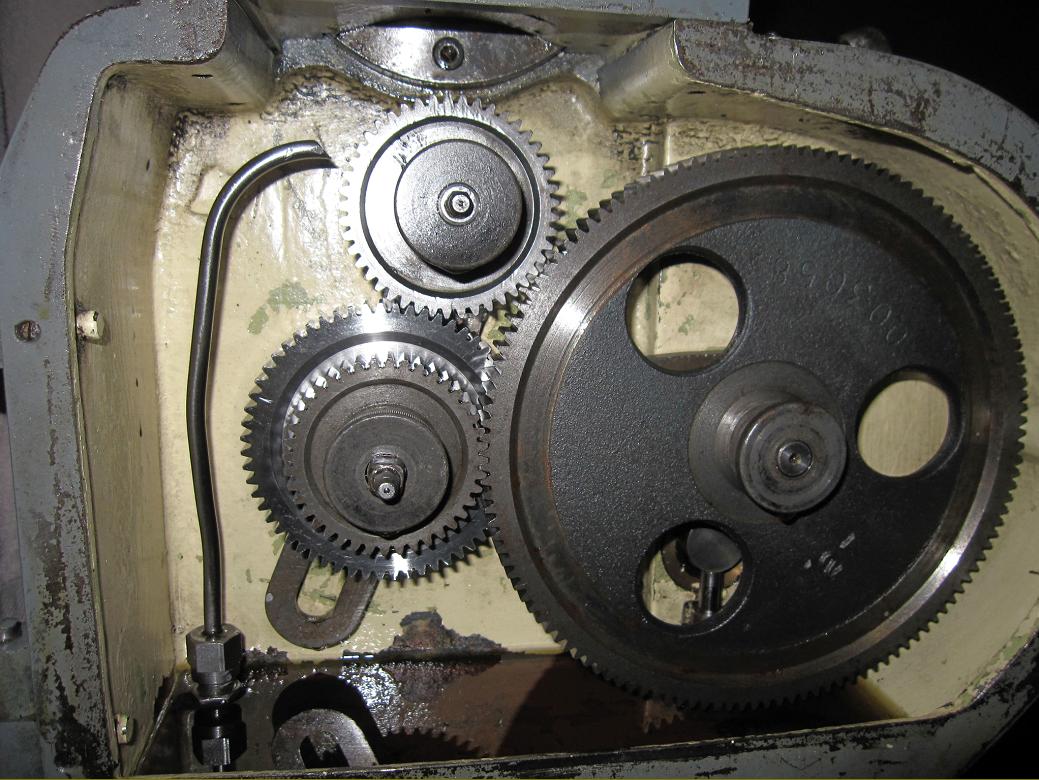
Able to generate metric pitches between 0.25 and 5 mm pitch and, with the addition of a supplementary transposing gear, English threads from 88 to 2.5 t.p.i., the screwcutting gearbox had its drive protected by cotton-fibre tumble-reverse gears) was The leadscrew, stiffened by being held in tension against an adjustable thrust ball bearing at the tailstock end, was slotted for its full length to provide a drive (from a keyed worm gear within the apron) for the power sliding and surfacing feeds; the feeds were each protected by a clutch, with a master adjustment provided on the outside front face of the apron and an independent setting (on the inside face) for the cross-feed. The slowest sliding feed along the bed was set at 0.033 mm per revolution of the spindle, the fastest at 0.5 mm.
Some versions of the lathe were fitted with a spindle-direction control shaft below and parallel to the leadscrew with an operating handle fastened to the right-hand face of the apron. In the photographs below the insertion point for the connecting link can be seen on the right-hand end of the gearbox immediately below the leadscrew.
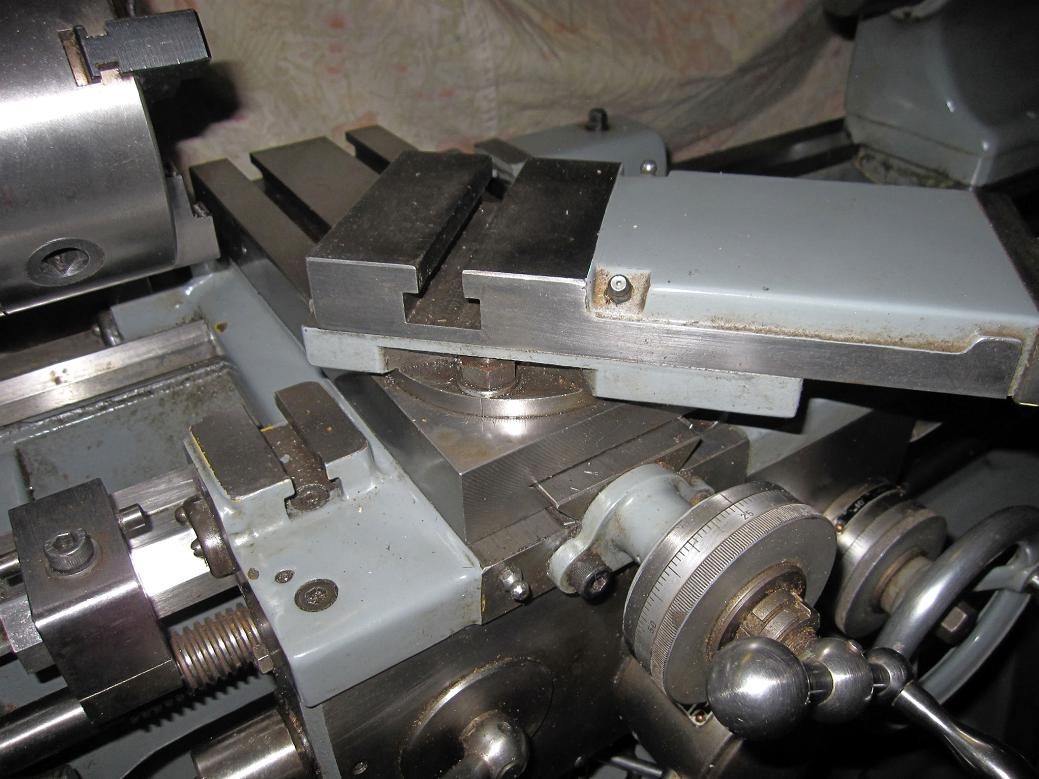
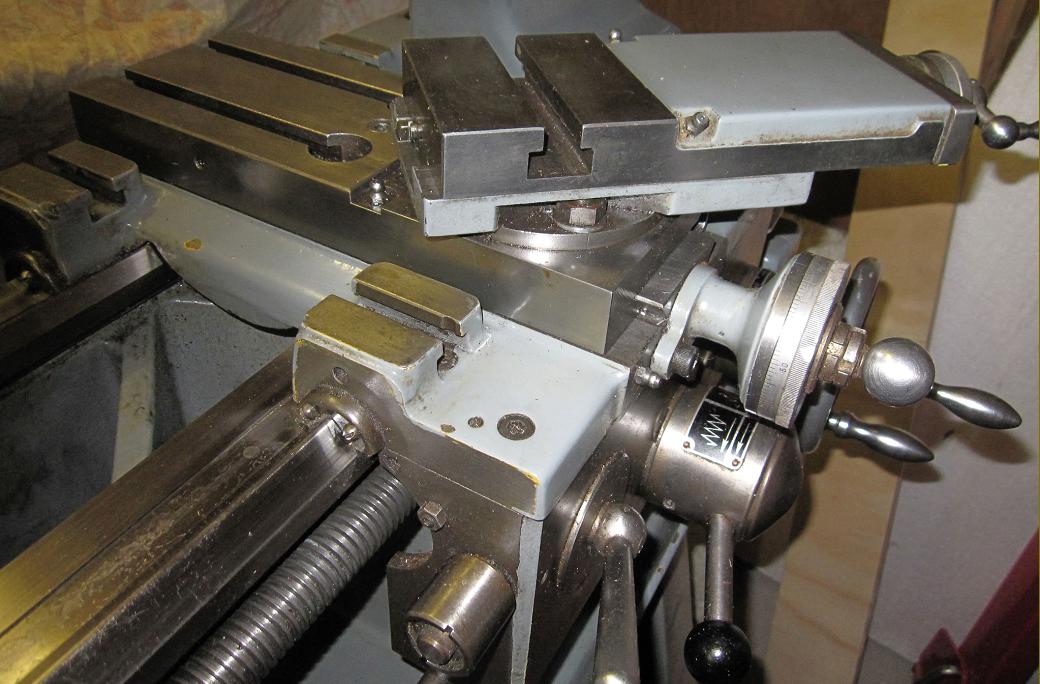
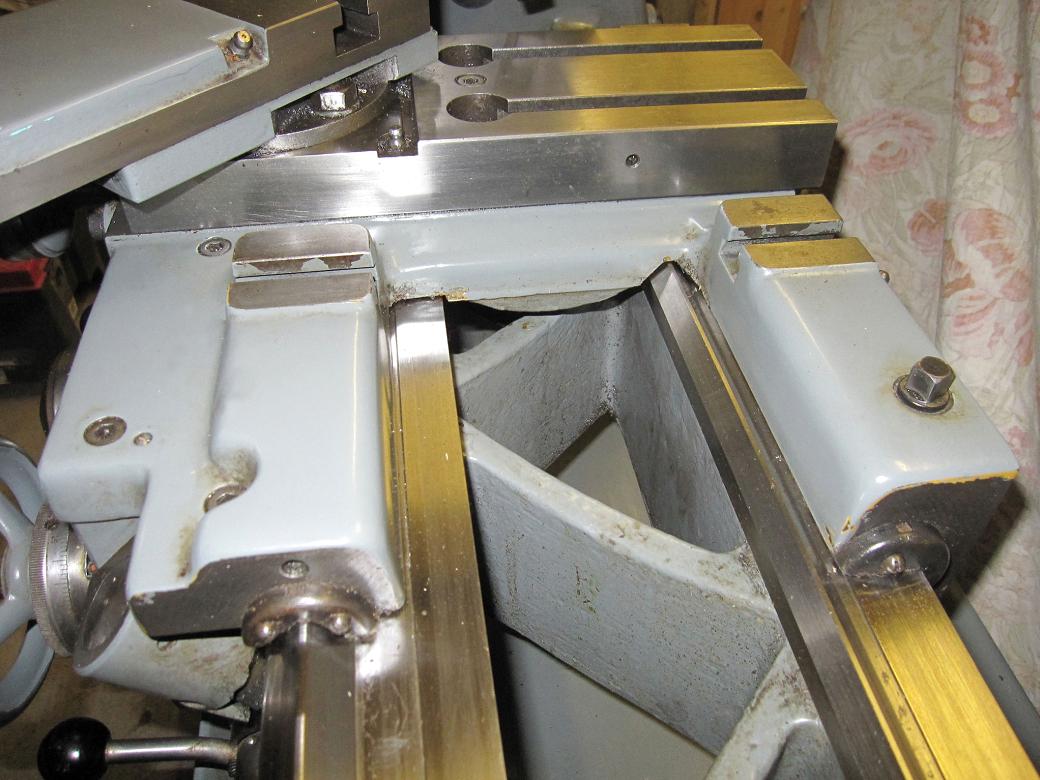
Beautifully constructed, the compound slide rest was fitted gib strips of the superior tapered-type, the feed screws fitted with miniature ball-bearing thrust washers to improve the feel against both inward and outward movements and (a nice detail touch) each slide was provided with nipples that allowed the injection of oil to lubricate its ways. In order to assist with the mounting of a rear toolpost or other fittings, machined into the rear section of the cross slide were two traverse T-slots, each thoughtfully provided with a hole bored at the inward end to allow the easy release of mounting bolts. Especially large, the cross-feed micrometer dial was crisply engraved and finished in a dull satin chrome. Especially strong T-slots were machined into the top of each saddle wing, so allowing the lathe to be adapted for boring and other special operations.
Of the traditional, precision-lathe type where the barrel protruded through both front and back of the casting - and so remained fully supported even when fully extended--the tailstock was equipped with a No. 2 Morse taper barrel. It is known that the Hembrug A1 was built in several versions with some incorporating extra mechanical refinements - for example, beds with riveted-on hardened steel "V" ways and roller bearings under the compound slide to prevent it from rocking.
A standard A1 weighed 1885 lbs (855 Kg) in its shorter-bed specification, and 2005 lbs (910 Kg) in its longer..
|
|