E-Mail   Tony@lathes.co.uk 
Home    Machine Tool Archive    Machine Tools For Sale & Wanted
Machine Tool Manuals   Machine Tool Catalogues   Belts


Flexispeed Miller Mk. 1 & Mk. 2 "Venus"
Flexispeed Milling Machine   Flexispeed MK. 2 Miller Pictures   
Additional Mk. 1 Miller Pictures
Flexispeed Home Page   
Norfolk Lathe   Perris Lathe   Cowells lathe

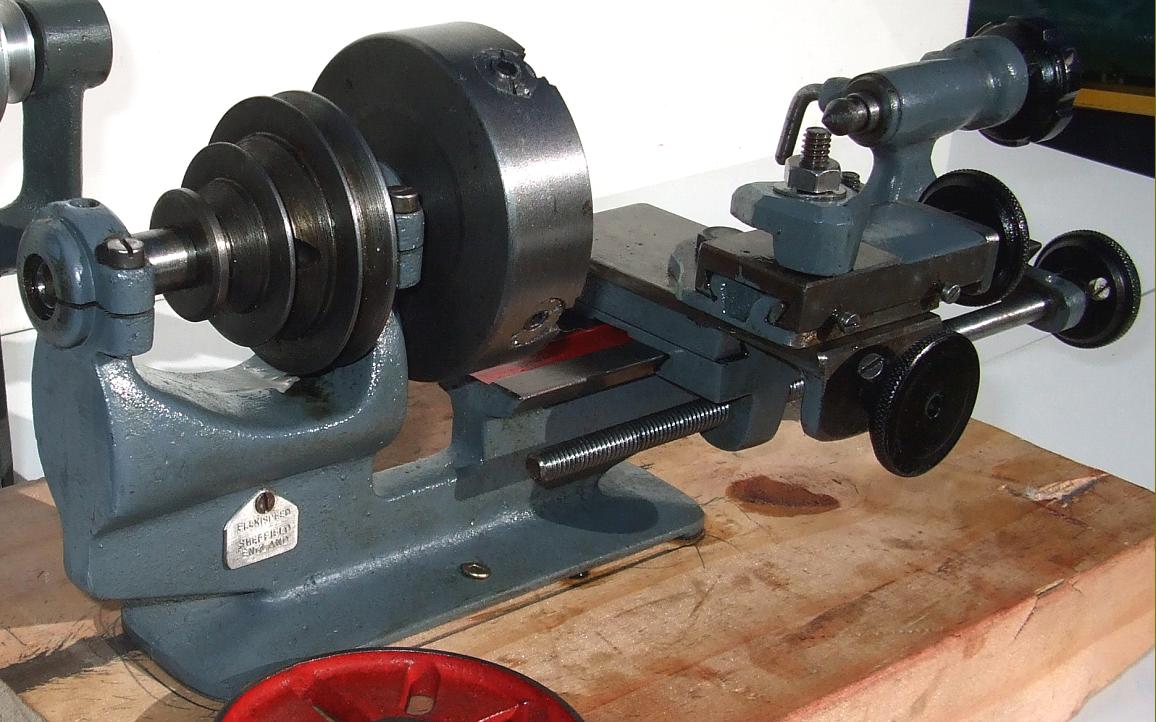
Produced from the early 1950s until the late 1970s, the Flexispeed horizontal bench miller was and was made in two versions, the Mk. 1 and Mk. 2. The former was a relatively simple affair with parallel sides to the main column and a three-step V-belt drive pulley carried between the spindle bearings with a bench-mounted countershaft available as an option.  Weighing around 44 lbs the machine stood 15.5 inches high, on a base 6" x 10.5", with the tiny table just 35/16" x 103/4" driven on its 5.5 inches of cross-feed motion by a 16 t.p.i square-form screw - but longitudinally though around 2.25 inches by an ordinary 3/8" BSF (British Standard Fine) right-hand pitch. The knee was elevated though its 5.5 inches of travel by an 8 t.p.i. square-form left-hand thread screw. Non of the simple cast-iron handwheels were graduated - an economy that would have rankled with owners as they got to grips with using the machine for the first time.
Running in plain, split bronze bearings the 9/16" bore spindle carried a No. 2 Morse taper nose into which socketed a 1/2" diameter arbour with 3/4" OD spacers. A three-step "Z" section aluminium pulley was carried between the bearings with step diameters of 1
5/8", 23/8" and 31/8".
In comparison, the Mk. 2 (called "Venus" in the advertising literature) was a substantially different machine with a much improved and strengthened column (with angled sides) bolted to a hollow, box-section, 13.25" by 10.5" cast-iron base. The drive system was completely re-engineered and integrated into the machine; the 2850 rpm, 1/4 hp, one-phase motor was held within the base and drove first to a large intermediate M-section V pulley (with a concentrically-mounted three-step pulley from the Mk. 1 with 1
5/8", 23/8" and 31/8" steps) running on a stud fixed into the back of the main column. From the intermediate pulley the drive was taken straight to the back of the spindle for three directly-driven high speeds, or diverted through a set of lathe-like 4 : 1 ratio backgears; the result, when used with the recommended motor, was a useful set of six speeds from 126 to 1500 rpm.  The motor switchgear was fitted into the side of the base and the belts and gears neatly enclosed under a tight-fitting cast-aluminium cover that hinged backwards from a lug on the rear of the base plate.
With a No. 2 Morse taper nose, the spindle ran in split, parallel, adjustable phosphor bronze bearings, and, although the front one was 1.125" in diameter, this assembly could not be considered the most rigid of designs for the rigors of milling. Socketed into the spindle was a three-inch long, 3/4" diameter horizontal cutter arbor with a 1/2" bore and a round overarm support carried in extensions to the main casting that reached above each main bearing. The overarm was not locked into place by split compression fittings, or even close-down slots, but by the simple and crude expedient of bolts (or socket-headed screws) that threaded through the casting on the right hand side and bore against the side of the arm.
An 8 t.p.i. square-form screw elevated the knee, the assembly arranged so that the thread, instead of  having to pass inconveniently downwards through the bench (like so many other small millers) rose upwards with its operating handwheel at the top. The screw was fitted with a micrometer dial calibrated in 0.005" increments.
With a vertical movement of 6", a cross feed of 2
1/4 " and a longitudinal travel of 11 inches, the  11" x 3.5" table carried two T-slots and was driven by chrome-plated handwheels graduated in 0.0025" divisions - as on the Mk. 1 the cross-feed screw appears to have been a square thread and the longitudinal and ordinary BSF type..
Although it was claimed by the makers to be "
of the finest quality grey iron and slides are hand scraped and fitted to close limits."  in the early 1950s, at just over £30, including a No. 2 Morse taper arbor, the Flexispeed was relatively expensive at just over half the price of a standard Myford ML7 lathe. The miller stood 20 inches high, weighed 100 lbs and was finished in Hammerite light blue.
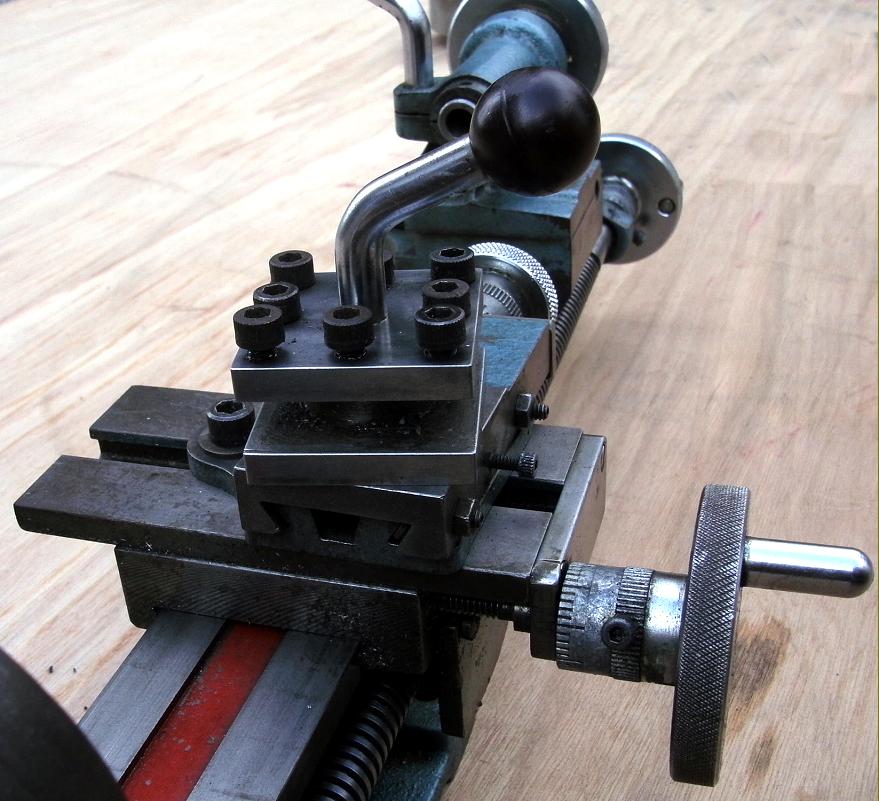
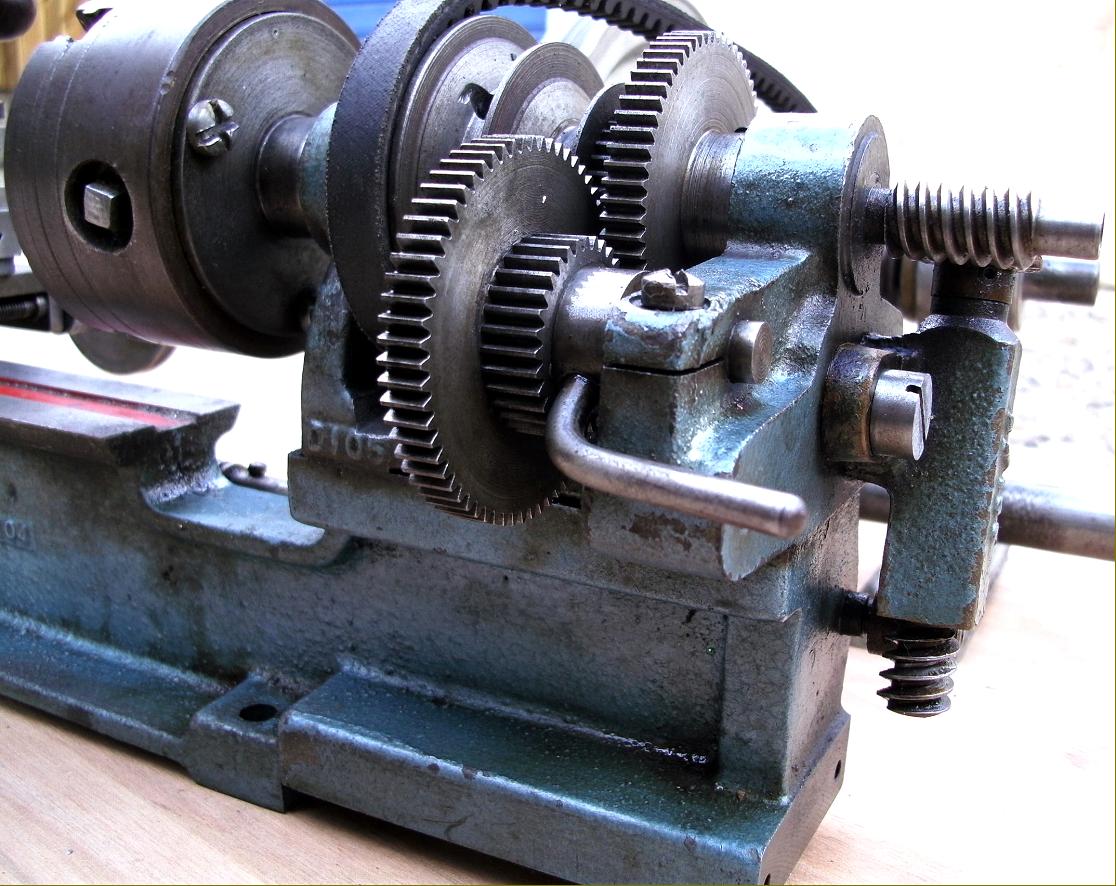
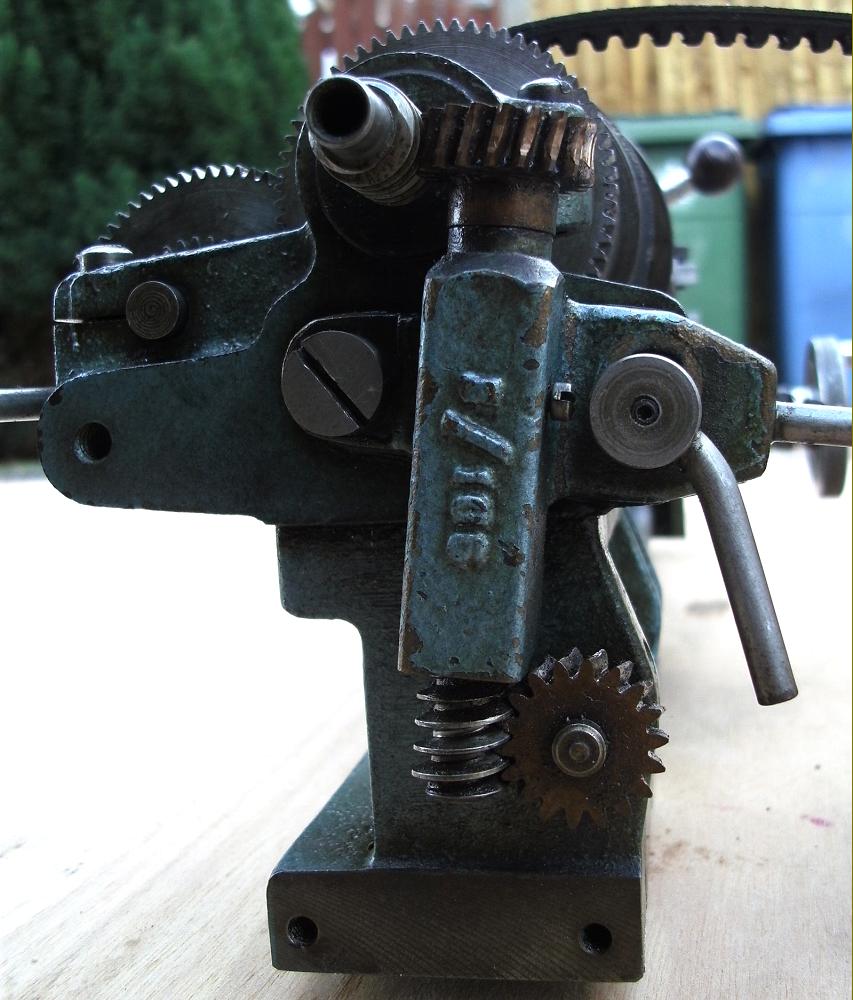
Additional photographs of a Mk. 2 miller can be seen here.
If any reader has one of these machines, either a Mk. 1 or Mk. 2, and is able to provide detailed photographs, the writer would be very interested in making contact..

The simple Mk. 1 Flexispeed miller--more pictures below

The Mk. 2 Flexispeed miller was greatly improved with a strengthened column, hollow base to hold the motor and a re-designed drive system.

On the Mk. 2 the drive system was completely re-engineered and able to be diverted through a lathe-like 4 ; 1 ratio backgear assembly that gave three high and three low speeds from 126 to 1500 rpm. The belts and gears were enclosed under a tight-fitting cover that hinged backwards from a lug at the rear of the machine's base.

A completely original Flexispeed Mk. 1 horizontal milling machine. Many additional pictures below and here