Home       Machine Tool Archive       Machine tools For Sale & Wanted
E-MAIL   Tony@lathes.co.uk

Dalton Lathes & Combination Machine
Combination Machine - Photographs      Conventional Dalton Lathes   Original 1918 Dalton
Unknown Dalton Model   Dalton Lot 4 Model B4

Hubert Dalton (1866--1952) the manufacturer of Dalton lathes, was English by birth and the first born of eleven children. He moved to the United States when he was 16 and found work in New York as a toolmaker and machinery salesman. His subsequent and very successful career as a businessman involved several companies including the Dalton Motor Car Company, the Dalton Manufacturing Corporation of New York (making lathes), the Dalton-Thibault Corporation of New York , the Armstrong Products Corporation (late 1920's), the  Willowbrook Corporation (a nursery business - Dalton had a love of hybridising orchids) and the  well-known Dalton Tool & Machine Corporation based in  South Beach CT. The latter company enjoyed a well-equipped plant where castings could be poured and parts and accessories machined for lathes and other lines.
Production of lathes began, it is believed, in 1910 with the "OT" Series, a 3.5-inch centre height machine of light build. The various models were then built in "Lots" numbered 1 to (possibly) 8 with each assigned a fresh set of serial numbers - and hence some duplication, though of course within the different Lots. Early machines, as might be expected, were of light built and show considerable variation in design from year to year with, for example, three different types of tumble-reverse mechanism discovered. "Lot 4" lathes had probably arrived by 1914 (and coincided with Dalton's first patent application) and by the time "Lot 6" lathes of the 1920s were in production changes had been so extensive that they could be considered equivalent in status to a South Bend with a particularly heavy build and, consequently, a greater weight than their competitors. However, not all Dalton models can be precisely identified - and examples have surfaced where the exact model remains, for the moment, a mystery.
The New York branch seems to have started operations at the outbreak of the First World War, in 1914, and finished (having never made a profit, and being forced into liquidation) in 1925. Court records from 1933 show that Mr. Dalton refunded creditors some $365,000 from his own pocket, a deep one almost certainly filled by profits from his other interests including the extensive South Beach Plant (constructed in the early 1920s and first occupied by the Welte-Tripp Pipe Organ Company). The papers appear to show that, although production of lathes was officially moved to South Beach during 1925, the New York address was still being used - some New-York-built machines being discovered with their address details on the gear chart overlaid with a small tag giving the South Beach location. The youngest Dalton known is Serial 7014, manufactured in 1929, though production may have continued for a little while longer into the years of the Great Depression. After being vacated by Dalton the South Beach plant was taken over (in 1931 or 1933 and complete with all the existing machine tools for the production of lathes) by the Swedish vacuum cleaner company Electrolux as their first American factory.
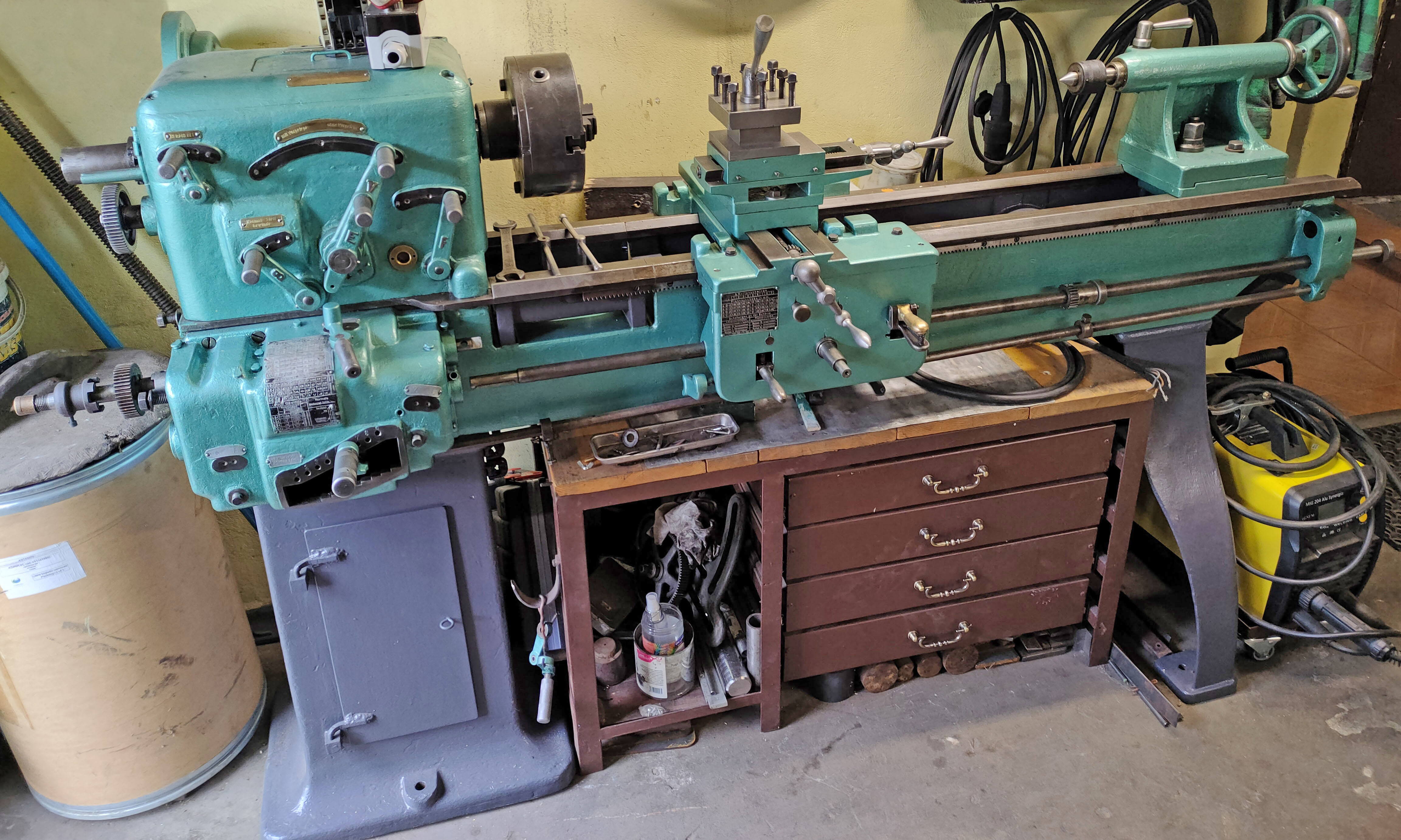
Dalton's ordinary lathes were of an absolutely conventional pattern and listed with swings of  7-inches, 8-inches and 9-inches with backgear and screwcutting by changewheels only - the jump to a gearbox-equipped lathe never being made. A rarer 6-inch lathe (with a 3-inch centre height) was also produced, but details of this machine are, for the moment, uncertain. A variety of interesting stands were available, including some with remarkable (and rather over-engineered) motor drive-mountings and one with a column plinth and single-pedal drive.
The "Combination Machine" was large and heavy - but based on a standard Dalton bed and carriage; this machine was obviously a new departure for the Company with elements of the design protected by patents taken out in July of 1921 and February of 1923. The lathe was originally advertised as being of: "
special interest to garage and steam-ship owners" and was claimed to occupy: "one fifth of the space taken up by separate machines of the same type" and, of course, to need just: "one-fifth of the power to run" - although using all the combinations at once on the Dalton would have been impractical.
A detachable gap-bed, backgeared, 13-inch swing screwcutting lathe was the basis of the assembly and built onto the headstock end were a horizontal miller - with a powered 24" x 7.5" table - and a combined vertical milling and drilling machine. The most ingenious feature of the machine was the arrangement by which power was fed to the vertical milling head: the smaller of the two "backgears" on the headstock spindle drove not only backwards to the backgear "proper", but also outwards to a bevel box that transmitted the drive vertically - either through an optional 3-speed gearbox or directly through a dog-clutch - to a second set of bevel gears at the very top connected to the vertical milling spindle. Combined with the headstock cone pulley, backgear and built-in gearbox, this arrangement could give the milling and drilling head up to (an impressive) eighteen speeds.
The arbor support overarm for the horizontal miller was made to pass through the top of the headstock and so, to an extent, stiffened the structure.
The lathe admitted 37" between centres in the standard-bed version and 73" in the long bed - the latter being braced by a third leg positioned between the outer two. The 4 Morse-taper, phosphor-bronze bearing spindle had six speeds, between 20 and 441 rpm, a hole 11/16-inch in diameter and a spindle thread of 17/8" x 8 tpi. On the "Motor Drive" version a shielded 1.5HP motor drove first to a reversing countershaft unit which contained helical gears and clutches and then, vertically, via a three-step pulley and 2-inch wide flat belt which passed around wide, adjustable idler wheels (running on ball bearings) set behind the headstock; the idler wheels turned the belt through ninety degrees to pass  horizontally to and from the headstock spindle.
The lathe changewheels drove not only the 1-inch diameter 8 t.p.i. leadscrew for screwcutting and power sliding and surfacing, but also, though a 3-speed gearbox, the milling table power feeds. Because one motor drove the entire machine it was impossible to divorce cutting speeds from table-feed rates and, although the range was a "deep" as possible, it was still an unsatisfactory arrangement if optimum machining capability was required.
The Motor-Drive lathes were supplied with a set of changewheels for screwcutting, a drive plate, large and small faceplates, a fixed steady, eight spanners, a crank handle to elevate the miller knee, a drill knock-out drift, a round drilling table with base to mount on the rectangular milling table, a plain milling vice, four clamp bolts, one milling arbor, an oil pot and driving belt.
These interesting Dalton lathes are rare and if any owner has further literature, or photographs, the writer would be interested to hear from them. Photographs of a Dalton Combination can be seen here.
For more Dalton information visit Dennis Turk's Web Site

Annotated picture of the Dalton Combination Machine, designed, in this form, to be connected to overhead line shafting. This example is fitted with the optional 3-speed gearbox drive to the vertical head.

Horizontal Milling

End View

Vertical Milling

Drilling with the standard round table and mounting base

Rear View of the Dalton Combination Machine showing the unusually complex belt run arrangements and motor-drive-clutch unit.

Dalton Combination Machine fitted with the self-contained "under-slung" motor-drive system that employed friction clutches engaging helical gears to provide forward and reverse to the lathe spindle and other rotating parts. This machine has the simpler and cheaper direct shaft-drive to the vertical head through a dog clutch.

Home       Machine Tool Archive       Machine tools For Sale & Wanted
E-MAIL   Tony@lathes.co.uk

Dalton Lathes & Combination Machine
Combination Machine - Photographs      Conventional Dalton Lathes   Original 1918 Dalton
Unknown Dalton Model   Dalton 4 Model B4