|
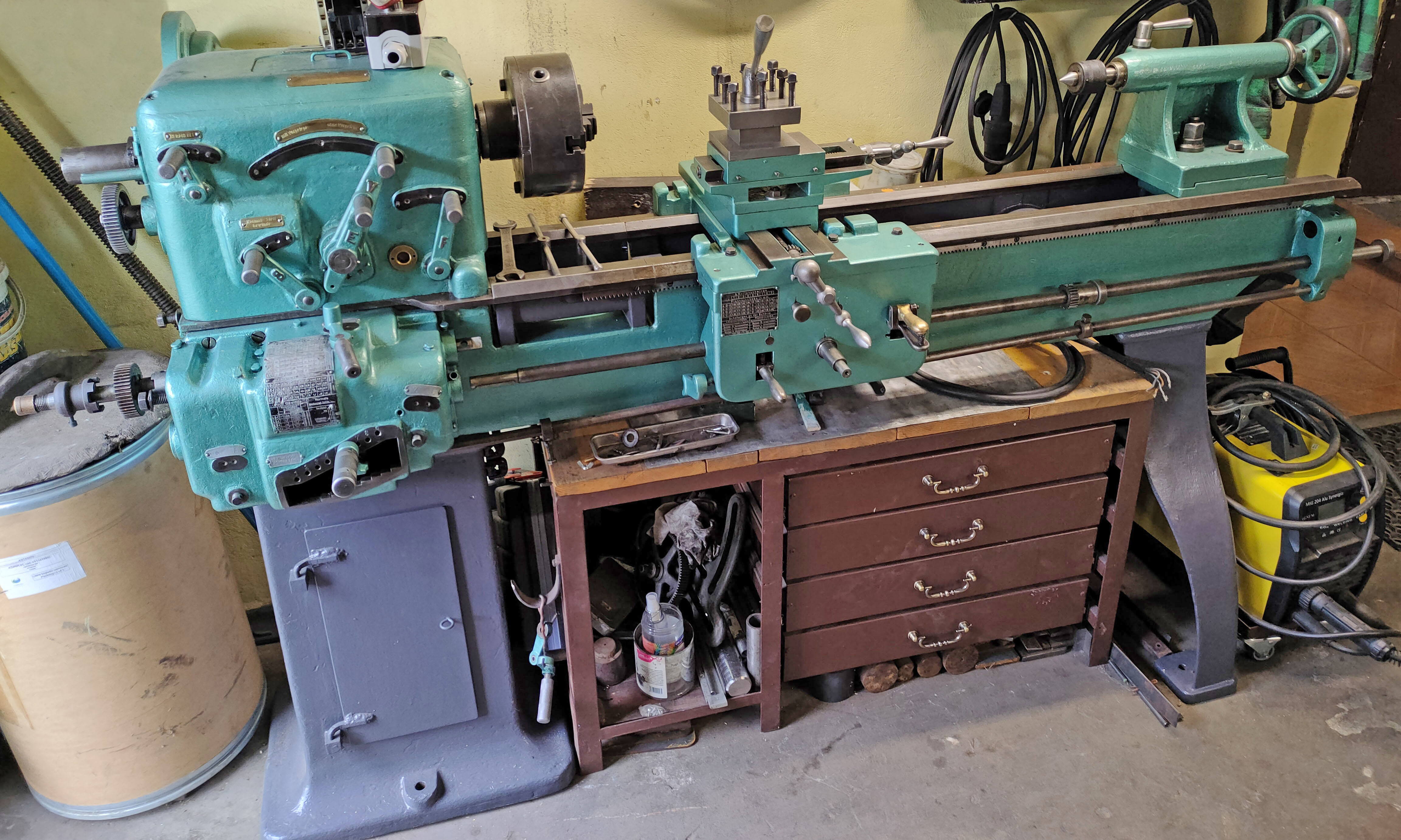
Clearly not by a Company called "New Wonder", this backgeared and screwcutting lathe with a centre height of about 6.6" and taking perhaps 30 inches between centres, is not by any machine tool company known to the writer. Resident in England, it appears to have been made in Europe during the 1930s, possibly in Czechoslovakia. While it follows conventional design for the period, the covered headstock with its built-in, lever-operated spindle brake and an enclosed motor drive does set it apart from many other makes, where an exposed flat-belt drive would have been common.
Screwcutting was by changewheels; there was no screwcutting gearbox, though this may have been an option. As the screwcutting chart lists both Inch and metric pitches, a metric transposing changewheel of either 127 or 63 teeth must have been included in the standard set. A thread dial, mounted on the left-hand face of the apron, would have been a standard fitting.
Fitted power sliding and surfacing feeds; control was by the long-established Colchester method: a bar sliding along the bottom edge of the apron, then lifted into one of two slots to select the feed direction. Oddly, for such a relatively large lathe, there was no power shaft; the drive was taken from a keyway in the leadscrew, which would have required additional, probably expensive, gearing inside the apron to alter the drive through 90°. The leadscrew - always a difficult item to make accurately - appears to have a rather fine square thread rather than the expected Acme type.
Longer on the tailstock side than those on the headstock, the saddle wings were machined with four T-slots to let them act as a useful boring table.
With V and flat ways, the bed was originally fitted with a removable gap piece, though, as is so common, the one for the lathe in the photograph appears to have been lost..
|
|