|
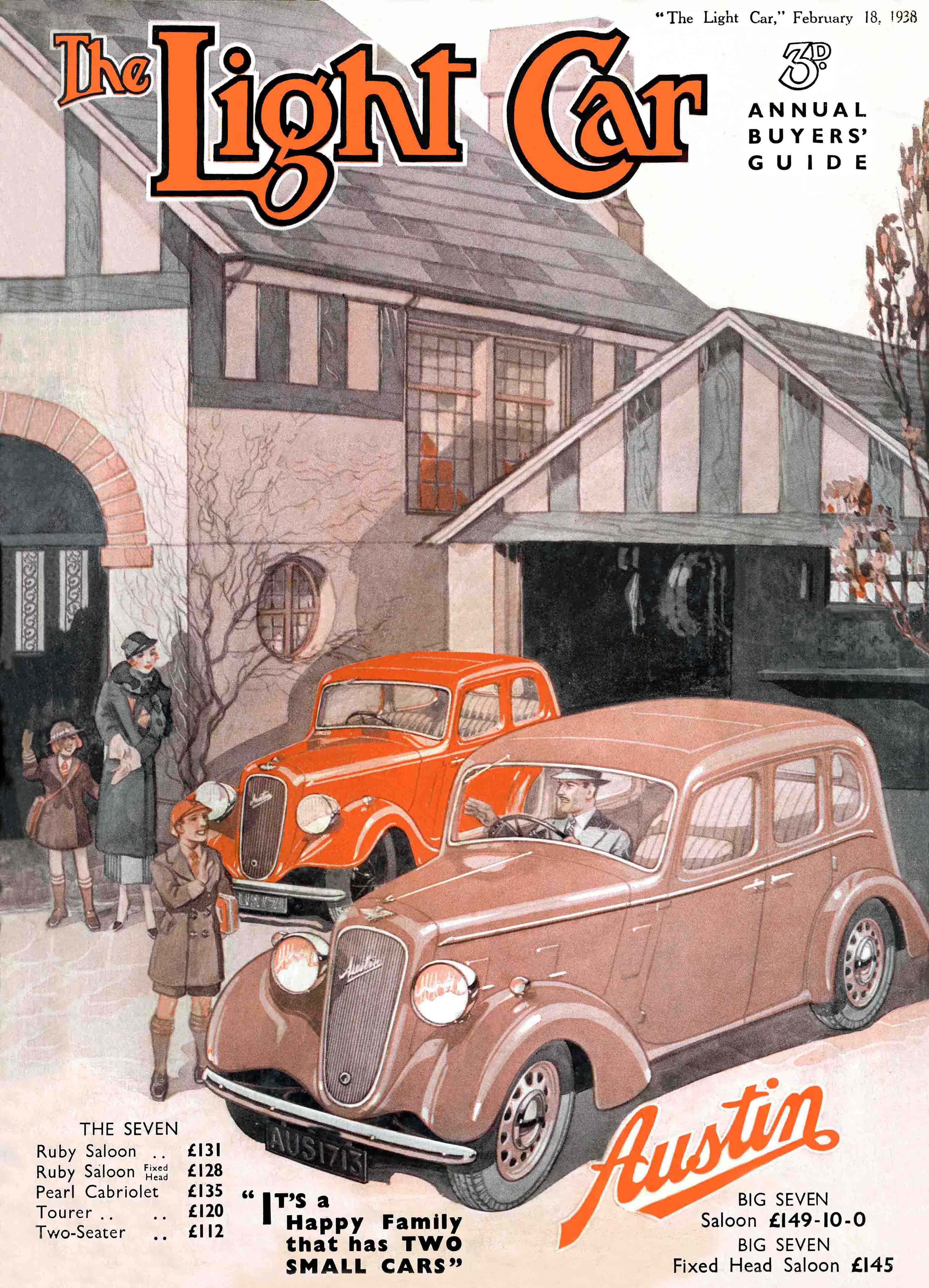
The first Ruby, the Mk.1 Type ARQ. An recognition feature is the way that the rear side windows that form an acute angle at their lowest, rearmost point
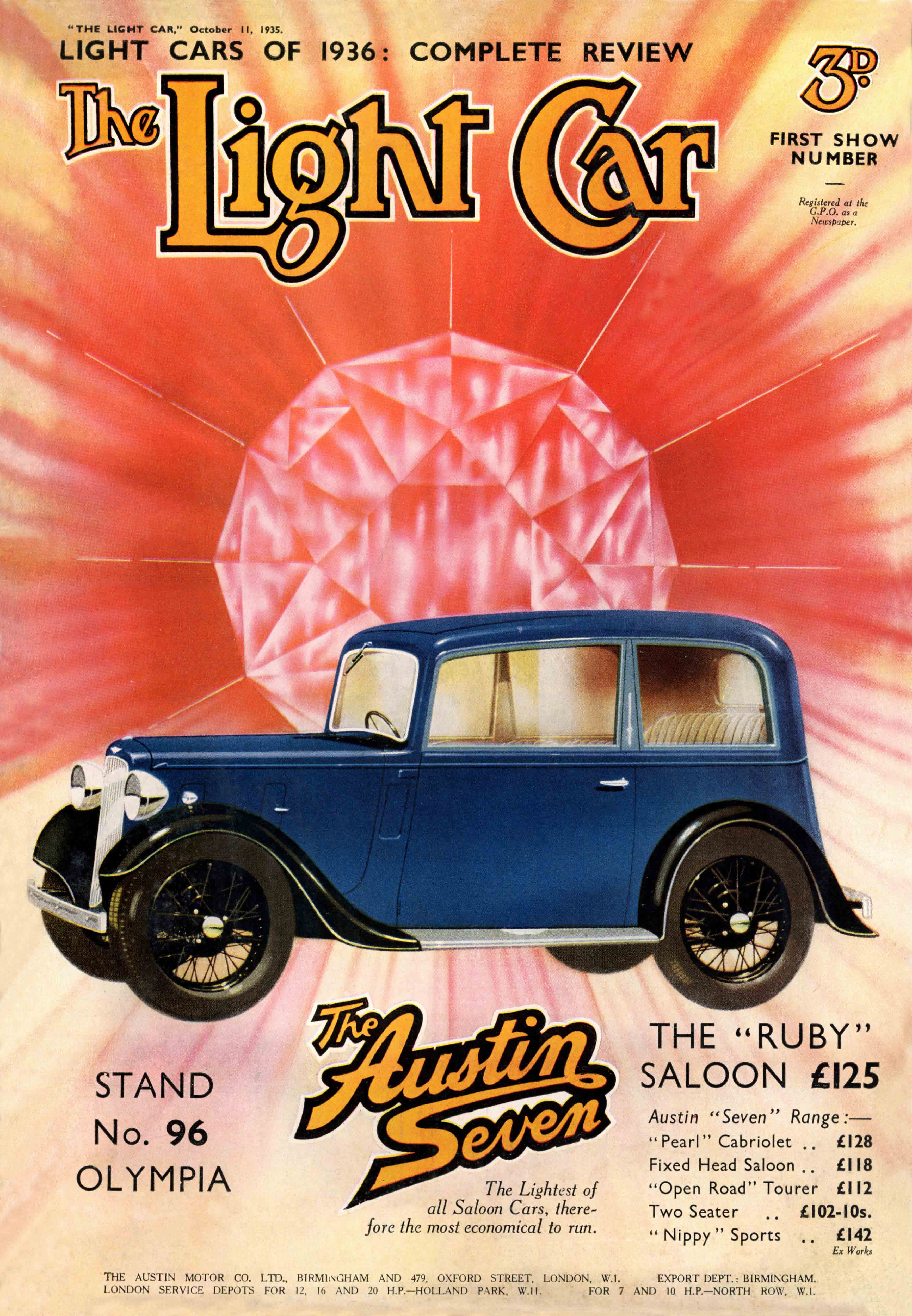
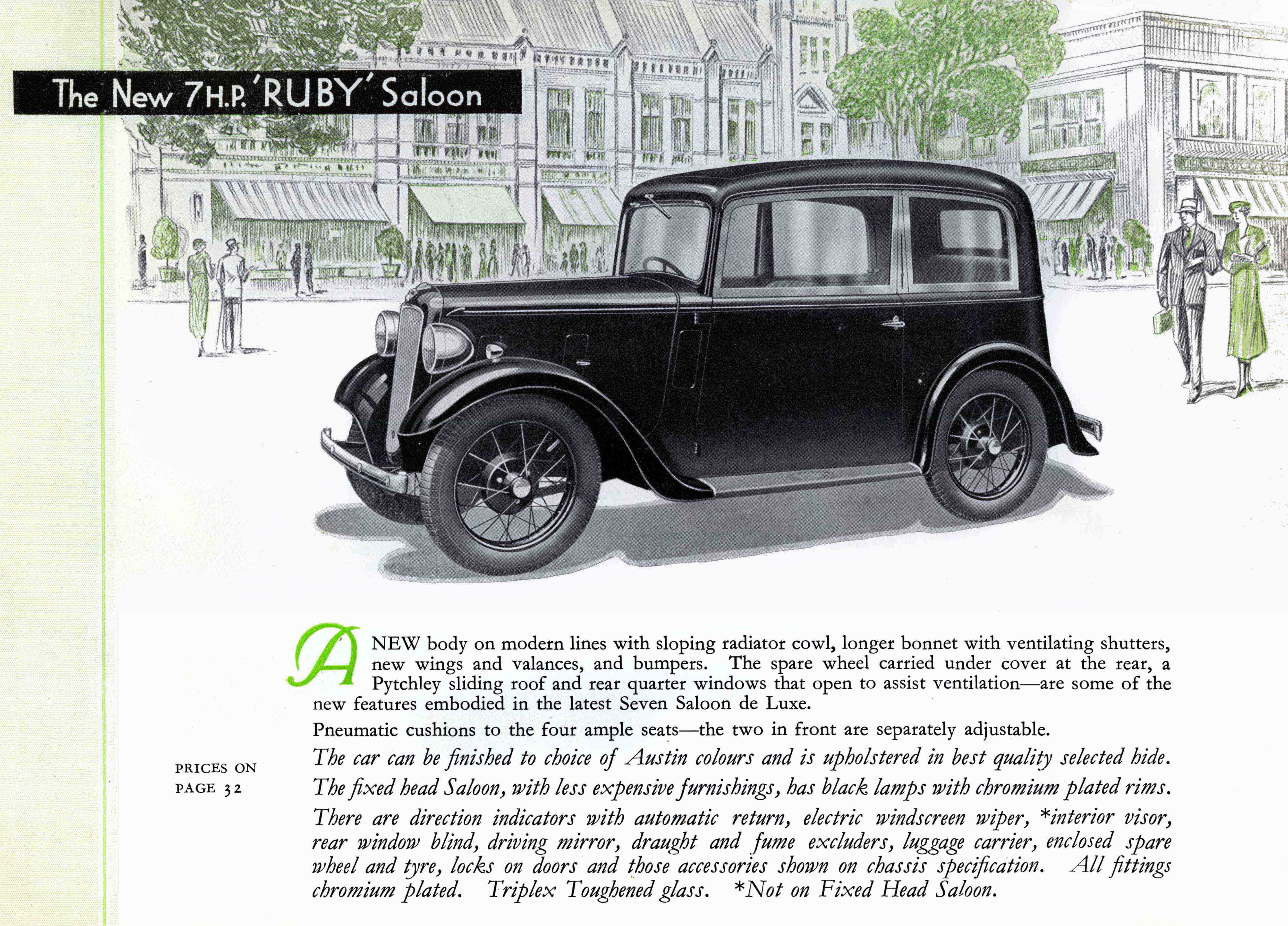
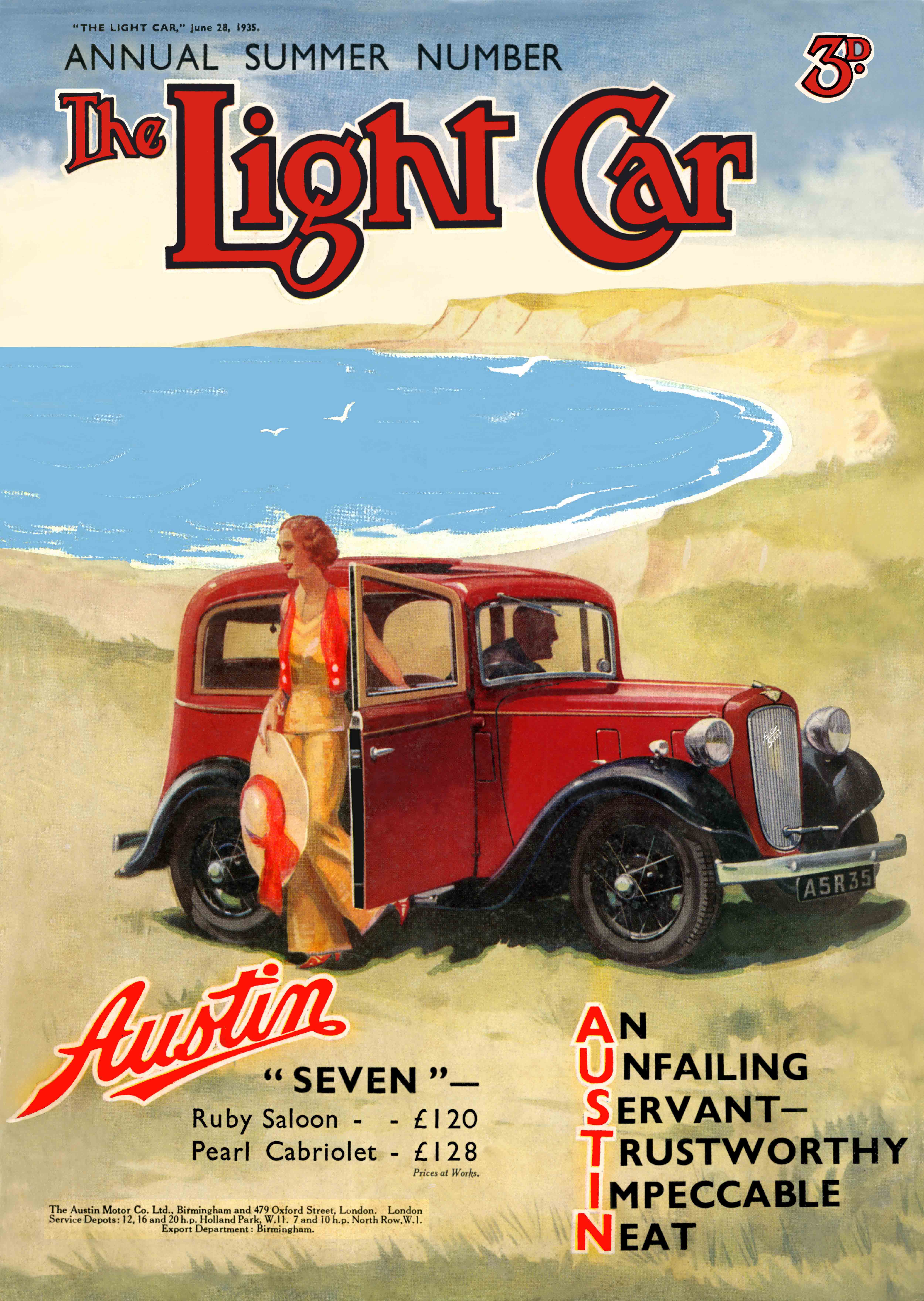
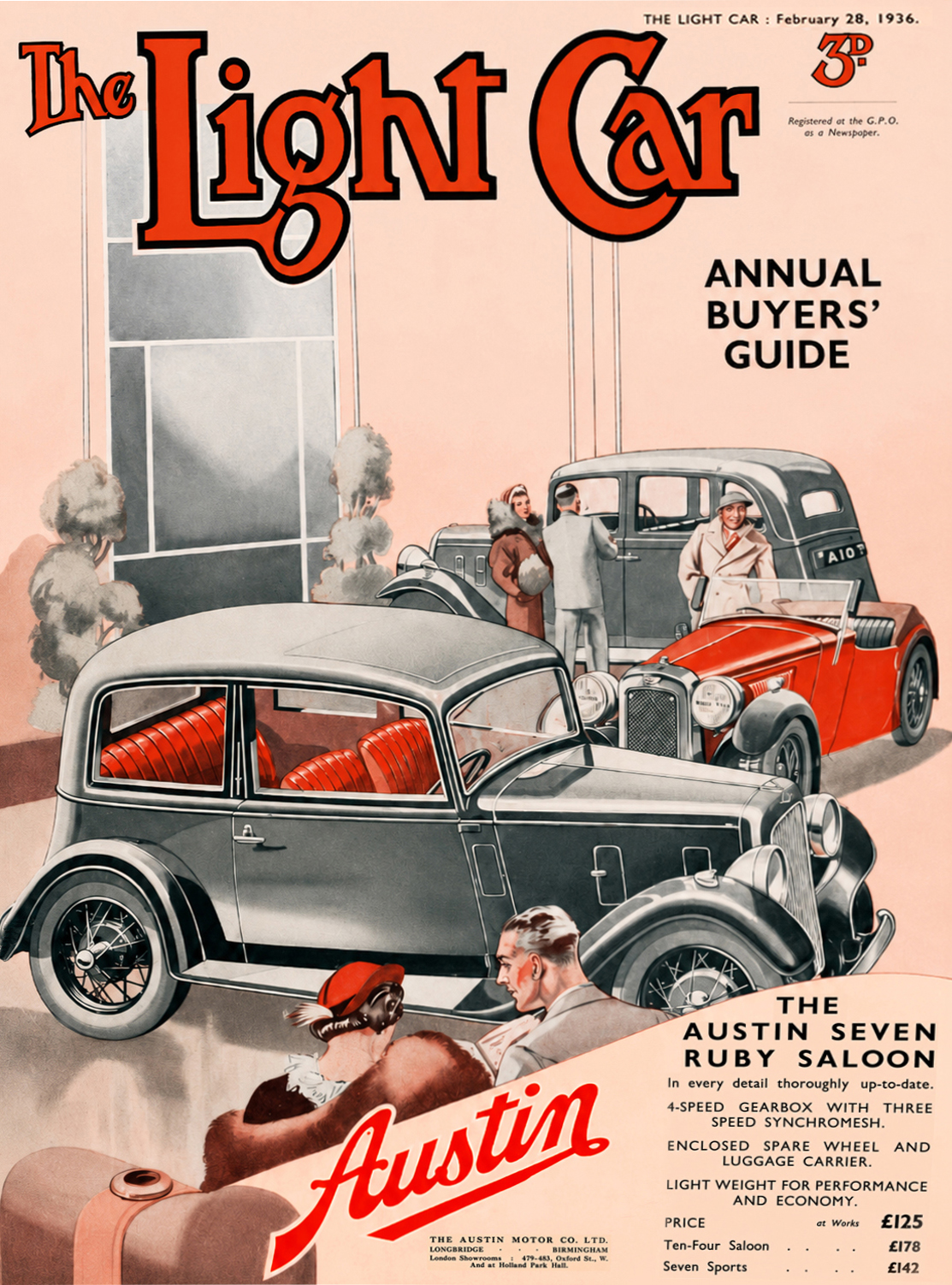
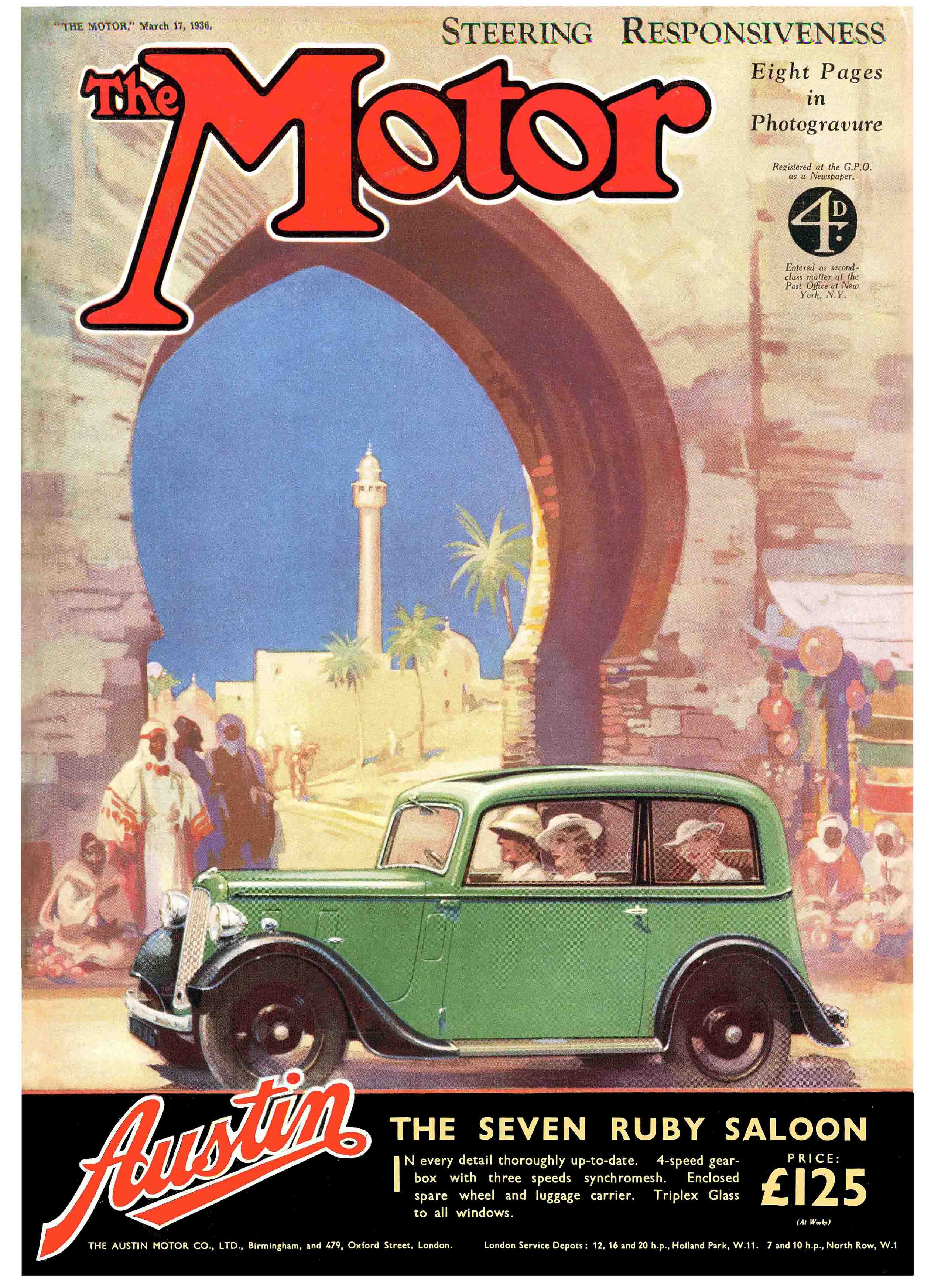
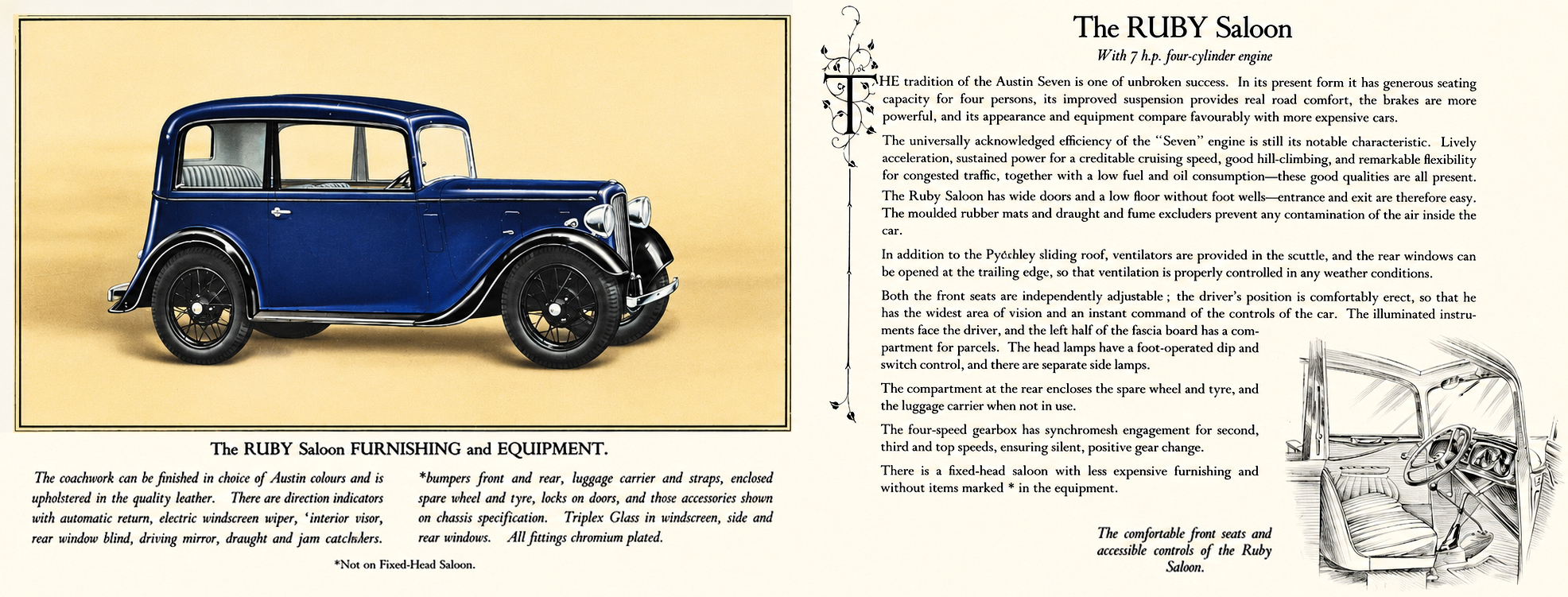
Austin listed what are now generally known as the Mk.1 and Mk.2 versions of the Ruby in its official registers as Types ARQ and ARR, respectively. Austin introduced the ARQ in July 1934 in two forms. The "De Luxe", priced at £120 on its introduction, was fitted as standard with bumpers, a Pytchley sliding roof, chromium-plated headlamps, flush-mounted trafficators in the B-pillars, an electric windscreen wiper on the driver's side, and an interior sun visor. Its price was increased to £125 in August 1935.
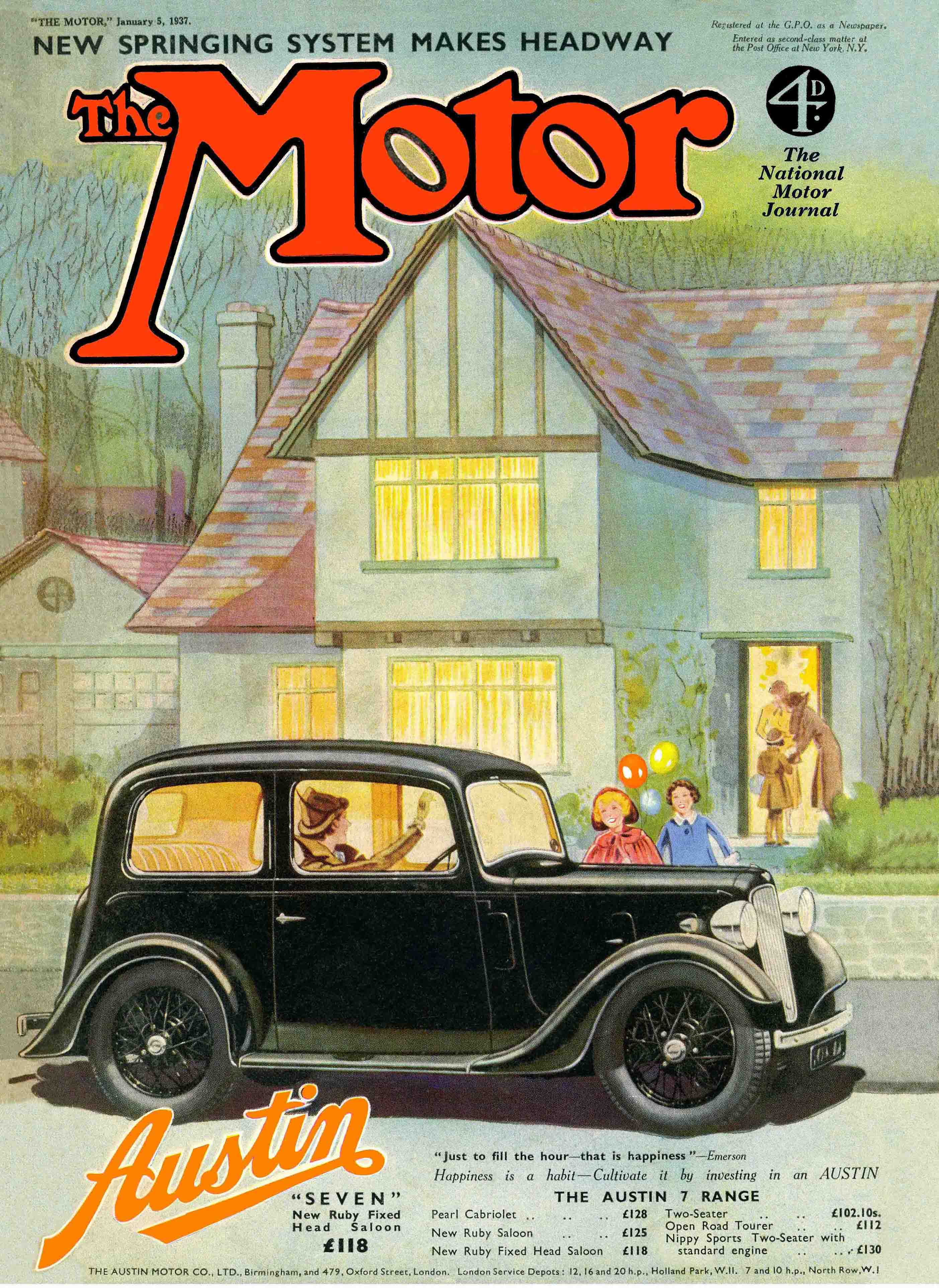
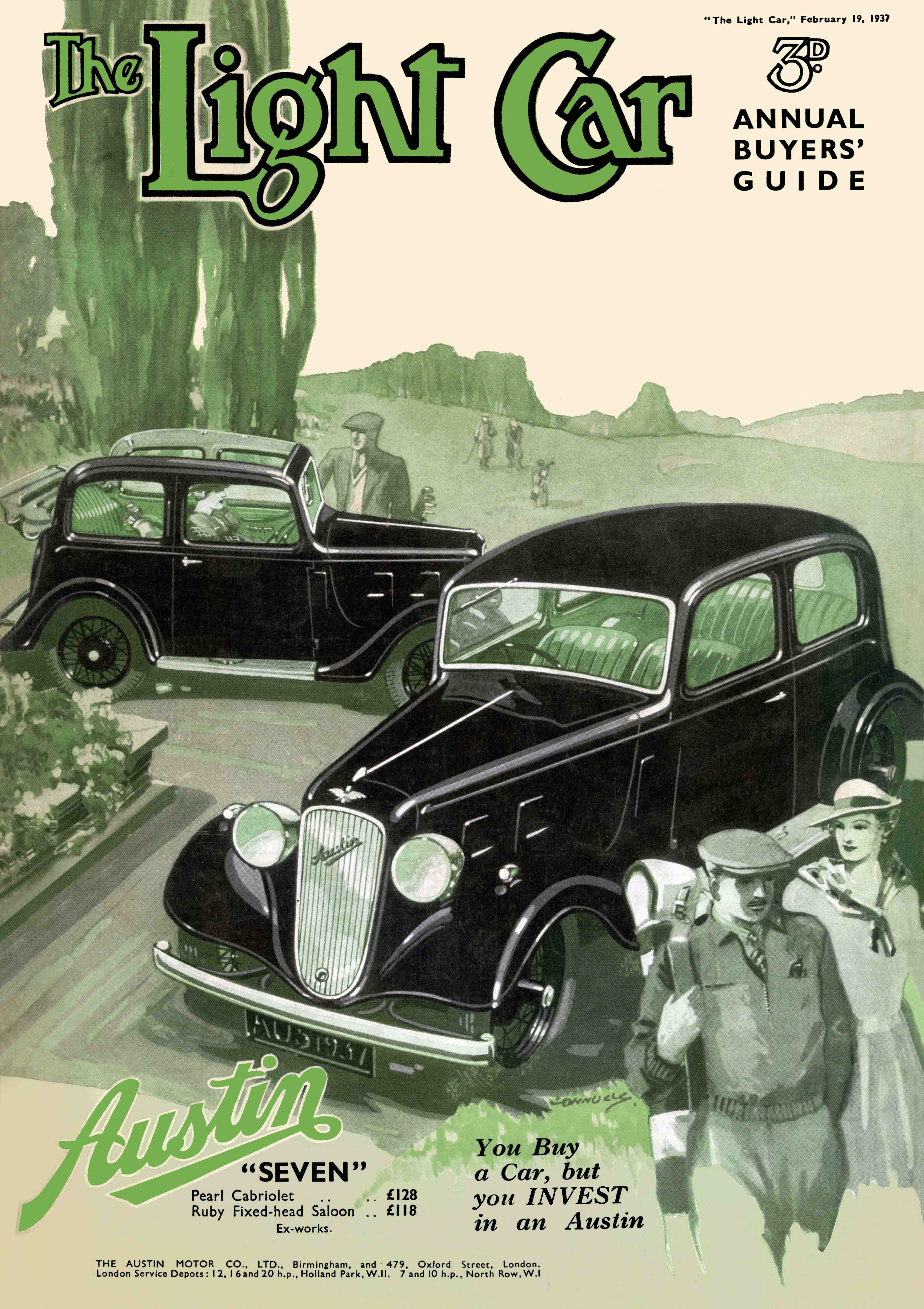
The other version was the now seldom found and originally slow-selling "Fixed Head", priced at £112 when introduced and increased to £118 in August 1935. This omitted the bumpers and sun visor, had black-bodied headlamps with chromium-plated rims and, as its name suggests, a fixed roof. The roof was nevertheless fabric-covered and surviving cars are sometimes found with a "smoker's hatch", a small opening intended to provide a modest degree of ventilation.
The headlamps fitted to the Mk.1 Ruby were the Lucas Type LB130, the first example used on the Seven to have their glasses moulded and fluted to shape and direct the beam correctly. While the new headlamps provided improved illumination on main beam, on dip it was a different story. Gone was the remarkably effective and simple Lucas-Graves system employed on the RN and RP saloons, where both bulbs dipped; instead, in a moment of madness it was arranged for the nearside reflector to be flicked downwards by a heavy solenoid unit and the offside bulb to extinguish. During 1934 and into 1935, the slidelamps were Lucas LD108s, with reeded-pattern glass and a blooming awkward-to-fit twist-on rim. From some point in 1935 onwards, the sidelamps changed to the Lucas LD109 type, whose rims were secured with a screw. During this period, the reeded-pattern glasses were gradually phased out and replaced with plain ones. Curiously, all the glasses used in this series are marked LD108, regardless of the lamp model they were fitted to.
At the rear, the Ruby always had only one light: a centrally mounted Lucas ST38D, a fitting always referred to as the 'pork-pie' type. At first, the lamp also illuminated the number plate. Still, from late 1935, in anticipation of a stop light becoming compulsory on January 1st 1936, it was modified to combine stop, tail, and number-plate lights in a single unit.
During the 1940s and 1950s, when many Rubies were being run into the ground as little more than mobile wrecks, the sliding roof was frequently sealed up, often none too elegantly, and rendered inoperable. However, the original internal fittings were commonly left in place, and restoration of the sunroof is often possible. Some export-market Fixed Head cars are reported to have been supplied with all-metal roofs and, as some of these cars have subsequently returned to Britain, they have sometimes caused understandable confusion over what is, and is not, original.
The Ruby used the comfortable Moseley "Float-on-Air" pneumatic seat cushions with factory publicity literature describing the De Luxe upholstery as selected hide. At the same time, the Fixed Head had "rather less expensive furnishings". Rubber floor mats and a draw blind for the rear window were also standard.
Although a Hardy-Spicer universal joint had replaced the Carden-block joint at the rear of the propshaft from 12 June 1933, at chassis 176,687, the front fabric coupling was retained. With the introduction of the low-frame cars in 1934, the entire arrangement was finally revised, with a proper Hardy-Spicer propshaft fitted with needle-roller universal joints at both ends. The complete assembly was listed as Part BP161.
By this stage the Ruby was, of course, a considerably heavier car than the post-June 1930 coupled-brakes Chummy. Yet its braking system remained fundamentally similar, apart from the wider drums introduced in 1932 and the more effective, better-supported "centre-pull" brake cross-shaft. A further attempt to improve matters came in July 1935 with the introduction of what is variously described as the "oval backplate" or "offset-shoe" arrangement. From chassis 226,847 the shoe fulcrum points were moved outwards and longer operating levers fitted; as the shoes now contacted the drums more equally and with greater pressure, braking efficiency increased notably. The corresponding alteration is recorded on Pearl Cabriolets and Open Road Tourers from chassis 226,873.
Another small but important change followed in May 1936. From chassis 246,176, listed as Car ARQ 35,030, the brake drums were changed from steel to much more rigid cast iron, the new drum carrying the part number 1A-4106. Later that same month, another alteration was made when, from chassis 246,835, the offset brake shoes were changed from aluminium to steel. The new steel shoes, part C1-167, are particularly interesting because they belong to a very short-lived intermediate stage in the development of the Seven's brakes and were fitted only from chassis 246,835 to 249,700, a run of just 2,866 units. At chassis 249,701 in July 1936, the entirely different Semi-Girling system was introduced.
Contrary to what is sometimes assumed, however, the first Girling shoes were not C1-312; the original Semi-Girling arrangement used C1-188 and C1-189 shoes provided with spring-anchor studs. The later C1-312 shoe, without these studs, did not appear until chassis 276,213 in July 1937. The comparatively rare C1-167 steel offset shoes (why they were made in steel is a mystery) therefore represent the final development of the old Austin braking system rather than, of course, the first version of the Semi-Girling type.
It is also worth clearing up a possible source of confusion concerning Austin's numbering system. Throughout production of the AQR Ruby, the Car No. and chassis numbers remained separate sequences: As an example, one Seven had chassis 246,176 and Car No. ARQ 35,030, these bearing no obvious relationship to one another. With the introduction of the New Ruby in July 1936, Austin abandoned the separate Car No. and the chassis number became the primary way to identify a car.
Several other detail changes were made during 1935 and the first half of 1936. From chassis 235,130, in November 1935, a cast-iron fan pulley replaced the earlier type (though interchangeable with it); from chassis 236,210, in December 1935, the electrical system was changed from negative to positive earth; and for 1936 the tiny Lucas Magmo barrel-type speedometer gave way to the larger, dial-type and conventional Nemag needle instrument. In March of the same year, from chassis 241592 the dipswitch became foot-operated, and in June 1936 a self-lubricating Oilite bush was fitted to the fan pulley spindle.
The ARR, or "New Ruby", followed in July 1936, beginning at chassis 249,701. One important point is that the much smoother three-bearing engine was not actually introduced with the Mk.2; it had been fitted to the Mk.1 earlier. The A7CA Index Cards give it as engine 249001 or 249052, the latter supposedly on chassis 247,765, car No.35,724. As the new engine had a stiffer crankshaft, the distributor was also listed as having been modified, though this probably only concerned the advance curve and perhaps the maximum advance allowed. Another change was the use of a Borg and Beck clutch, from chassis 247765. At this point the separate Car Number is dropped and the chassis Number becomes the sole factory reference; engine and chassis number changes should not be treated as the same number.
The new ARR inherited this engine, along with the higher-compression Ricardo-type cylinder head (previously used on sporting Sevens) and other improvements that made it a distinctly more developed car.
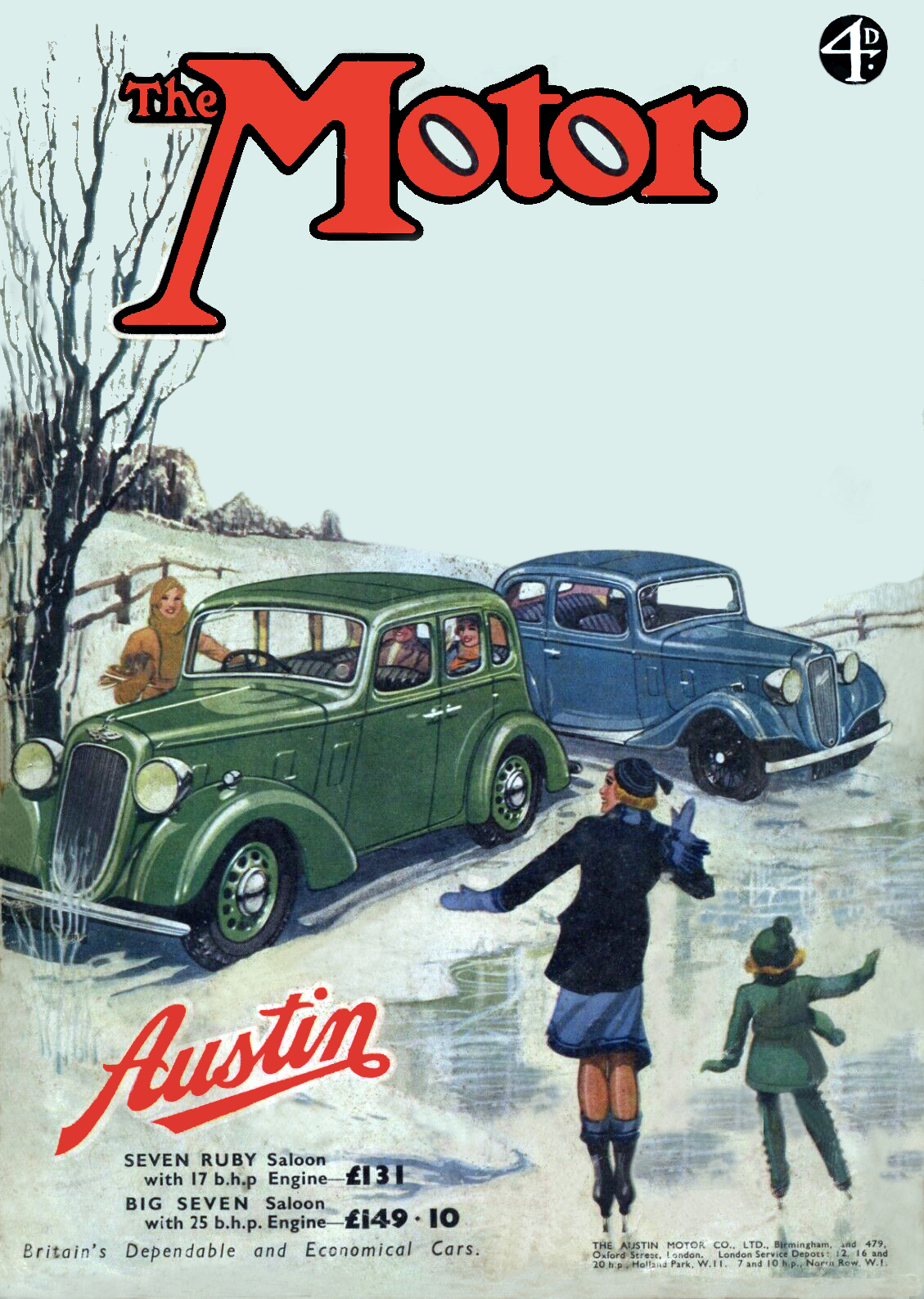
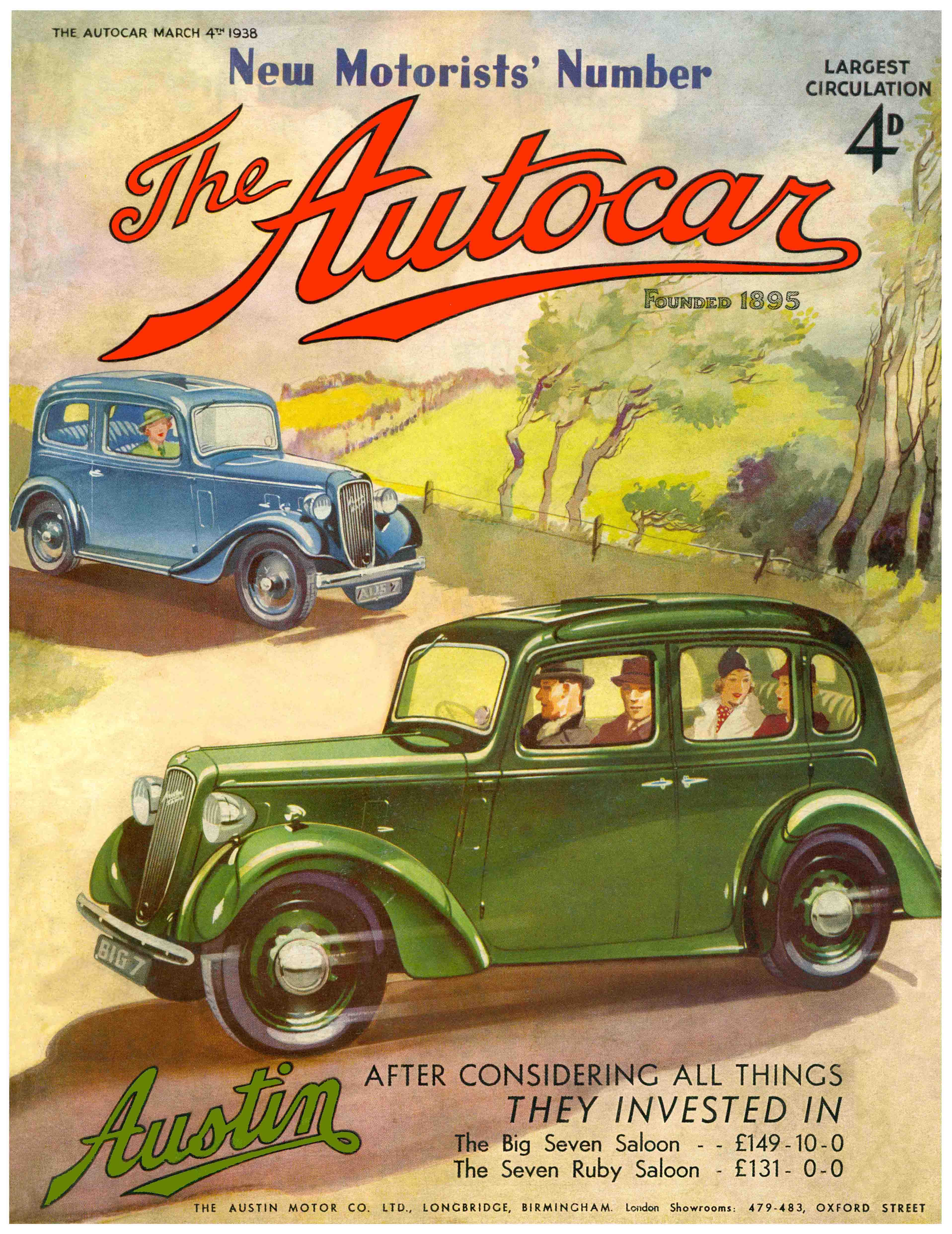
Although the ARR MK.2 Ruby looked very much like the ARQ Mk.1, it did differ in several ways, with the body being of a more rigid construction and the windscreen having a slightly greater inclination, the latter a help when at night, as the headlights of a following car were not as badly reflected as before. Identifying the two models is simple: on the Mk.2, the side rear windows no longer finished in an acute angle at the bottom rear; instead, the whole frame has corners with a distinct radius. The rear side windows now wound down instead of hinging open, though the curve of the wheel arch prevented them from lowering fully. From the rear, the Mk.2 can be recognised by the absence of the moulding line that ran across the back of the Mk.1.
A change was made to how the front seats could be adjusted front to back. On the Mk.1, the system used a horizontally sliding bar that ran across the lower face of the seat and slotted into cut-outs in the seat runners. Because the bar had to be pulled out towards a door before the seat could be moved. it was always stiff and awkward to use, with adjustment almost impossible when sitting down, On the Mk.2, the arrangement was simplified to an almost modern system: a simple, easily reached release lever set on the outside of each seat level with its base. Even so, this new system hardly ran with ball-bearing smoothness and was also usually stiff in action.
In August 1936 the outside shape of the headlamp was modified intermittently, according to the Service Department card s, the lights perhaps becoming the Lucas Type L131 (followed later by the L133). They were fitted with curved, teardrop-shaped glasses but unfortunately, the crazy system of the nearside lamp dipping and the offside bulb being extinguished remained.
The most important chassis change was the adoption of the Semi-Girling braking system together with stiffer brake drums. These changes provided not only a much more efficient way to expand the shoes, but also the convenience of individual, square-headed adjusters at each backplate together with improved compensation in the operating mechanism. As the greater braking forces generated placed additional stress on the radius arms, they were strengthened and attached to the front axle with an additional smaller bolt above the main one. As a point of interest to those new to the Austin Seven, this much-improved front-axle assembly, with its rigid cast-iron drums, Semi-Girling brakes with individual adjusters and strengthened radius arms, became a particularly desirable improvement for owners of earlier Sevens. As a result, the axle can now be found on many earlier cars including Ulsters, both genuine and replica; specials; Box saloons; and, occasionally, even a vintage Chummy. Effective brakes are one departure from originality that only a few Seven enthusiasts find it difficult to forgive.
In January 1938, another revision to the Girling brake system was introduced: the rear brakes were now rod-operated, while the fronts stayed cable-operated. Although the Wyatt book dates this change to chassis 286571 in June, the change was apparently announced on 27 July, with the Austin Index cards surviving in the A7CA Archive list the change around chassis 287000 in September and October. Yet another change was also made to the clutch, the Borg & Beck being abandoned and replaced by a Newton-Bennett type.
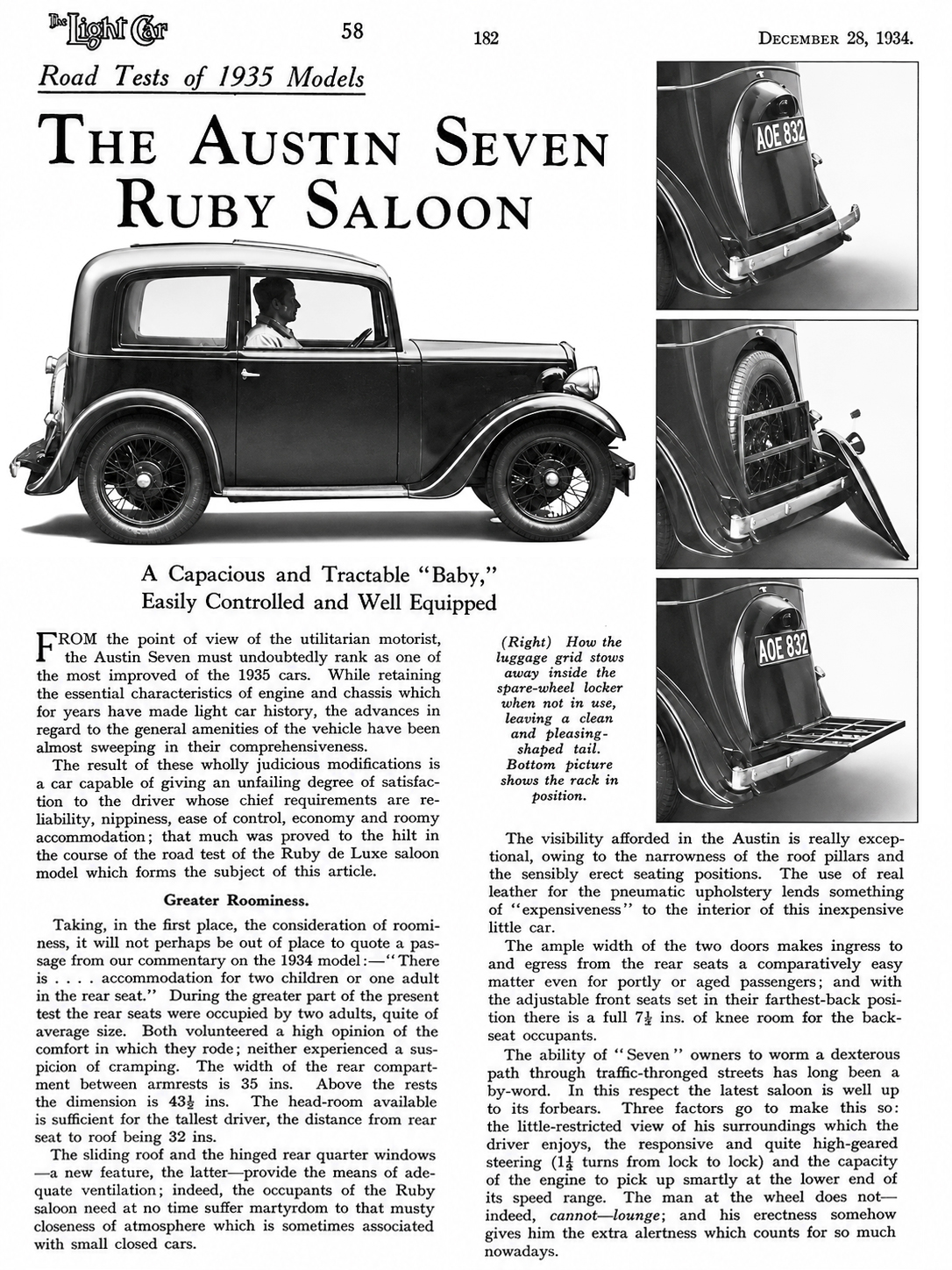
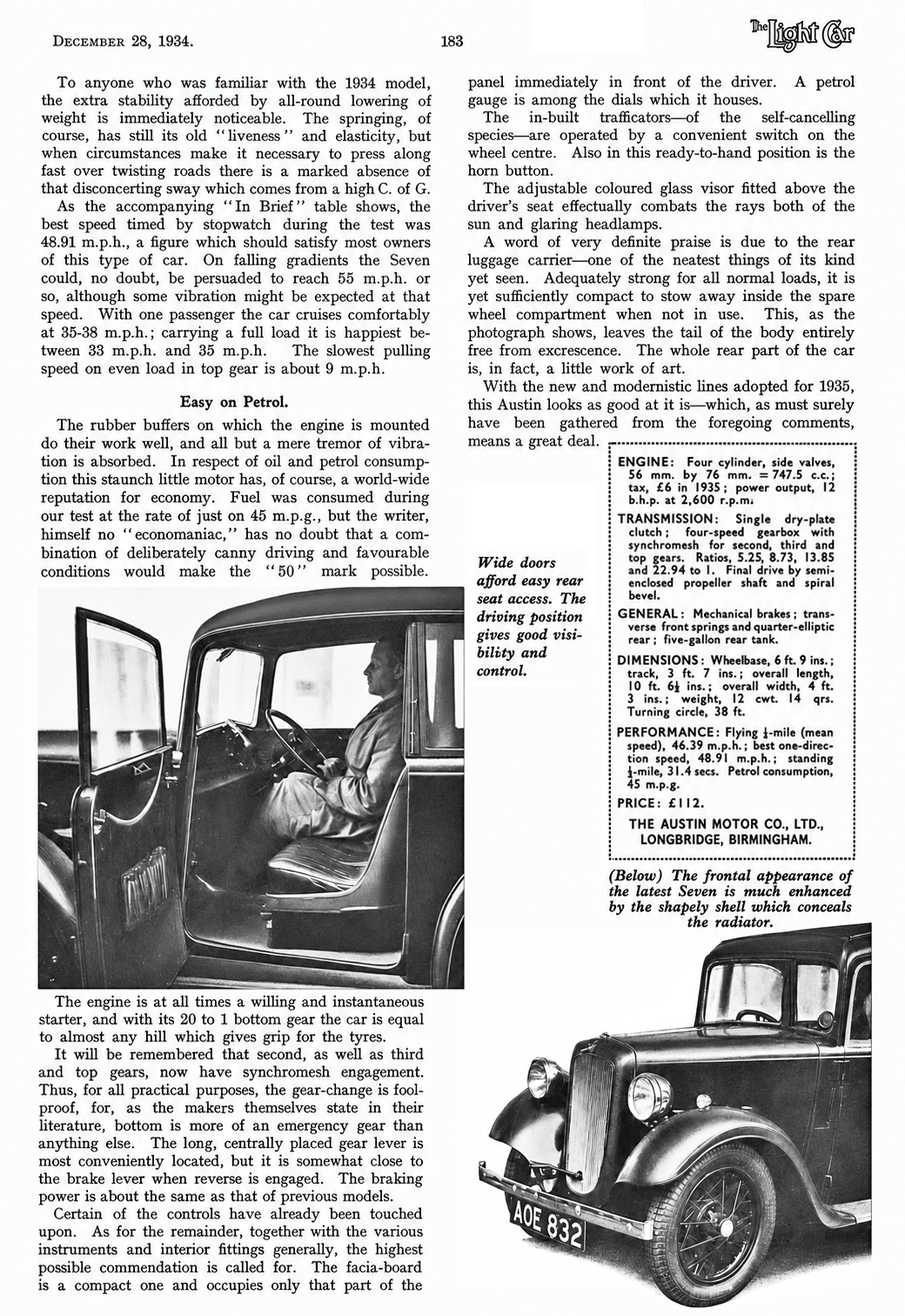
The mechanical specifications, dimensions and performance figures of the ARQ and can be seen in the road test below, and for the ARQ and ARR in two more towards the bottom of page 4
|
|