|
Built during perhaps the 1970s as part of a school GCSE (General Certificate of Education) metalworking project, three examples of the lathe were constructed. The teacher must have been a go-ahead type, for in that era proper metal working skills had started the degradation to "stick a ready-made mechanism to the back of a clock face".
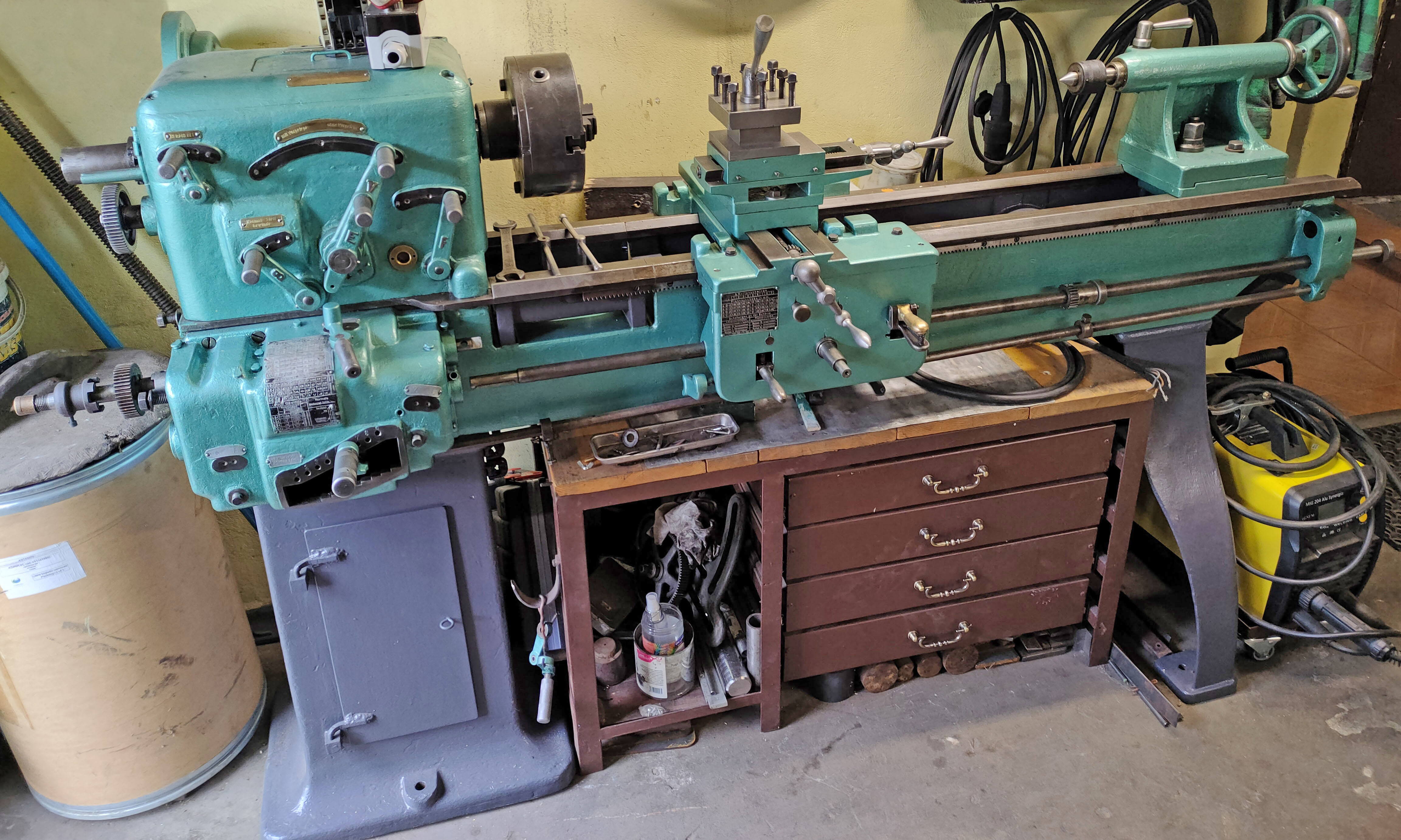
Heavily built and of the simple plain-turning type without a slow-speed backgear or screwcutting, the carriage had the advantage over several similar types of being driven along the bed by a hand-operated leadscrew.
With a centre height of around three inches and admitting perhaps ten inches between centres, the lathe would have provided sufficient capacity and usability to manage many small jobs in the workshop of a model engineer. Both cross and top slides were fitted with good-sized micrometer dials and the 3-speed drive by an A-section V-belt.
The builder never used the lathe, but stored it at home for many years and the photographs show it when rediscovered in 2026. With a few hours' work it could easily be restored to working order.
Another lathe built by students was the Haighton Cadet, this being part of a project by a college local to the Haignton factory where in the 4th & 5th year of their City and Guilds Machine Shop Engineering Course, (due to and their teachers' common sense) students had to build a 'Cadet' from castings and parts supplied by the Company.
|
|