|
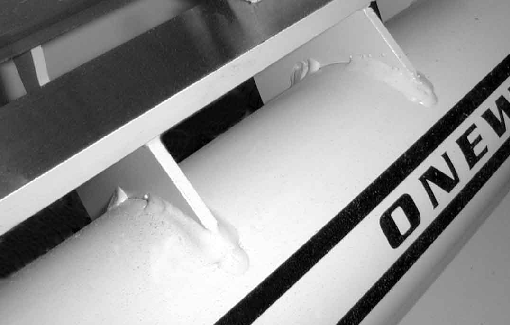
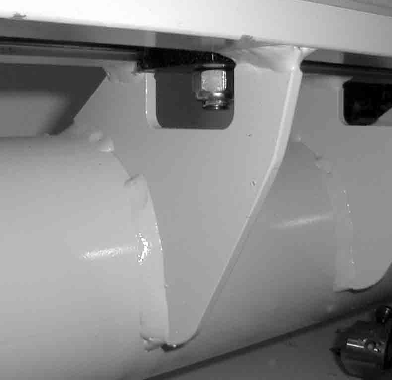
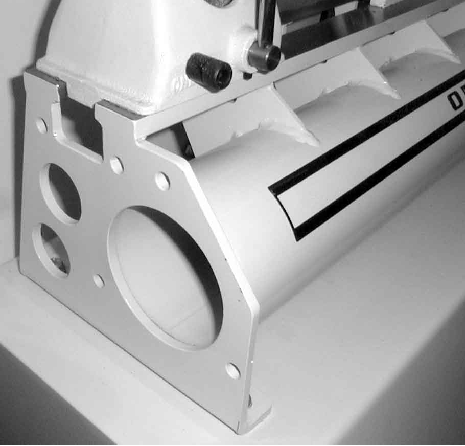
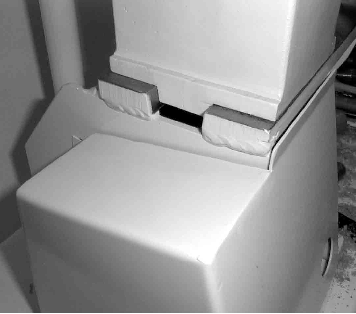
The end of the bed tube (this is a Model 1018) is bracketed to both the bench and welded to the ends of the flat ways.
Continued:
Also built up from a tube, the headstock assembly of the "Large" lathe is welded to a stiff rectangular support and its spindle manufactured from a high-tensile steel hardened and finish ground all over. The nose is a M33 by 3.5 mm pitch thread which incorporates a locking arrangement to allow full-speed reverse with safety; the end flange of the Poly-V pulley is provided as standard with 6 holes for the locking plunger to engage with and an additional ring of 48 (optionally 96) holes for indexing work. The spindle runs in four bearings - a pair of sealed-for-life, deep-groove, pre-loaded ball bearing immediately behind the nose and a pair of "floating" ball races at the other end - and is driven directly from a high-quality, electronically speed-controlled motor (with a choice of 1.5, 2 and 3 hp) mounted directly beneath the headstock in the base of the stand. A 3-step, 10-groove poly-V pulley is provided to give three speed ranges: 0 to 800 rpm, 0 to 1800 rpm and 0 to 3000 rpm. To assist in changing the belt from pulley to pulley a section of the headstock is cut away at the top and provided with a heavy drop-in cover. Interestingly, the control box for the motor is mounted on a two-part arm pivoted from a bracket beneath the bed; it can thus be swung into any position, either in front of or behind the bed, which takes the operator's fancy.
Of fabricated construction, the tailstock of the "Large" has a generously-proportioned 1.5" diameter quill (barrel) with a useful No. 3 Morse taper and 4 inches of travel. The assembly is fitted with an extra-long clamping handle and a robust bed clamp - whilst a welded-on "lifting" handle assists with its safe removal and replacement.
Oneway lathes of the "Large" type really are just that - with tremendous physical presence, considerable weight and as much capacity as even the most experienced and enthusiastic amateur turner could possibly handle with safety; however, even though the lightest (the 1224) weighs 300 lbs and the heaviest (the 2436) 850 lbs, the overall lengths are not excessive; the shortest is just 40 inches long (as was the older 2016) and the longest only 60 inches. Prices are, however, are another matter, and the maxim of you-get-what-you-pay-for applies very strongly; these are not cheap machines built down to a price for the casual user but a quality product for the serious enthusiast and professional.
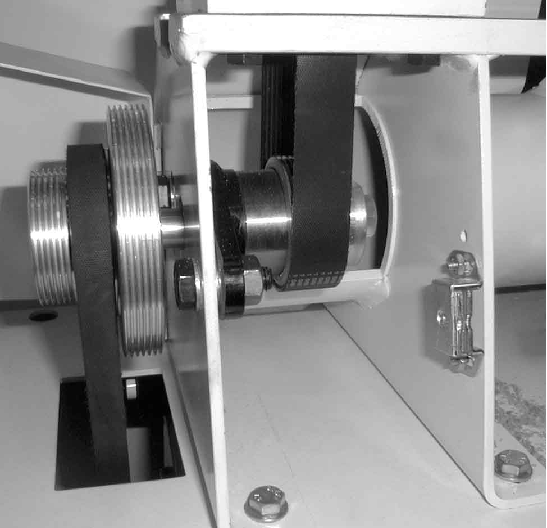
While the "Mini" lathe had exactly the same type of headstock construction as the "Large", it carried a smaller, 1 5/8" diameter No. 2 Morse taper headstock spindle with a 1" x 8 t.p.i thread; the entire spindle was hardened and ground and ran in exactly the same type of high-quality bearing arrangement as its larger brothers. In order to obtain a top speed of 4000 rpm the drive arrangement included both a continuously variable-speed, inverter-controlled 3-phase motor of 0.5 or 1 hp (the supply required being either 110 or 220 volts, 1-phase, respectively) and a countershaft (jack-shaft) unit with three Poly-V pulley carrying inch-wide, 6-groove belts mounted on the headstock-end bed plate immediately below the spindle. The three speed ranges covered: 0 to 1000, 0 to 2000 and 0 to 4000 rpm; however, because the drive system was biased towards a high top speed - this was, after all, a lathe for smaller work that requires high speeds for a good finish - the continuous slow-running speed was limited to not less than 150 r.p.m. Unlike the larger lathe, the tailstock of the 1018 "Mini" lathe was of traditional cast-iron construction with a smaller 1.125" diameter barrel but still with a still-adequate No. 2 Morse taper - and 3 inches of travel. The least satisfactory element in the lathe's design could be found in the tailstock spindle clamp - a crude, screw-down affair of the type which should only be employed on the cheapest of machines.
The bed and ways of the 1018 were identical in arrangement to those of the "Large" lathes, but based on a much smaller 4.5" diameter tube with a wall thickness of 0.25".
The Oneway web site is at: http://www.oneway.on.ca
|
|