Logan Lathe Drive Systems
9" Lathe 10" Lathe 11" Lathe 12" Lathe 14" Lathe Headstock Spindle
Logan Home Drive Systems Carriage & Bed Accessories
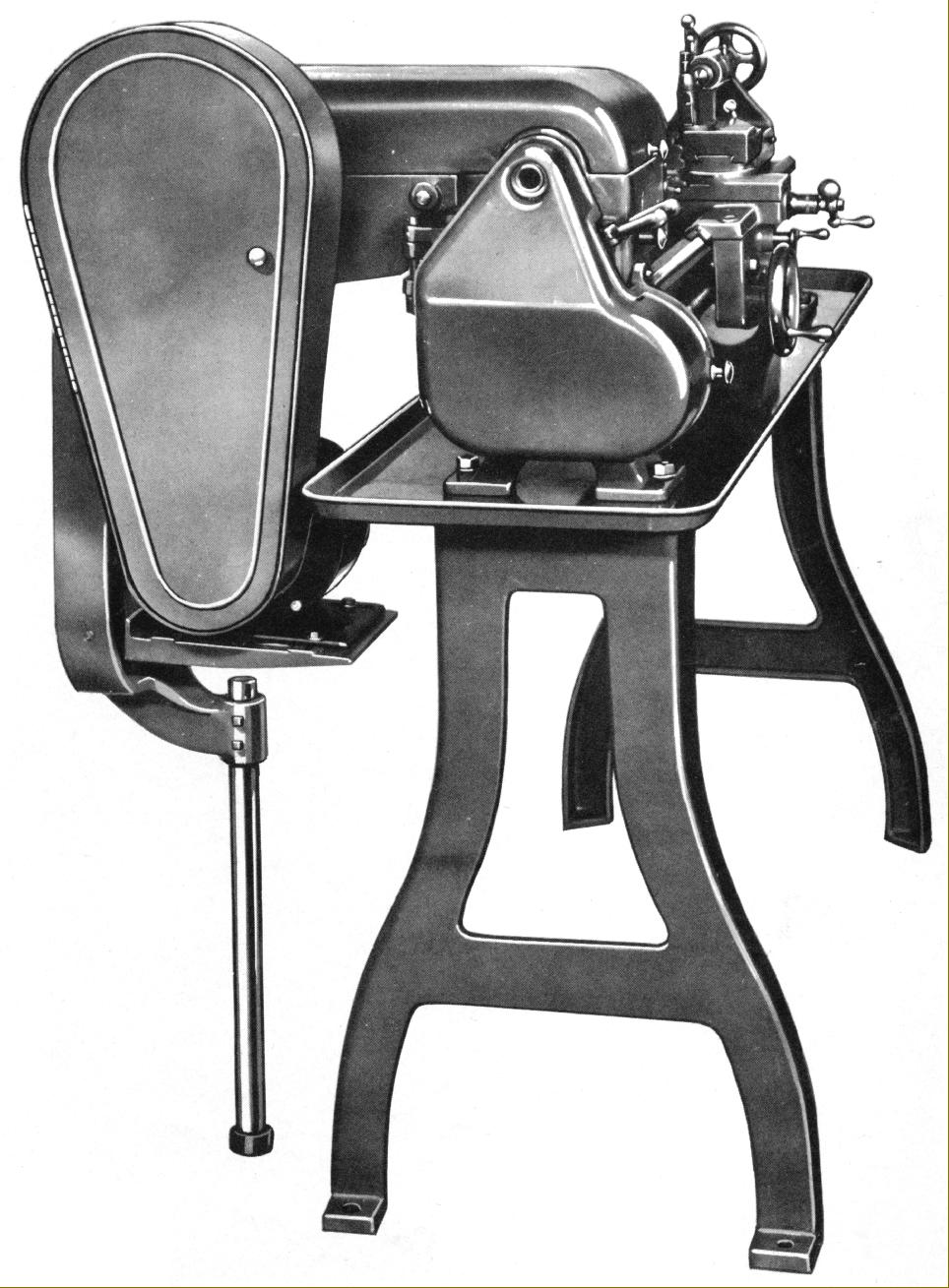
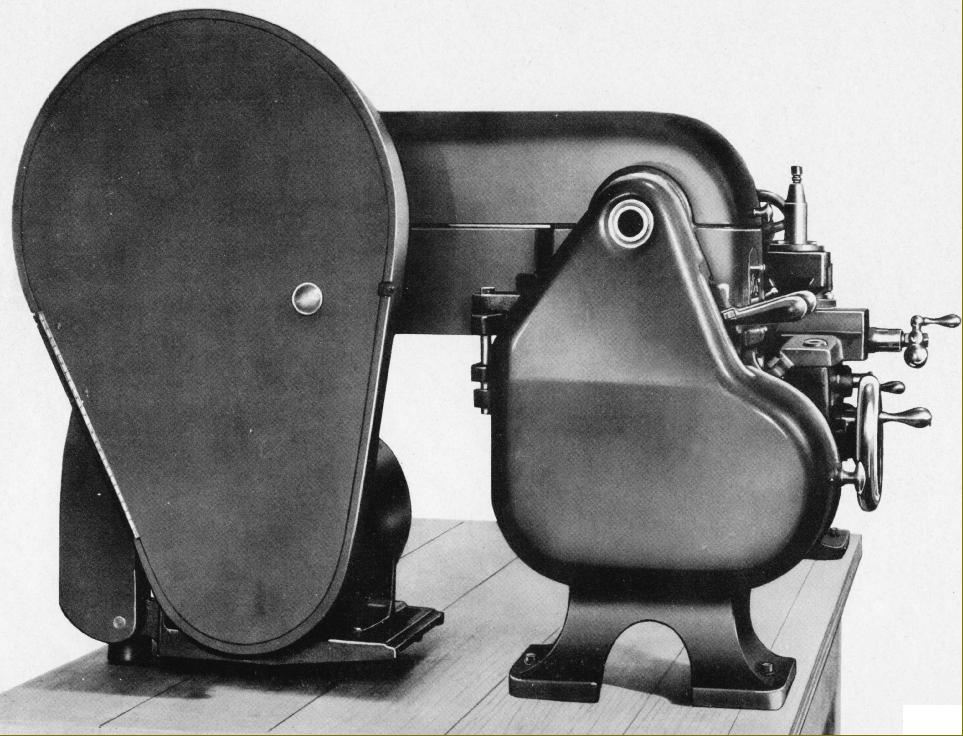
Available as a "no-cost" option on some models the mechanical variable-speed drive unit was neatly built into the left-hand side of the cabinet stand. The motor pulley was fixed and the expanding and contracting pulleys fitted to a parallel shaft above. The lower (motor) belt was 38" long and the upper headstock drive belt 60" long.
According to the year of manufacture the speeds available varied slightly and also changed with the particular model and the exact type of motor employed: for example, until 1956, the factory figures for the 12" lathe suggested a range in backgear of 38 to 295 rpm and in direct drive 250 to 1575 r.p.m. whilst after this, the speeds were altered slightly to span 38 to 1400 rpm. The 14" appeared to use the same range of 38 and 1200 r.p.m. throughout its production run.
Fitted to the 14" lathe the maker's standard-specification motor was a 2 h.p. 3-phase and for the 12" a 1 h.p. 3-phase. Although the larger lathes were required to have 3-phase motors, no such recommendation was made for the smaller machines, where 1-phase motors were considered adequate - that for the 11" being 0.75 h.p, the 10" a 0.5 h.p - and the 9" a 0.3 h.p.
Interestingly, when the variable-speed drive was specified, the factory offered to fit the customer's own motor and dynamically balance the entire assembly, otherwise they "… cannot be responsible for vibration in your lathe." This was an eminently sensible precaution, as it can often be surprisingly difficult to set up even a simple motor-drive system - and have it run sweetly and effortlessly - without first having to spend a surprising amount of time fiddling with alignments and belt runs.
A control wheel on the front of the cabinet operated the system - and required twelve turns to change the speed from maximum to minimum. A single oil cup provided lubrication for the entire assembly. A later Logan lathe, the "Powermatic", used an entirely different variable-speed drive system that should not be confused with this earlier system..