|
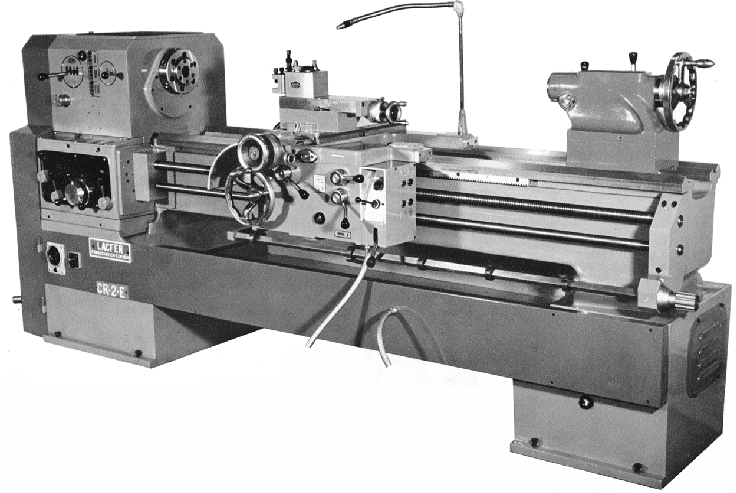
Lacfer lathes were made in Spain and, during the 1960s and 1970s (when Spanish labour costs were low) their conventional machines, the very similar CR-1 and CR-2 models , found sales in both Europe and America (machines are often badged with the between-centres distance in mm as a suffix, for example: CR-1-1000). Cleanly designed with an unusual "gate-change" spindle-speed selector on the front face of the headstock, the CR-2 had a 250 mm (10") centre height and a capacity between centres of 1000, 1500 or 2000 mm (39, 59 or 79 inches) With gears manufactured from hardened chrome-nickel steel the headstock held 60 mm-bore, 6 Morse taper spindle rotating in a pair of super-precision, English-made GAMET taper roller bearings; a ball-race bearing, at the tail of the spindle, was used to absorb end thrust. The spindle nose could be supplied with a variety of fitting but was offered as standard with a DIN 55022 Nt. 6 bolt-on flange type. The headstock internals were lubricated by a suction pump from an oil supply held within the base of the casting with an oil-flow indicator positioned on the front face of the headstock to allow the operator to check that the pump was functioning correctly. Driven by a 10 hp motor the spindle was controlled though a pair of EIDE Type ELA 68 electro-mechanical clutches that also acted to engage a powerful brake. 12 speeds were provided of 25, 40, 55, 75, 110, 190, 270, 360, 600, 1050, 1350 and 1800 rpm.
Totally enclosed and oil-bath lubricated the screwcutting gearbox selected its feeds and threads by the use of a neat rotary dial and three levers; for 'English-threading' markets the 35 mm diameter leadscrew was of 1/4" pitch (or M6 as an option) and, as standard, 36 metric threads from 0.5 to 7 mm pitch, 36 Whitworth threads from 2 to 56 t.p.i, 24 metric module threads from 0.5 to 7 mm and 24 Diametral pitch threads from 4 to 32 t.p.i could all generated without having to demount or alter the position of any gears on the quadrant arm.
Doubled-walled and strongly built the apron held a supply of oil in its base that was hand pumped (through a controlling valve) around its inside and also to the lathe bed ways. A useful refinement was a long 'third-shaft' control rod, fitted below and parallel to the power shaft, held a set of 5 stops that could be arranged to automatically disengage the carriage feed at a number of pre-set points. Fitted with an unusually large micrometer dial, and using wide, full-length casting, the cross slide had a travel of 270 mm. With its deep, robust base the top slide had a travel 180 mm and was fitted as standard with a Dickson-type quick-set toolholder.
At 335 mm wide the lathe bed did not qualify as being of toolroom speciation (where a width equal to twice the centre height would be considered normal) but it was very deep, hardened as standard and carried 3 V-ways that gave independent guidance to the carriage and tailstock.
Of especially heavy construction the tailstock held a 65 mm-diameter hardened and ground spindle running in a lapped bore; its feed screw was fitted with a zeroing micrometer collar and the large handwheel rim, like that on the carriage drive, was provided with internal finger grips.
Standard equipment provided with a new machine consisted of: coolant, fixed and travelling steadies, a set of Allen keys, spanners, oil can, chuck-mounting backplate, a headstock Morse reducing sleeve (6 to 5 MT), two standard hard and soft centres, a slender handbook and sectional parts list and a post-construction inspection chart. Optional extras included a hydraulic coping attachment, semi-automatic threading device, pneumatic chucks and their associated operation equipment, pneumatic tailstock, rear tool holder, cross-feed stops and various kinds of programmed installations to give automatic working cycles or to meet other special requirements.
Machines to standard specification had weights of approximately: 1000 mm bed 1900 kg.; 1500 mm bed 2150 kg.; 2000 mm bed 2410 kg.
If any reader can provide further information about lathes of Lacfer manufacture the writer would be very pleased to hear from them..
|
|