
|
Home Machine Tool Archive Machine-tools Sale & Wanted Greaves-Klusman Lathes Page 2 |
||
|
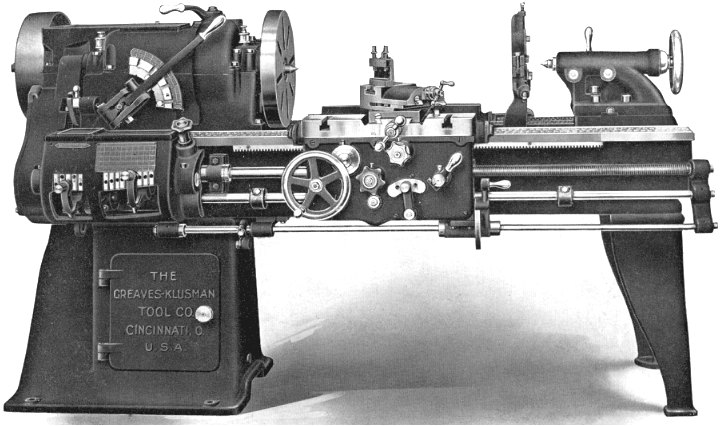
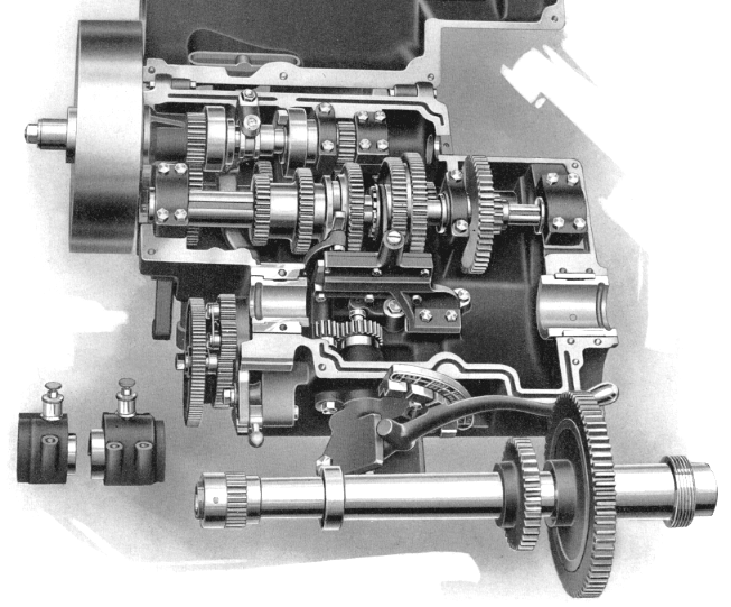
Founded in 1889 by William A. Greaves and Herman H. Klusman the Greaves-Klusman Company was based in Cincinnati, Ohio, the home town of the two owners. Early days were spent in premises on Second Street, near Plum, with early advertising literature stating that their aim was to "... manufacture machine tools and woodworking machinery.". Obviously well capitalised - in their first year of trading over twenty men were employed - by 1898 a move had been made to a new and much larger factory of sixty thousand square feet on Alfred and Cook streets where one hundred and twenty five "skilled mechanics" were employed. By the 1920s the firm appeared to have concentrated production around a range of heavy-duty metal-turning lathes distinguished from their competitors not only by an unusual control mechanism for the selection of headstock-spindle speeds - but through the use of an all-geared headstock arranged along the lines of the sliding-gear transmission used in automobiles. Instead of a separate control for the clutch, in the Greaves-Klusman lathe a single movement of a vertical lever, in or out, engaged or disengaged the clutch while a further movement of the same lever, to the right or left (in plainly-marked notches) instantly selected any of 10 spindle speeds without stopping the lathe - and with the tool still cutting. Self-locking, the selector lever worked in connection with the notched segments and a direct-reading index plate to form a simple control system - the extreme movement from low to high speed occupying an arc of 70 degrees. |
|
Continued: |
|
Greaves-Klusman lathe with the headstock spindle removed to show the arrangement of the three shafts, the drive gears and the associated selector mechanism. |
||
|
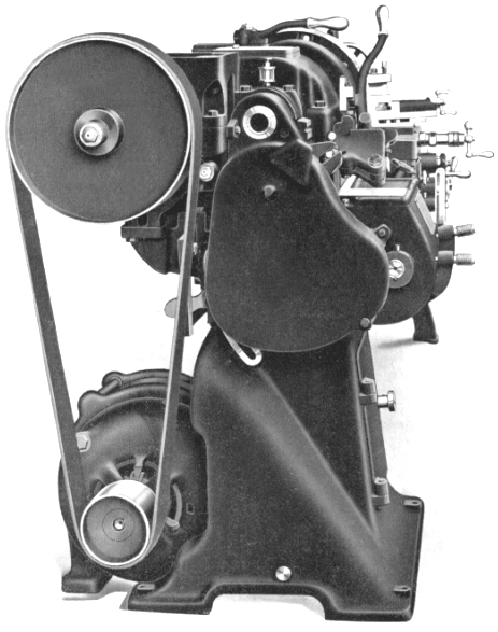
Greaves-Klusman lathes had the option of a neatly arranged and very compact drive system - though the use of a jockey pulley to increase the "wrap-around" of the wide flat belt on the motor pulley would have been useful addition |
|
Home Machine Tool Archive Machine-tools Sale & Wanted Greaves-Klusman Lathes Page 2 |
||