E-Mail   Tony@lathes.co.uk 
Home    Machine Tool Archive    Machine Tools For Sale & Wanted
Machine Tool Manuals   Machine Tool Catalogues

Bryant Symons Lathe
- high-precision thread-correcting -
If you have a Bryant Symons lathe, experience of using one or any maker's literature, the writer would be interested to hear from you

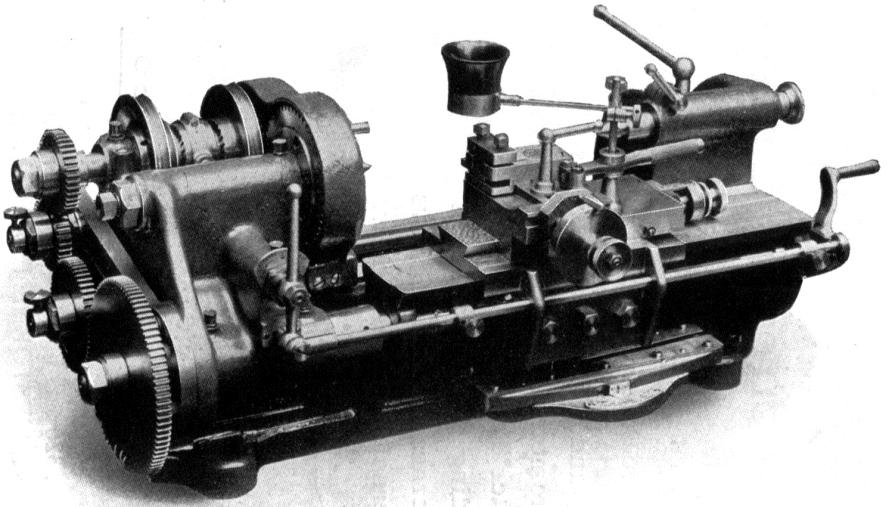
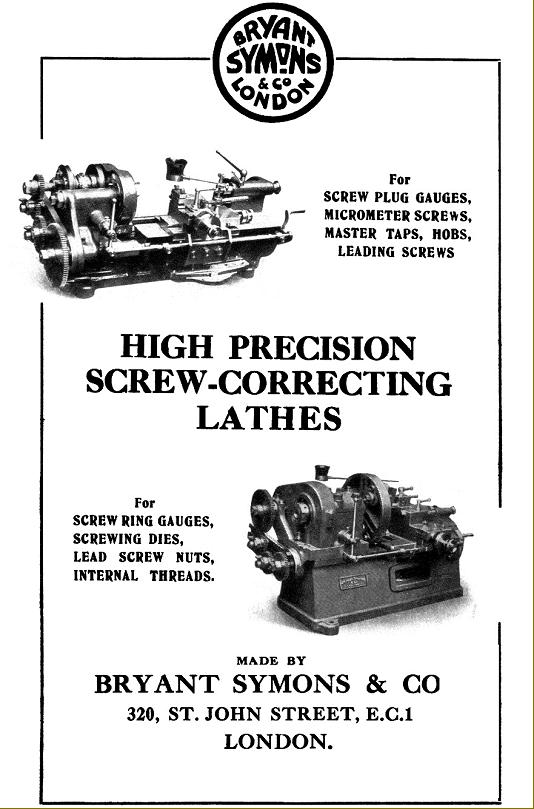
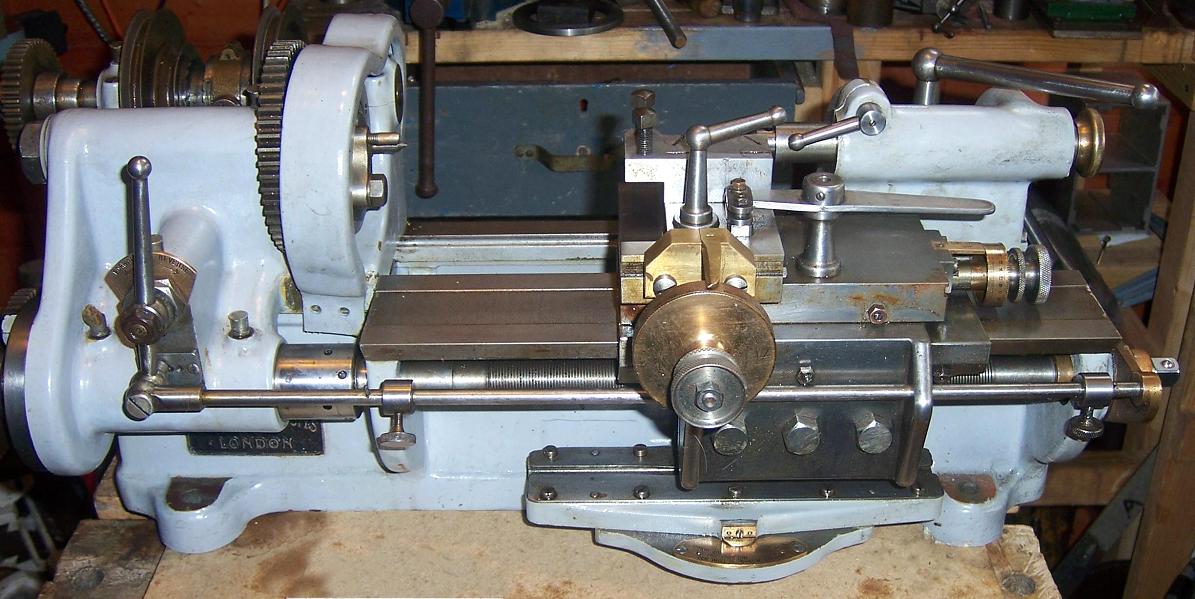
Manufactured by Bryant Symons & Co. of 320 St. John Street, London, E.C.1, the ingenious and beautifully made little Bryant Symons lathe was designed for the correction, checking and measuring of very high quality screws, thread gauges and taps, etc. Founded in 1901, and long known for their ultra-precision machine tools and highly specialised one-off products, today the Company is still trading under its original name and continues to operate in the same fields.
With a centre height of 2-inches, and 8 inches between centers, it was fitted with a clever leadscrew pitch-correcting device patented by Mr. A. B. Symons in 1917 - each example of the lathe being supplied with a certificate of accuracy from the National Physical Laboratory. It's intended function was identical to the similar (though different in detail) Swiss-made SIP (
Société Genevoise d'Instruments de Physique) thread-correction lathes also made during the 1920s.
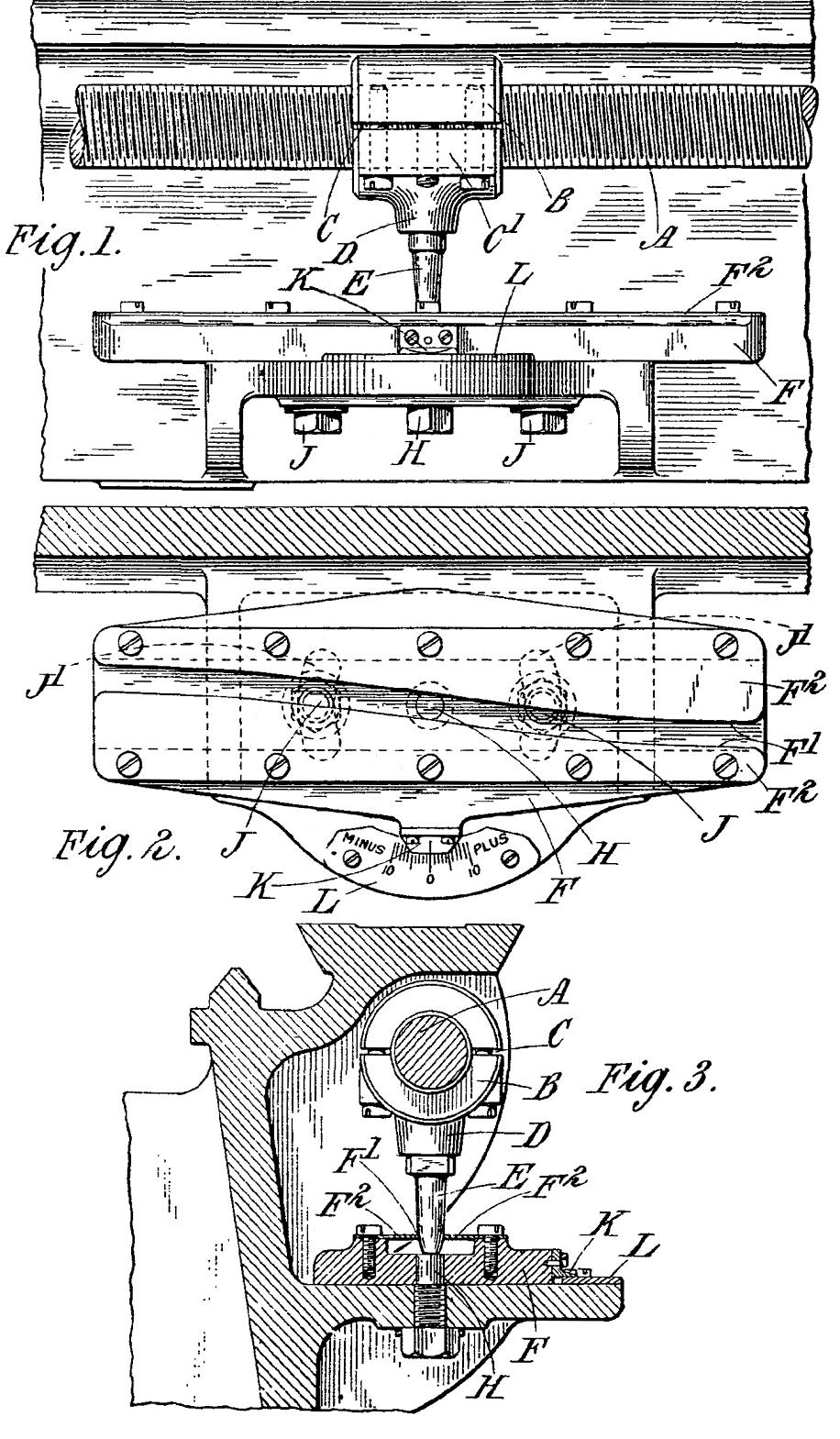
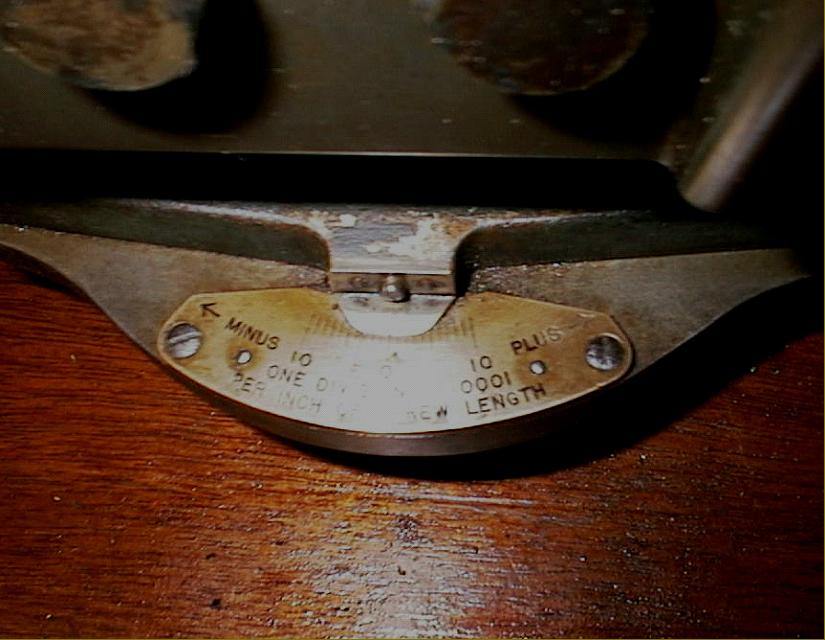
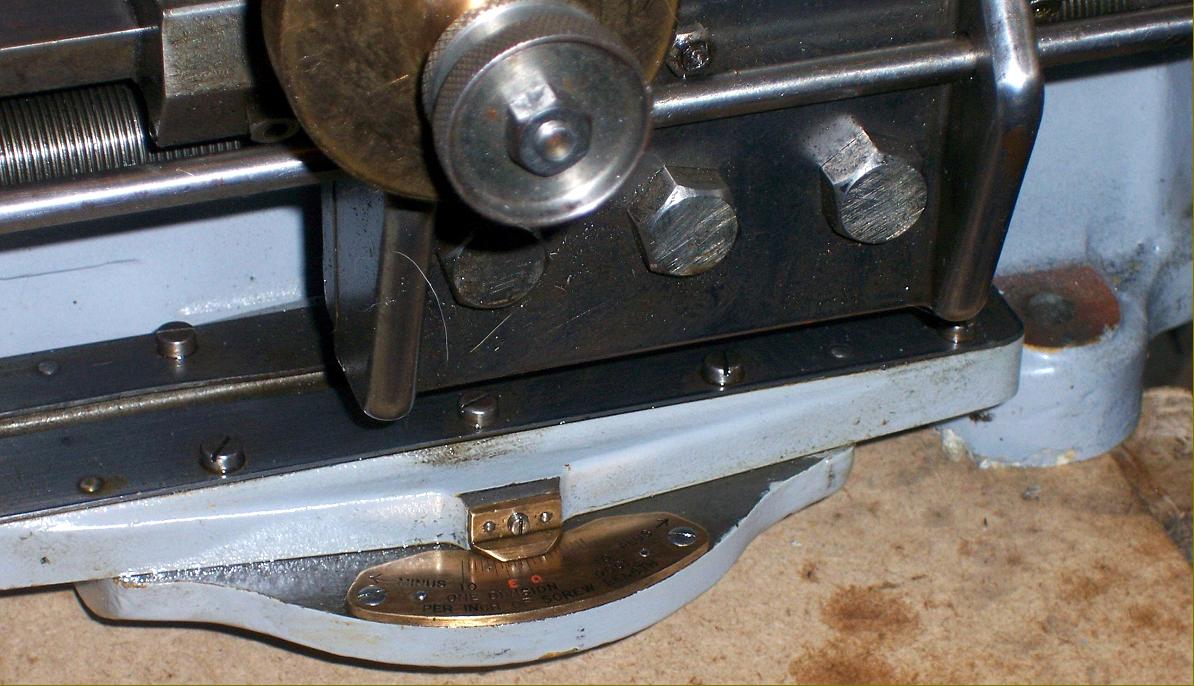
As only the American Moore Company was (eventually) able to achieve on a commercial basis (though on screws limited to 20-inches long) an absolutely dead accurate leadscrew with no variation of pitch from end to end that generated precisely the same linear movement throughout its range, screws of lesser accuracy required some means of correction. To engineer this, Symons arranged for the leadscrew (which was made to very tight tolerances) to be of large diameter, made from hardened Bessemer steel and cut with a 30-degree V- thread at (a very fine) 16 threads per inch. Unlike the SIP lathes, which carried their leadscrew in the best theoretical position, down the centre line of the bed and protected beneath it, that on the Symons was at the front, through supported in a long bearing at its left-hand end with special care being taken to face the flanges dead flat to stop the screw being oscillated from end-to-end. An adjustable phosphor bronze clasp-nut was fitted into a carrier mounted on the saddle and, while held rigidly in a longitudinal direction, was able to correct pitch errors by being allowed to moved very slightly in a rotary direction from either side of central. The fractional turn of the nut was arranged automatically, by a steel rod attached to it and projecting downwards to engage its tapered end in a slot formed as a gentle wave by the edge faces of two thin steel plates bolted to a carrier beneath the leadscrew. The wavey slot (the same length as the leadscrew's threaded section) caused the rod to be moved backwards and forwards and so impart a very slight turning motion to the clasp nuts. The unit supporting the slot plates was able to be swivelled about its centre point and the amount of correction altered, the aim being to obtain a uniform increase or decrease in pitch to compensate for changes caused when a workpiece was, for example, hardened. A scale was attached to the front of the unit with degree marks indicating the plus and minus correction that could be obtained.
Continued below:

The curved  face of the mounting point for the correction slot unit can be seen low down on the front face of the bed

Continued:
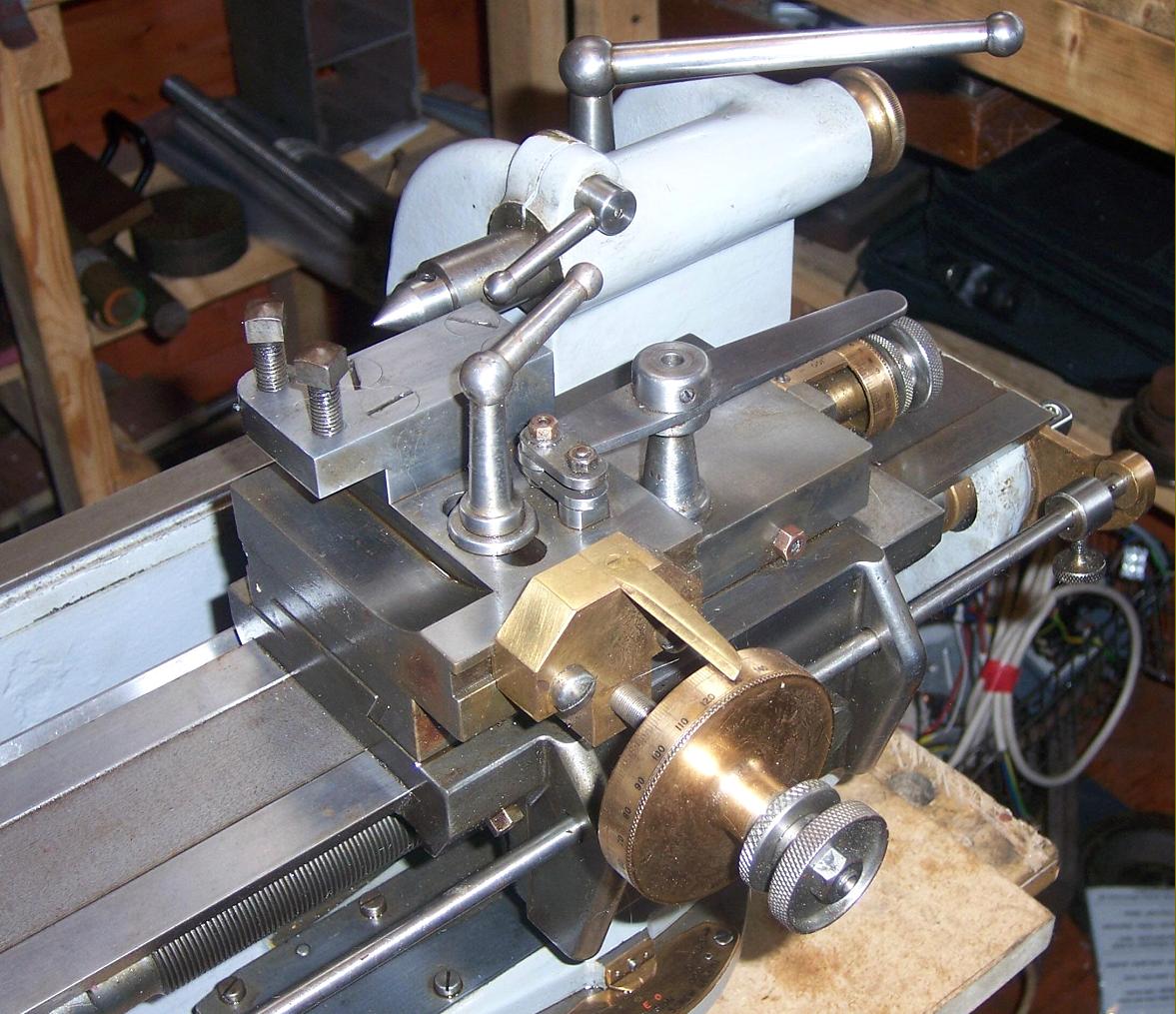
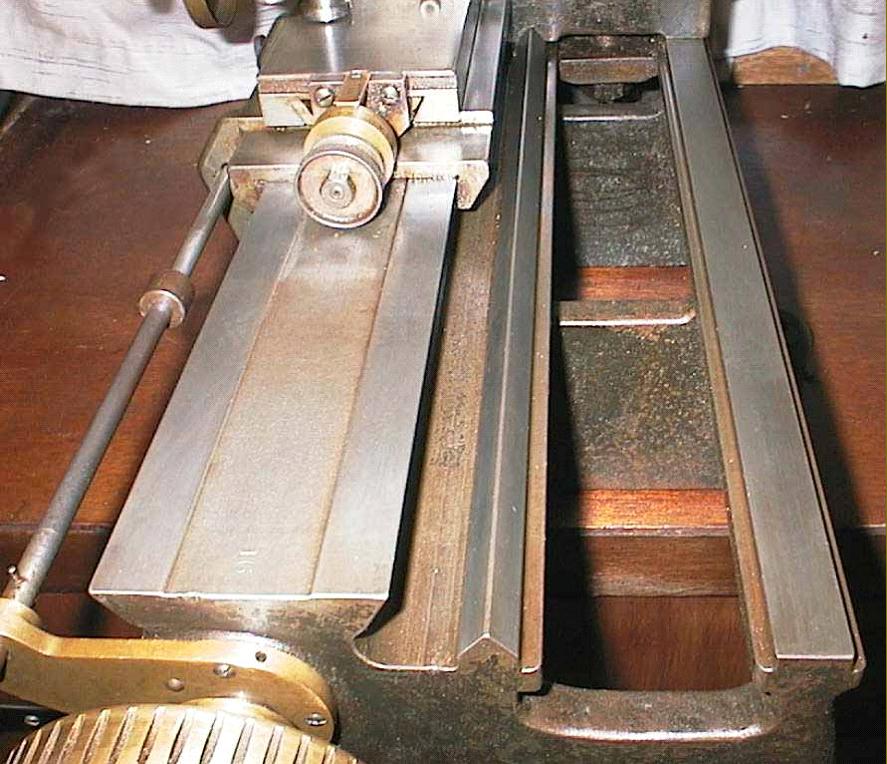
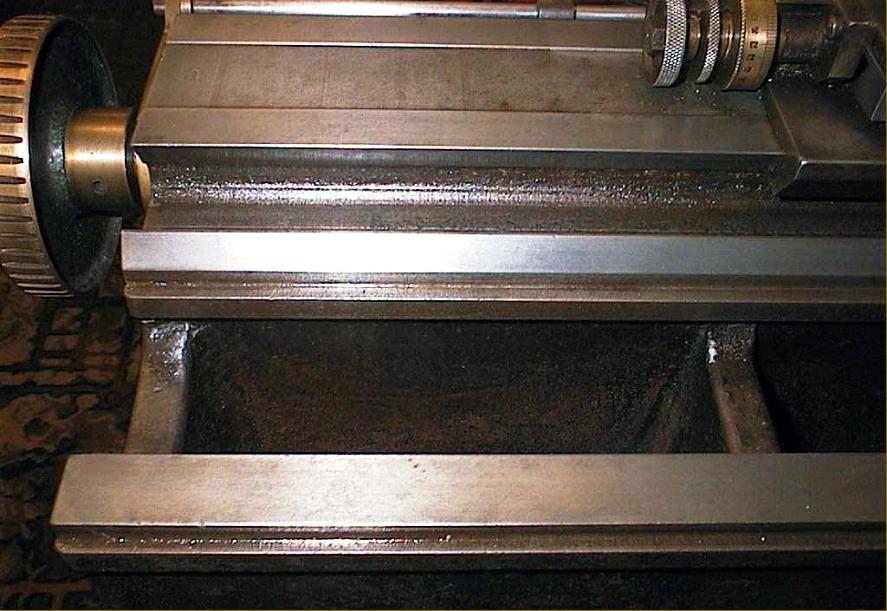
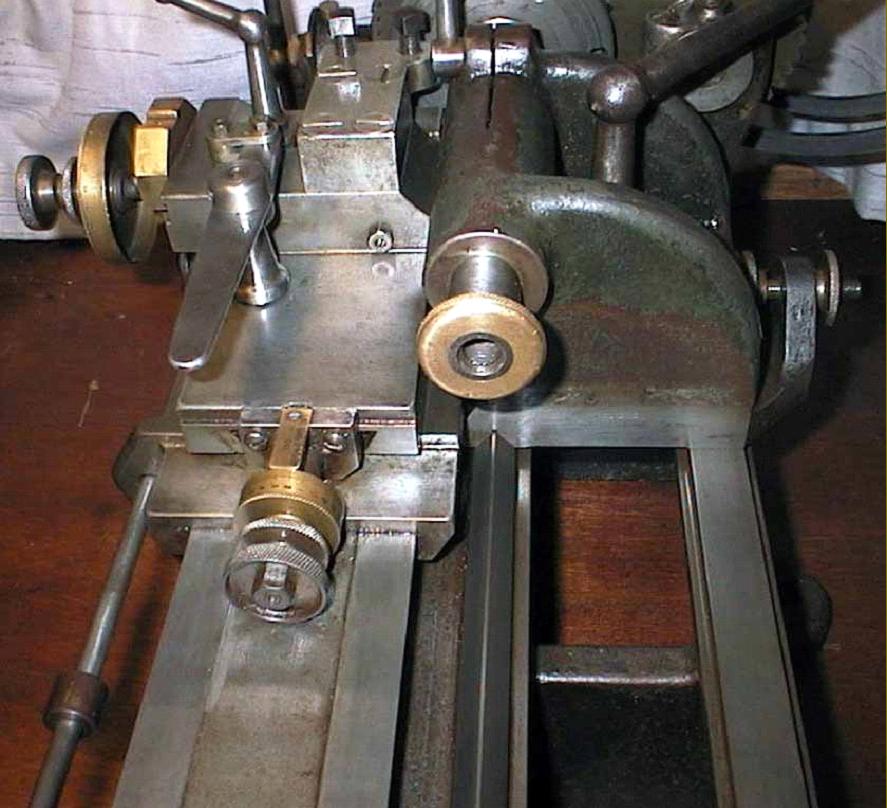
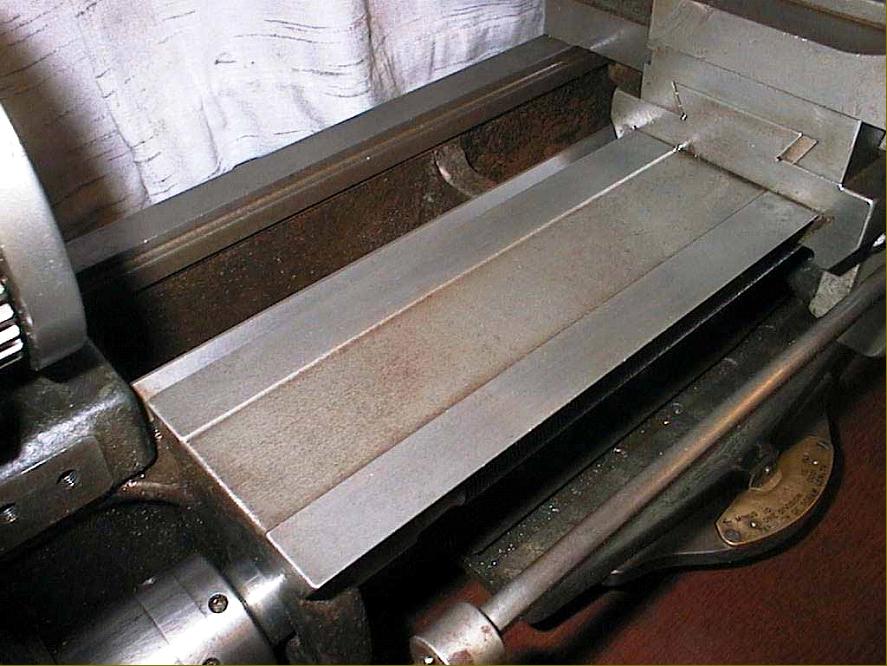
Formed as a heavy, very rigid box casting strengthened by transverse ribs, the bed and headstock were cast as one. Two sets of ways were provided, those at the front being flat with 60° edges and arranged to carry a saddle topped by a slide set in line with the bed ways (rather than across them as on a normal lathe). This arrangement allowed a very precise lateral adjustment to be made to the tool setting - the feed screw carrying a micrometer dial reading to 0.00025". At the back, to carry the set-over tailstock (with a simple push-feed barrel) ways were formed with a flat at the rear and a V at the front. A simple lever-action cross slide was fitted with its movement measured and limited by a micrometer screw stop with a particularly large bronze dial reading to 0.0001" (the slide being advanced up to the stop to make the cut). Provision was made to read the micrometer dial and tool settings through a magnifying glass attached to a stem that passed through the pivot point of the cross-slide lever.
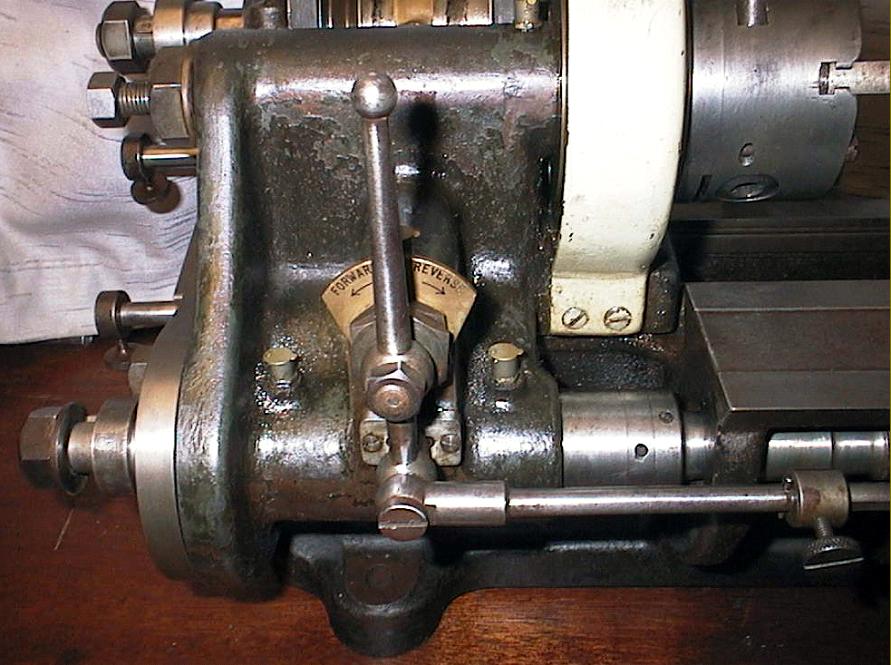
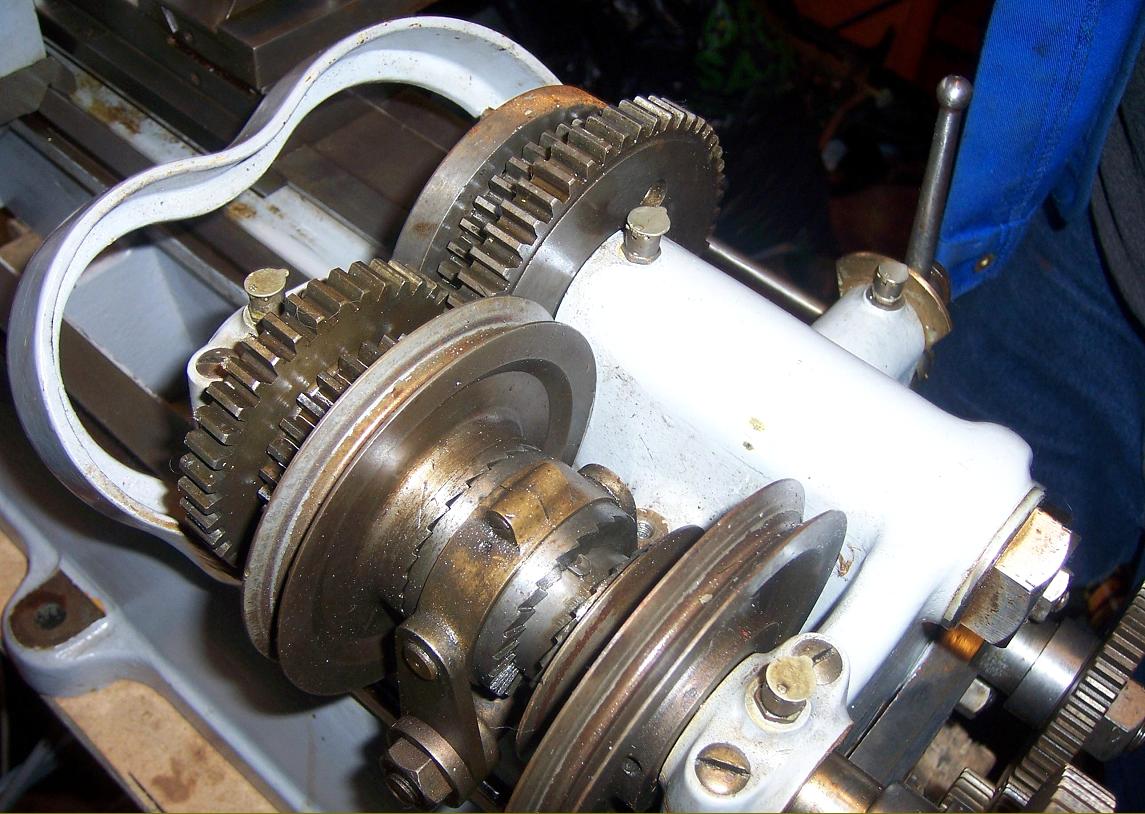
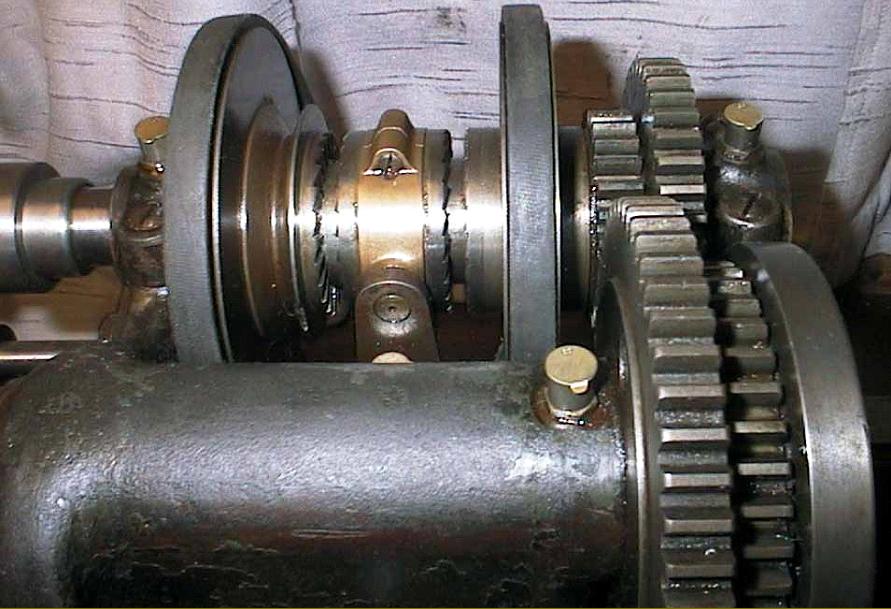
Because the cutting tool would have been required to make several passes up and down a workpiece, removing a only little material on each pass to machine it dead true, the countershaft was arranged to provide an automatic and instant forward-and-reverse drive. Running free on a hardened steel sleeve, the two V-belt driving pulleys were formed with saw-tooth dog clutches on their inner faces with, mounted between them, an engagement clutch (keyed to the sleeve) that could be moved from side to side to engage either. The clutch centre was connected to a lever pivoting from the front face of the headstock and could be operated either by hand, or automatically through a rod fitted with adjustable stops struck by tabs cast as part of the saddle - one being positioned to the left and the other to the right of the cross slide. The spindle was driven not by the belts, but through gearing, the arrangement of this (and the changewheel drive) being relatively complex and interesting: behind and fastened to the catchplate were two gears: the rear of the pair meshed with another half its size fixed to the end of the countershaft sleeve (this drive the spindle) while the second connected to a gear of the same size on the front end of the countershaft - that shaft passing through the hollow clutch sleeve and carrying the first gear of the changewheel train on its outer, lefty-hand end. Work was mounted between centres and driven in the usual way - pins on the catchplate turning dogs fastened to the workpiece -  this arrangement being essential for the highest accuracy. Although it was possible, of course, to machine the catchplate to carry a 3-jaw chuck, the makers certainly did not intend this to be done.
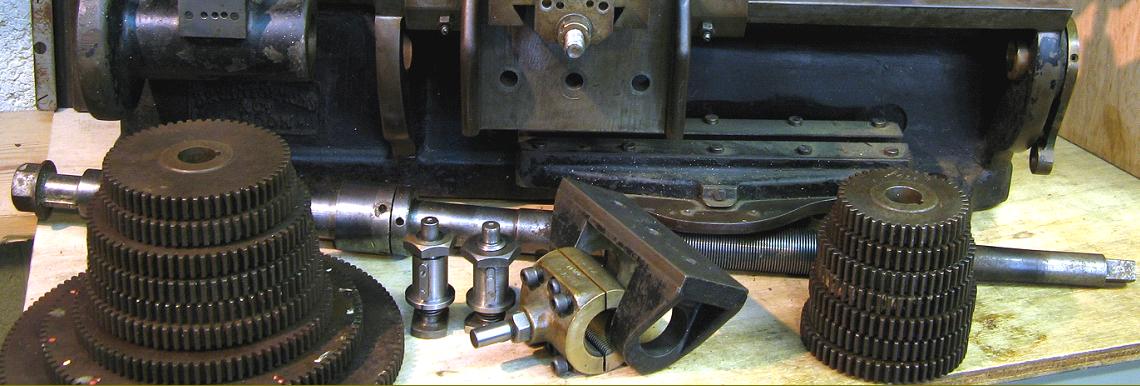
Even the arrangement of the changewheels (sufficient in number to generate pitches from 8 to 100 t.p.i.) was beautifully engineered with a T-headed stud located in a machined groove on the back of the twin-slot support bracket. The studs were retained by nuts on the outside, the slackening of which allowed (on some versions, if not all) a spring to push the unit loose and its position adjusted quickly and easily. Each changewheel was fitted to hardened and keyed running sleeve that slipped onto the fixed stud with retention by a short distance piece locked in place by a knurled-edge screw that could be released with just finger pressure.
As might be expected of such a high-quality machine, the changewheels and small accessories - centres, adaptors and drive dogs - were presented in a fitted wooden box.
By the 1930s the thread-correction lathe was obsolete, very accurate thread-grinding machines having being introduced in the UK by Matrix of Coventry (who published a very good book on the subject) in Germany by Lindner and (later) Reishauer and in Switzerland by SIP.

The patent drawing clearly shown the wavy guide slot, thin guide plates and locating rod

Some component parts: the fine-pitch leadscrew; the bronze clasp nuts and their carrier (note the peg that engaged with the correction slot); changewheels and their keyed studs. The adjustable correction slot carrier can be seen immediately behind the clasp nuts

Setting marks for the correction-slot carrier

E-Mail   Tony@lathes.co.uk 
Home    Machine Tool Archive    Machine Tools For Sale & Wanted
Machine Tool Manuals   Machine Tool Catalogues

Bryant Symons Lathe
- high-precision thread-correcting type -
If you have a Bryant Symons lathe, experience of using one or any maker's literature, the writer would be interested to hear from you