 |
|
|
|
|
|
|
|
|
|
|
|
|
|
|
|
|
|
|
|
|
|
|
|
|
|
|
|
|
|
|
|
|
|
|
|
|
|
|
|
|
|
|
|
|
|
|
|
|
|
|
|
|
|
|
|
|
|
|
|
|
|
|
|
|
|
|
|
|
|
|
|
|
|
email: tony@lathes.co.uk
Home Machine Tool Archive Machine-tools Sale & Wanted
Machine Tool Manuals Catalogues Belts Books Accessories
Bond's Maximus Lathe
Bonds Milling Machine
" Bond's" was a London-based tool company, established in 1887, who were known for many years as "Bond's O' Euston Road, Ltd." They sold, through their mail-order catalog, a wide range of engineering and model-making accessories including a number of lighter lathes and horizontal milling machines made for them by smaller independent machine-tool companies such as Sheffield firms of Portass and Adept.
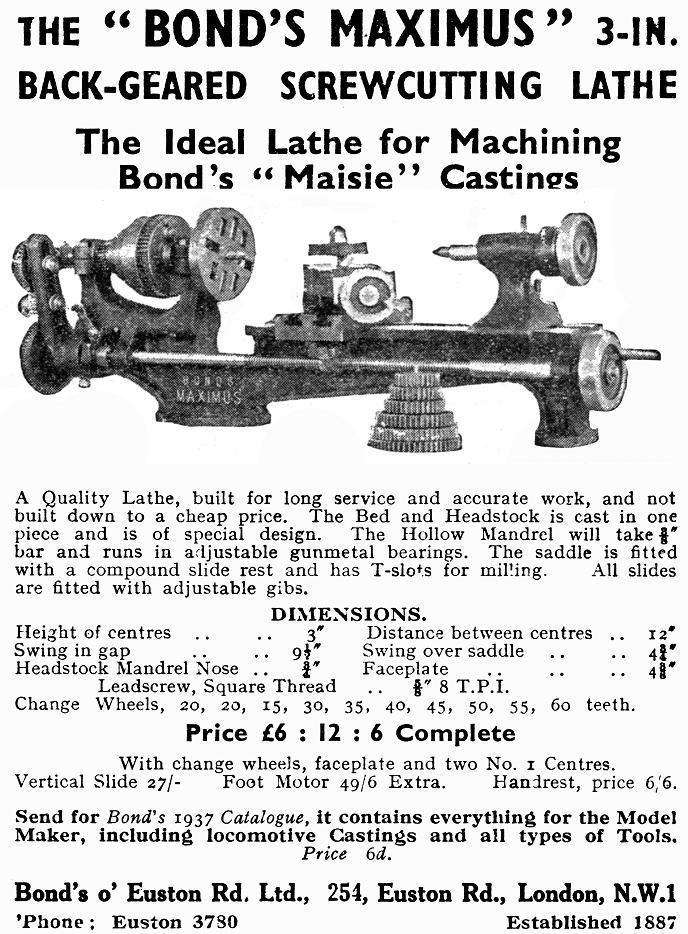
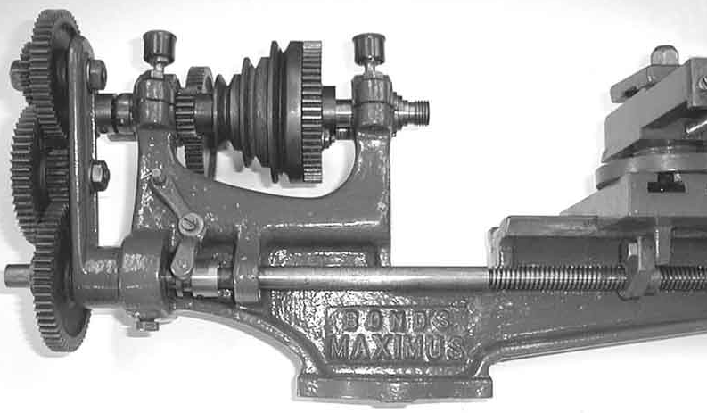
Advertised during the late 1930s, the Maximus 3" x 12" backgeared and screwcutting gap-bed lathe was a lightly modified Portass Model S built by Portass in their works just off Abbeydale Road. The Bond's Maximus name plate, so obviously attached to an existing mould, would seem to indicate that this was just a "badge-engineered" special yet, although the basic "S" was a simple-enough lathe, Bond's had managed to trim even that basic specification down and a point by point comparison with a standard Portass S of the same period indicates that almost everything was specially made. The No. 1 Morse taper headstock spindle and its bearings were of the skimpiest possible dimensions, the bed of the lighter, pre-war, un-braced pattern, the leadscrew nut of the very minimum size that could be envisaged and the tool slide, with two circular slots in its base completely different - although, strangely, the T-slotted saddle was longer and hence more useful on the Maximus. The dog-clutch lived up to its name by having a lever with dog-leg bend and, like all Portass Model S lathes, there were no micrometer collars on any of the feed screws nor any guards shielding the belt runs or gears.
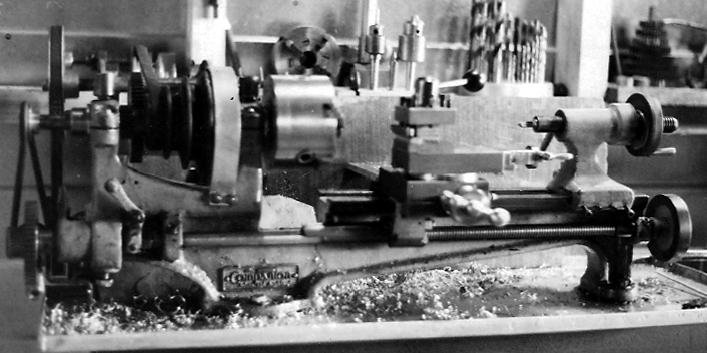
An example of the "Bond" has been discovered in New Zealand branded - with a brass plate nameplate - as the "Companion Lathe". .
|
|
|
|
|
|
|
|
|
|
 |
|
|
|
|
|
|
Bond's o' Euston Road advertisement from 1937
|
|
|
|
|
|
|
 |
|
|
|
|
|
The Bond's Maximus name plate, so obviously attached to an existing mould, would seem to indicate that this is a "badge-engineered" special - yet a point by point comparison with a Portass S type indicates that almost everything is different.
|
|
|
|
|
|
|
|
|
|
 |
|
|
|
|
|
|
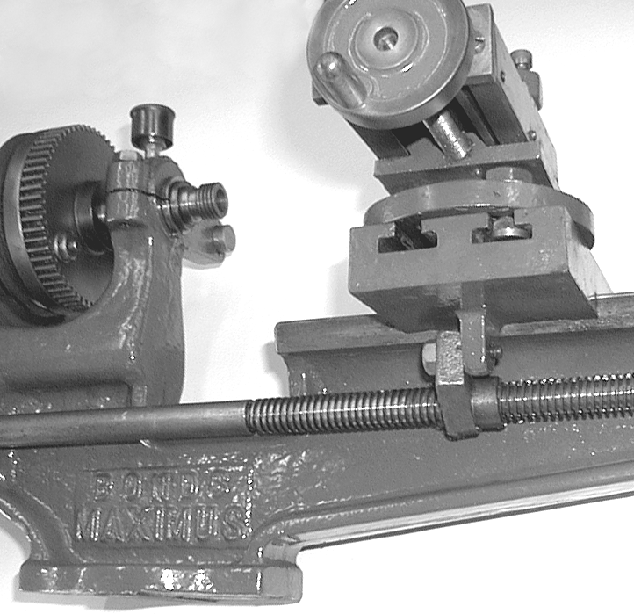
Minimalist - or marginal ? The leadscrew clasp nut used the smallest amount of bronze possible and was attached to a cast-iron boss on the underside of the apron by a single bolt.
|
|
|
|
|
|
|
|
|
|
|
|
|
|
|
 |
|
|
|
|
|
|
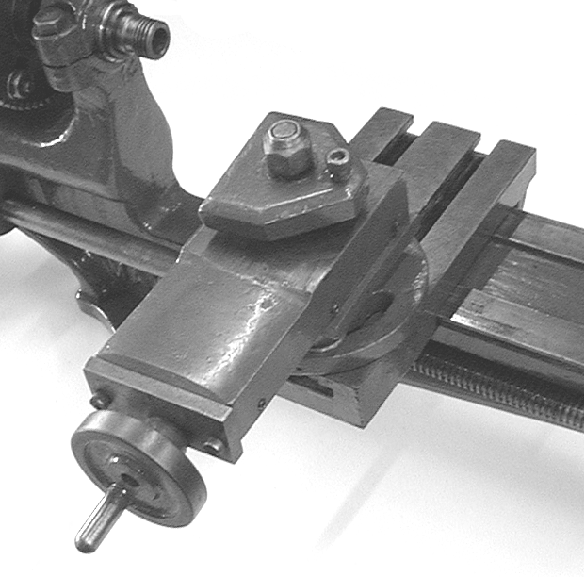
The long T-slotted saddle formed a usefully-large boring table.
|
|
|
|
|
|
|
|
|
|
 |
|
|
|
|
|
|
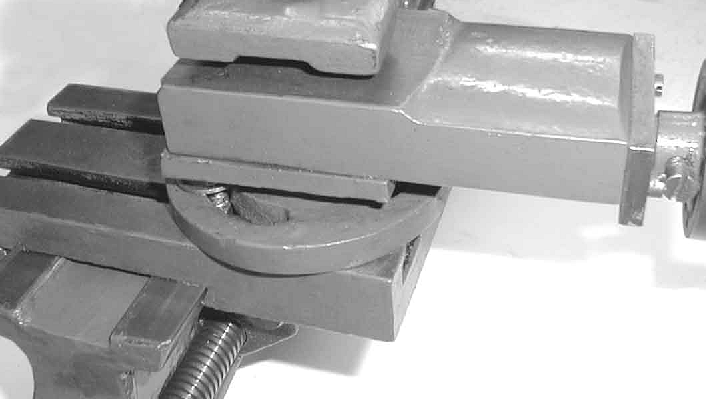
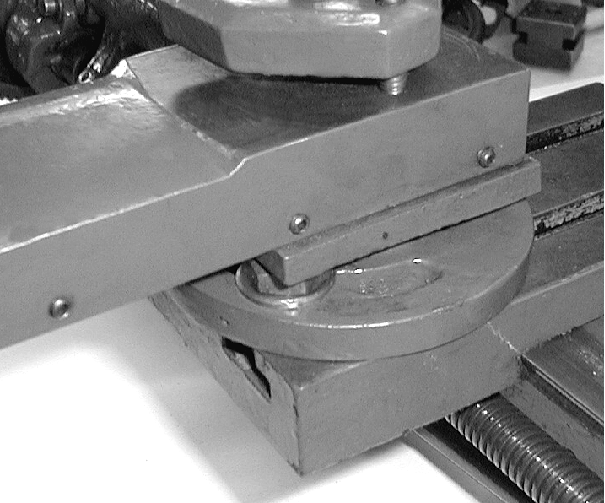
The circular-slotted base to the tailstock was an effective way of clamping it securely to the saddle (and certainly better than the single bolt normally used) but, with the bolt heads hidden under the slide, was an awkward arrangement to use.
|
|
|
|
|
|
|
|
|
|
 |
|
|
|
|
 |
|
|
|
|
|
|
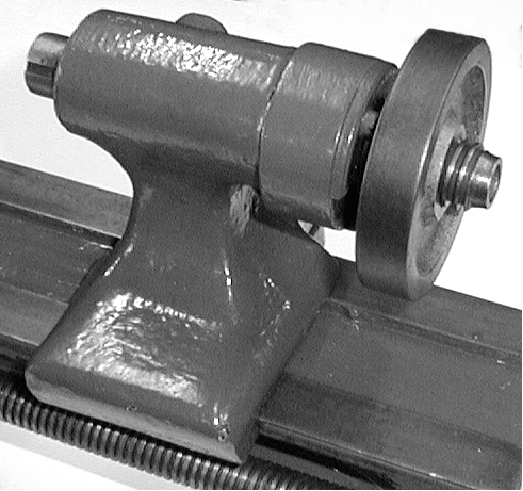
A single curved strip of steel, retained by one screw, held the tailstock handwheel in position and provided a thrust face for it to bear against.
|
|
|
|
|
|
|
|
|
|
 |
|
|
|
|
|
|
|
|
|
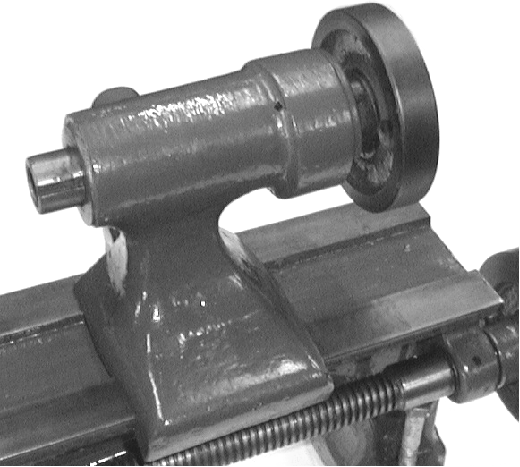
The tailstock casting was as simple as possible with flange at the back to tighten it to the bed - and no set-over facility
|
|
|
|
|
|
|
|
|
 |
|
|
|
|
|
|
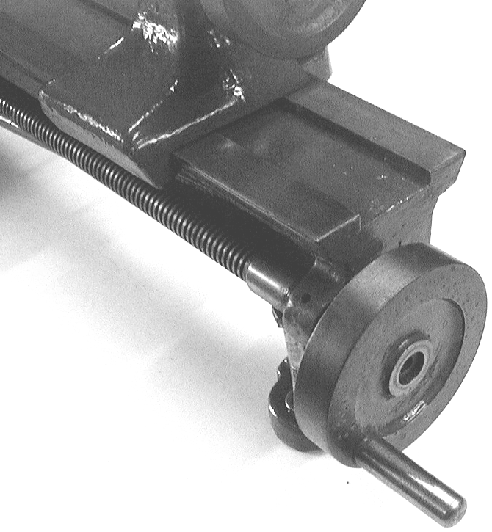
Ungraduated but full-circle handle on the leadscrew end.
|
|
|
|
|
|
|
|
|
|
 |
|
|
|
|
|
|
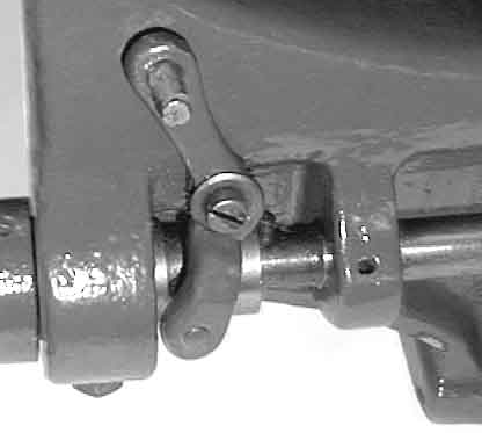
Dog-leg, dog-clutch lever ….
|
|
|
|
|
|
|
|
|
|
 |
|
|
|
|
|
|
|
|
|
|
|