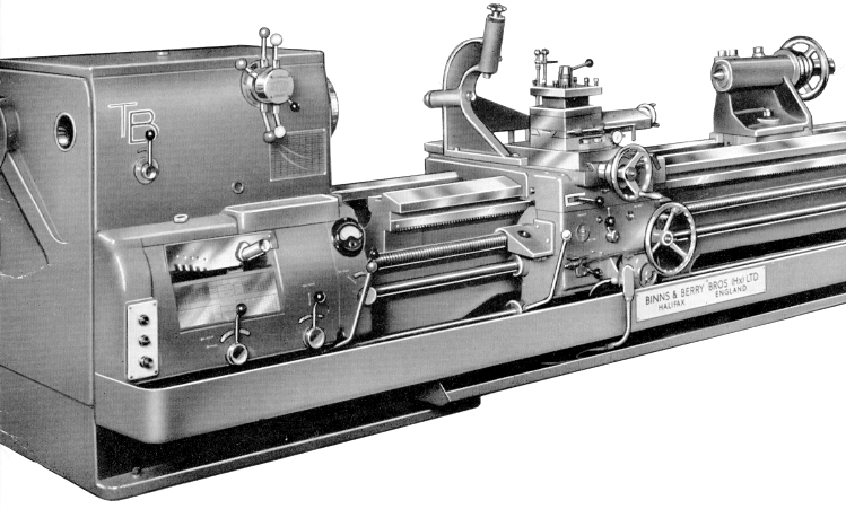
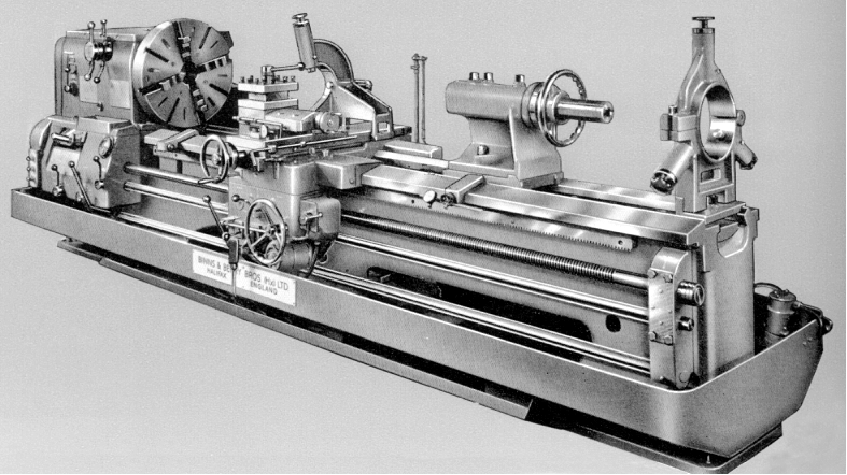
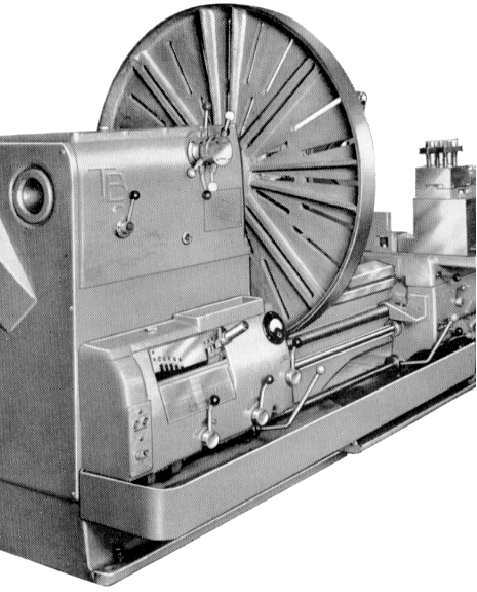
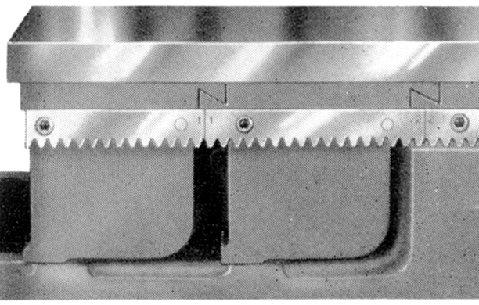
11.5-inch Light Type Binns & Berry Trident Lathe
A Manual is available for this lathe
Very similar in general arrangement to the Mk. 1, the Mk. 3 Model TB was built with a significant number of improvements.
Carrying V and flat ways - instead of all-flat - the bed was arranged along the lines of some models of the American LeBlond lathe (and other makes), with the front V made so that the outer, main load-bearing and wearing surface was made very wide and presented at a shallow angle - whilst the inside of the same V was made both steeper and shorter to better take tool thrust. Unfortunately, despite these precautions, these lathes had a well-deserved reputation for "soft" beds and many were rendered scrap after hard use. A wider range of bed lengths was also offered, from 10 feet long, in foot intervals up to 22 feet - at which point the between centres' capacity was 17 feet and 6 inches and the bed required five support legs. Most unusually, the optional gap could be ordered in two versions, single and double: the single gap allowed material up to 46 inches in diameter and 11.5 inches deep to be turned whilst the "double gap" had the same depth the length capacity was increased to 18 inches; although the gap was held by just a single bolt between the ways it was also, for accuracy of location, dovetailed and doweled into place as well.
The tailstock was modified so that the pressure applied by the three clamping bolts was more evenly distributed - two still emerged on top of the tailstock, the third was repositioned in the centre of the well of the casting. Unfortunately, the same design of un-graduated through-barrel was retained but, as an option, a worm-and-wheel driven barrel was offered - again based on what looked very much like a LeBlond-like design. Some versions of the TB`s have been found with a handy and rather uncommon feature - a stud that stuck out forwards from tailstock base onto which you could reverse the saddle, drop in a locking pin and use the saddle power traverse motor to drag the tailstock forward. This feature could be used for another purpose (which I'm sure was never imagined by B&B or they wouldn't have added it) power drilling using the tailstock to hold a large drill. Happily, the whole assembly was strong enough to accept this abuse. Of course, having used the pin it was necessary to withdraw it. Trying to use the lathe for ordinary work supported between centres resulted in the serious destruction…...
A more powerful main-drive motor was fitted - with 15 instead of 12.5 hp and two speeds instead of one - and the adjustment changed from a pivoting plate to vertical motor rails held within the headstock-end cabinet leg. With the two-speed motor the number of spindle speeds was doubled to 16 and spanned 12 to 400 rpm and the drive by (as on earlier types) 6 V-belts - but with the clutch was changed to one by Anderton that included a powerful brake; as before, the headstock clutch lever had its control duplicated by one on the saddle. The 4.125" bore headstock spindle was identical to that used on previous models, but now ran in two Gamet high-precision taper roller bearings instead of the Timken variety previously used.
Able to generate 60 pitches instead of the previous 50, the screwcutting gearbox still required the mounting of transposing gears (a quiet-running fibre type) in order to produce metric threads.
Binns & Berry estimated that the lathe's work potential was the removal of 15 cubic inches of .45 carbon steel per minute..