|
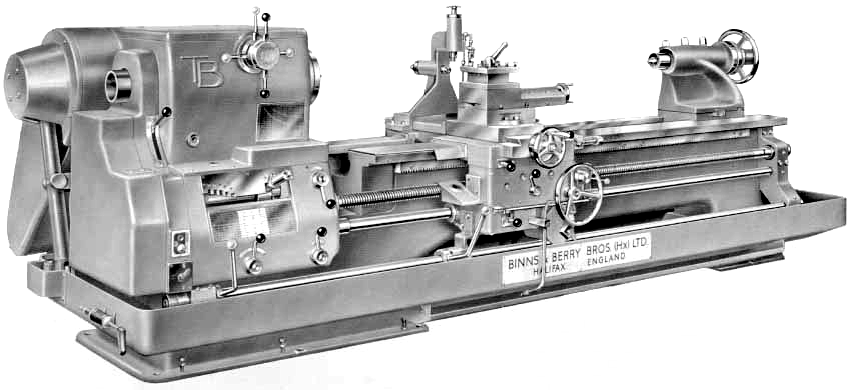
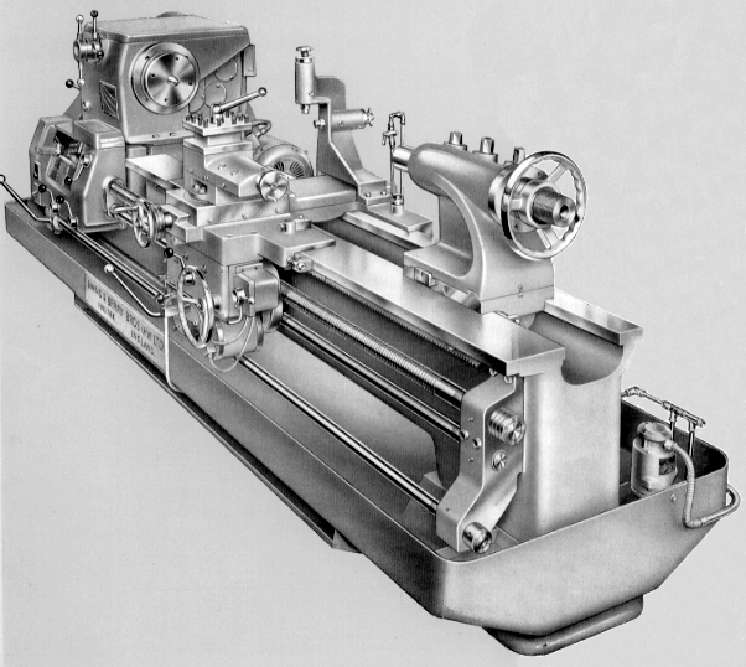
With a 12.5-inch centre height, the Binns & Berry model TB Mk. 1 admitted 7 feet 6 inches between the centres on its 12 foot long bed - though both longer and shorter bed machines could be built to special order.
Of the traditional English flat type with V-edged ways the bed was 19 inches wide and chilled hardened to provide a dense, close-grained structure which was hand scraped to close limits. Unfortunately these lathes had a well-deserved reputation for "soft" beds and many were rendered scrap after hard use. The detachable gap piece was held into the 17-inch deep bed by a single bolt between the ways and, when removed, allowed material up to 44 inches in diameter and 12 inches thick to be turned; the cross slide was arranged to allow up to 41 inches in diameter to be turned without having to reset the tool.
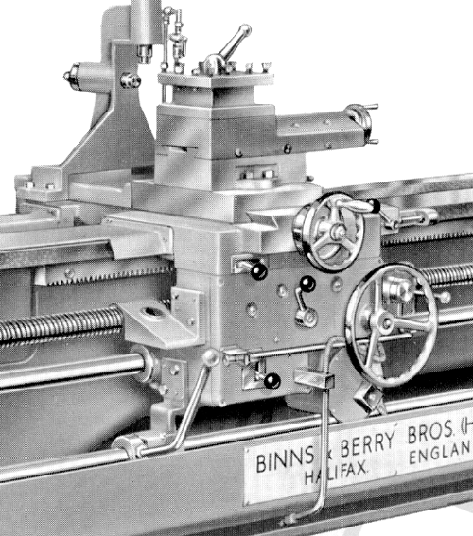
A complex affair, the carriage could be driven by the leadscrew for screwcutting, a slotted shaft for power sliding and surfacing feeds or by an electrically-assisted quick return which was independent of the other controls (but interlocked to the power feeds). This mechanism allowed the assembly to be returned quickly to the start point with just a single movement of its control lever, this being conveniently positioned just behind the manual carriage handwheel.
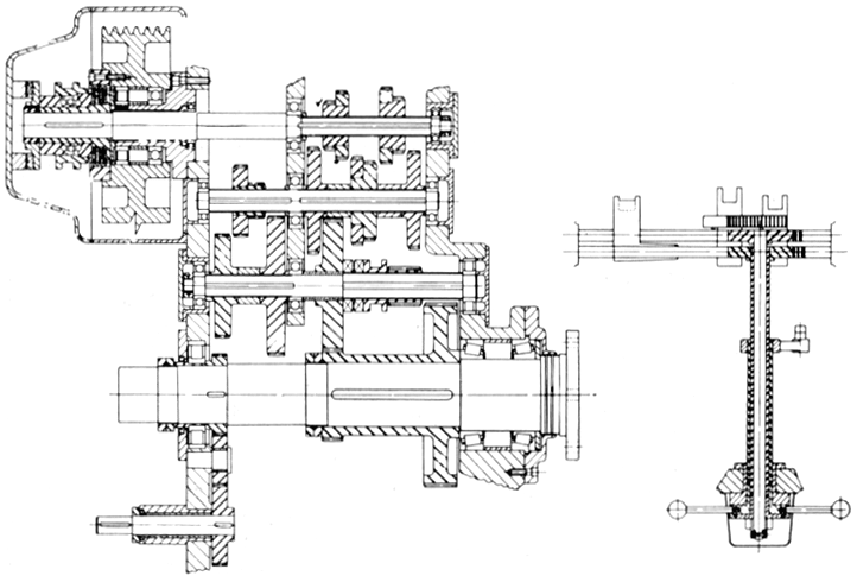
As found on the Company's other lathes, the main spindle was turned and ground finished from a solid carbon-steel forging and held in Timken taper roller bearings - in this case two immediately behind the nose - with a single roller bearing for support at the other end. The spindle was bored to pass a 4-inch diameter bar and fitted with a giant No. 5 Morse taper centre, together with a sleeve-down bush; unfortunately, the fitting on the end of the spindle was not an industry-standard American "L" Series Long -taper or CamLock, but a simple 10-inch diameter flange to which chucks and other fittings could had to be (laboriously) bolted and unbolted. Headstock gears were made from hammer-forged from either carbon or heat-treated nickel chrome steel with the sliding gears having rounded teeth; the supporting shafts were in carbon steel, ground all over and supported in ball or roller bearings complete with central supports. Where gear shafts protruded through the wall of the headstock casting, were fitted, as was usual for a Binns & Berry lathe, with "Angus" oil seals.
Drive was by either a 1500 rpm 12.5 hp motor or, optionally, at a slight extra cost, a 10 hp 1000 rpm motor; the motor mount was an adjustable platform behind the headstock and the drive transmitted by 6 V-belts into a Taylor-patent multi-disc clutch built into the headstock's 15-inch diameter input pulley; the clutch control on the headstock was duplicated on the saddle. 8 spindle speeds were available: 15, 26.4, 43.5, 75.5, 121.5, 208.5, 346 and 600 rpm when fitted with the 12.5 hp motor and 10.3, 17.6, 29, 50.5, 81, 139, 231 and 400 rpm from the 10.5 hp version.
Screwcutting (from a 2.25" diameter 1/2" pitch leadscrew) was provided by a conventional Norton-type quick-change gearbox able to provide (on the Mk. 1) 50 English threads; the 50 rates of power feeds available for power sliding and surfacing ranged from 0.003" to 1.00" per rev. for surfacing and 0.005" to 0.154" per rev. for sliding. A "tumbler change" unit was built into the gearbox, and allowed feeds to be changed without stopping the lathe; constant-loss lubrication was piped to the gearbox bearings through pipes joined to a supply tank located under the tooltray on the top of the gearbox.
Continued below:
|
|